
A pump patch can look reassuringly simple in a catalogue: a piece of adhesive material with an opening in the middle. Yet choosing an insulin pump overpatch involves more than making a sensor patch larger. The accessory has to work around a particular device, its original adhesive pad and the parts the wearer needs to inspect or operate.
For a distributor, that changes the buying question. Instead of asking only for a bigger size or a stronger adhesive, start with the exact pump and the job the accessory should do. A patch pump worn directly on the body and a tubed pump carried in a pouch have different fixation needs.
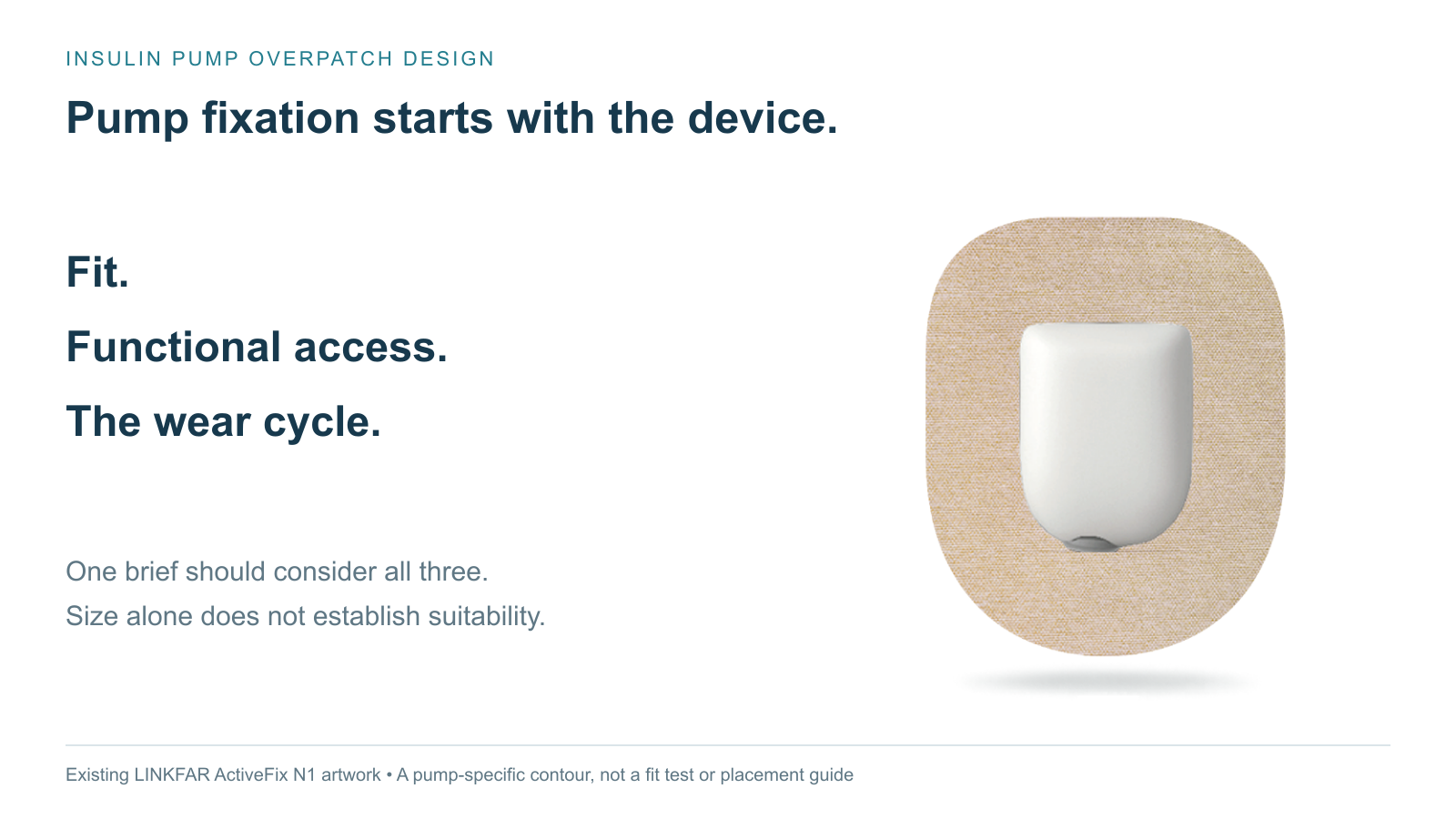
*Editorial composition using existing LINKFAR ActiveFix N1 pump-overpatch artwork. The depicted Omnipod-style form is a product-layout example, not evidence of fit for every Pod generation, manufacturer endorsement or a wear test.*
What makes an insulin pump overpatch different?
An insulin pump overpatch provides additional fixation around a named pump or infusion-set configuration. Its opening, contact area and removal method must suit that system while preserving required access. A CGM design is not automatically transferable: similar-looking outlines do not establish the same fit, function or use instructions.
Our CGM and insulin pump accessories guide explains the wider categories. This article focuses on the questions that make a pump-specific design worth evaluating, rather than repeating a general comparison of fabrics and films.
Start with the system, not the outside dimensions
The FDA describes insulin pumps as insulin-delivery devices that may be worn using a band, belt, pouch, clip or tape. Those options serve different arrangements; they are not competing versions of one universal patch. FDA guidance on insulin pumps at home.
A patch pump places its body and infusion attachment at the wear site. A tubed system separates the carried pump from the infusion set on the skin. In the second arrangement, a belt or pouch may carry the pump, while a suitable adhesive accessory addresses the infusion-set site. Increasing the area of tape cannot answer both jobs by itself.
For example, Tandem's infusion-set guidance discusses additional adhesive support and tubing security. Medtrum's TouchCare Nano quick-start guide describes a reusable pump base attached to a disposable reservoir patch. These are specific configurations, not a reason to treat all pump accessories as interchangeable. Tandem infusion-set tips, Medtrum TouchCare Nano quick-start guide, system overview.
| Design question | Why it matters in a pump brief | What a photograph cannot establish |
|---|---|---|
| What is being secured? | The pump body, original pad or infusion-set site may need different support | That one contour addresses all three |
| What must remain accessible? | Inspection, controls and system-specific connection points need review | That an attractive opening clears every required area |
| How is the device carried? | A tubed pump's carrying support is separate from its infusion-site fixation | That a belt replaces an adhesive accessory, or vice versa |
| What is the replacement cycle? | The accessory has to fit the named device's change and removal instructions | Permission to extend a reservoir, Pod or infusion-set interval |
| How will it be removed? | Adhesive removal should be considered alongside attachment | That peeling an extra layer away will leave an active infusion site undisturbed |
The table is a product-review framework, not an application procedure. The device and accessory instructions govern actual use.
The opening can be a functional requirement
An opening should be designed around what needs to remain clear, not merely around the outline that looks neatest. Insulet's UK PodPals instructions for the Omnipod System and Omnipod DASH specify coverage of the original adhesive pad without covering the Pod, particularly its cannula viewing window. That is a concrete example of a functional boundary. UK PodPals instructions.
That source names its systems and its own accessory. It is not a validation of a third-party LINKFAR product, nor should its scope be silently expanded to every Omnipod generation. For a new product brief, record the full device version and the applicable instructions before approving the cut-out.
This also explains why a covered centre and a physical opening cannot be treated as the same design. A clear film may still cover the area beneath it. A fabric centre with no adhesive still leaves fabric in place. Our CGM overpatch compatibility article explores that distinction for sensors; the same habit of checking the actual construction is useful when reviewing a pump accessory.
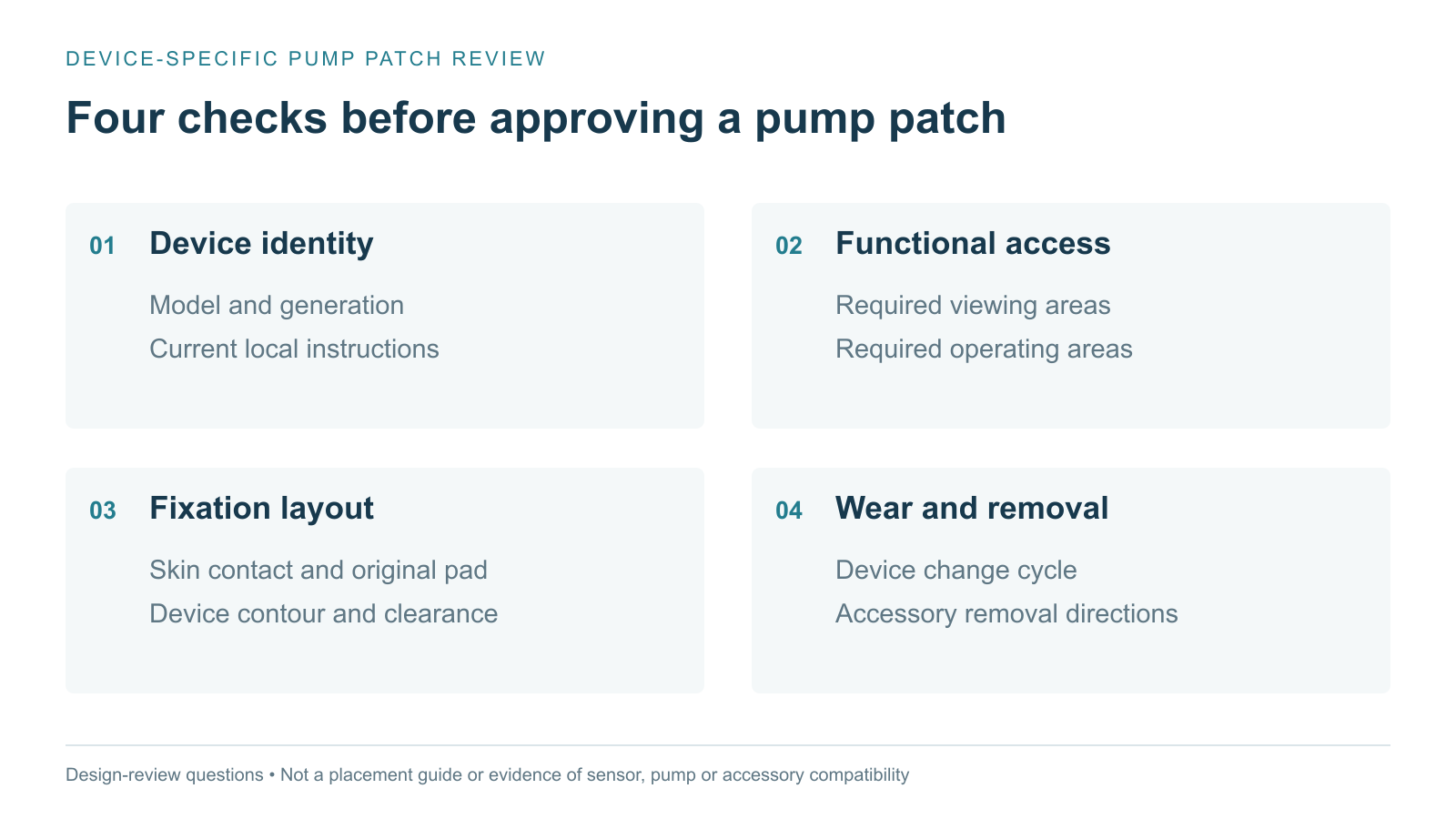
*Product-development review map, not a device cross-section or placement guide. The named device's current instructions determine the required clearance and use conditions.*
More adhesive is not a complete specification
In a sample review, we would check how the patch fits around the housing and original pad, whether it bridges over a contour, and whether clothing catches its edges. These are evaluation questions, not a claim that a particular LINKFAR model has already prevented dislodgement during sport.
The useful record describes the actual arrangement. Which area contacts skin? Which area overlaps the original pad? Does the sample require stretching to line up? What happens when the wearer moves in the intended body location? A flat material sample does not answer those fit questions.
Insulet's US wear guidance identifies skin preparation, activity and environmental conditions as factors in attachment, and discusses extra support for situations such as sport or hot weather. That supports discussing intended use conditions, not promising that an overlay will eliminate every adhesion problem. Omnipod Pod wear guidance.
A larger contact area is therefore a design option to evaluate, not a performance result. Ask whether the finished construction provides suitable fixation and acceptable removal under the proposed conditions. Do not substitute an unsupported adjective such as "strongest" for that work.
The pump's wear cycle is a separate limit
An accessory does not set the replacement interval of the device underneath it. Insulet's Canadian Omnipod 5 FAQ states a Pod delivery period of up to three days, or 72 hours. The Medtrum quick-start guide cited above describes its reservoir patch as lasting up to three days. Those are named-device examples, not a universal schedule for all pumps or infusion sets. Omnipod 5 Canadian FAQ.
An overpatch that remains attached is not permission to continue using a Pod, reservoir patch or infusion set beyond its instructions. Nor does a longer advertised CGM wear period become a sensible default specification for a pump accessory.
Removal belongs in the brief from the start. The UK PodPals instructions say that its accessory stays for the life of the Pod and provide a particular removal sequence. That is one more reason not to write a general instruction to change every pump overpatch independently during wear. Other systems must be checked against their own directions.
Overpatch, underpatch or carrying support?
An overpatch adds fixation over or around an existing attachment area. An underpatch creates a separate layer beneath the device's original adhesive. A belt, pouch or clip carries or supports a suitable device. These distinctions concern position and function, not simply thickness or shape.
An underpatch needs its own review of the insertion pathway, attachment and material combination. This article does not instruct anyone to insert a cannula through another layer. Likewise, adding a tight strap is not a default substitute for correct attachment: use only a suitable arrangement for the named system.
Skin discomfort is another question again. A fixation accessory should not be presented as treatment for an adhesive reaction. Our EASD discussion of pump adhesives and underpatches explains why a skin-contact layer is not an allergy-free guarantee. A persistent reaction needs appropriate professional assessment, not an automatic recommendation to add more adhesive.
What should a buyer send with a pump-patch enquiry?
For a LINKFAR sample discussion, a short device-specific brief is more useful than a request for "a universal pump sticker":
- Name the manufacturer, full pump or infusion-set model, generation and country of use.
- Identify the job: additional fixation, a separate skin-contact layer or carrying support.
- Supply the applicable device instructions and identify areas that must stay accessible.
- Describe the original pad, outside contour and intended body locations, with a drawing or suitable sample where available.
- Specify expected activity, clothing contact, moisture exposure and the device's replacement cycle.
- Agree which sample observations and evidence would support the proposed product claim, including attachment and removal.
Keep the accessory reference and drawing revision with that record. If the device or construction changes, review the combination again rather than assuming that the old sample approval applies unchanged. This is a proposed purchasing workflow, not a statement that every requested customisation is available or already validated.
Where LINKFAR's pump-overpatch range fits
LINKFAR's CGM accessories directory and ActiveFix product page provide starting points for a product discussion. The existing ActiveFix N1 artwork used here shows a pump-specific contour. It does not establish the applicable device generation, current specification or market claim by itself.
Once the required geometry and function are clear, compare suitable material and adhesive constructions. Our CGM materials and quality guide separates material choices from finished-product evidence. The P2/P3 film article discusses moisture management; it does not make those sensor illustrations a pump-compatibility certificate.
Questions buyers often ask
Can a waterproof overpatch make a pump waterproof?
No accessory claim should override the device's water-use limits. The Canadian Omnipod 5 FAQ gives separate water information for its Pod and Controller. Check the exact system and market; a water-resistant patch is not permission for deeper or longer immersion.
Does a firmly attached case prove that insulin delivery is working?
No. Fixation and insulin delivery are different checks. The FDA advises users to inspect their pump and follow its troubleshooting instructions for problems such as leaks or blockages. Follow the device guidance and seek the appropriate support if something is wrong; do not treat extra tape as a repair.
Does every pump user need a belt as well as a patch?
No. Carrying arrangements depend on the system and the user's needs. A tubed pump may use a suitable pouch or clip while its infusion site has a separate fixation arrangement. A body-worn patch pump should not automatically be assigned the same accessories.
If you are developing a pump-accessory range, send LINKFAR the exact device, market and fixation problem. We can discuss current references and sample requirements against that brief. Confirm fit, intended use and any proposed performance claim for the specific product combination before release.
*This article supports product selection, not individual treatment or device operation. Follow the current device and accessory instructions. Manufacturer names identify the examples discussed and do not imply affiliation or endorsement.*
Related guides
-
 CGM and Insulin Pump Accessories: A Guide to Patches, Skin Care and Secure Wear
A sensor that starts lifting after exercise and a patch that hurts to remove create different problems. Buying a stronger adhesive may help with…
-
 CGM adhesive remover: plan for removal, not only hold
Fixation and removal are different parts of device wear. Compare adhesive release, residue cleanup, formulation instructions and the questions buyers should ask.
-
 CGM overpatch wear time: why 15 days is not a universal promise
Compare CGM overpatch wear time with sensor life. Learn what 15-day claims need, how real wear differs and which evidence to request before choosing…
-
 Custom CGM overpatch development: what to decide before samples
What should a buyer decide before approving a custom CGM overpatch sample? A practical brief for device fit, material construction, evidence, revisions and purchasing.