
Fifteen days on a sensor label can quickly become fifteen days on a patch buying specification. The numbers look as though they should match. But CGM overpatch wear time, the sensor's permitted session and a person's experience of wearing both are different things.
A distributor needs to know which of those numbers a supplier is describing. A wearer needs to know what the accessory can reasonably support, without assuming that stronger tape changes the sensor's instructions.
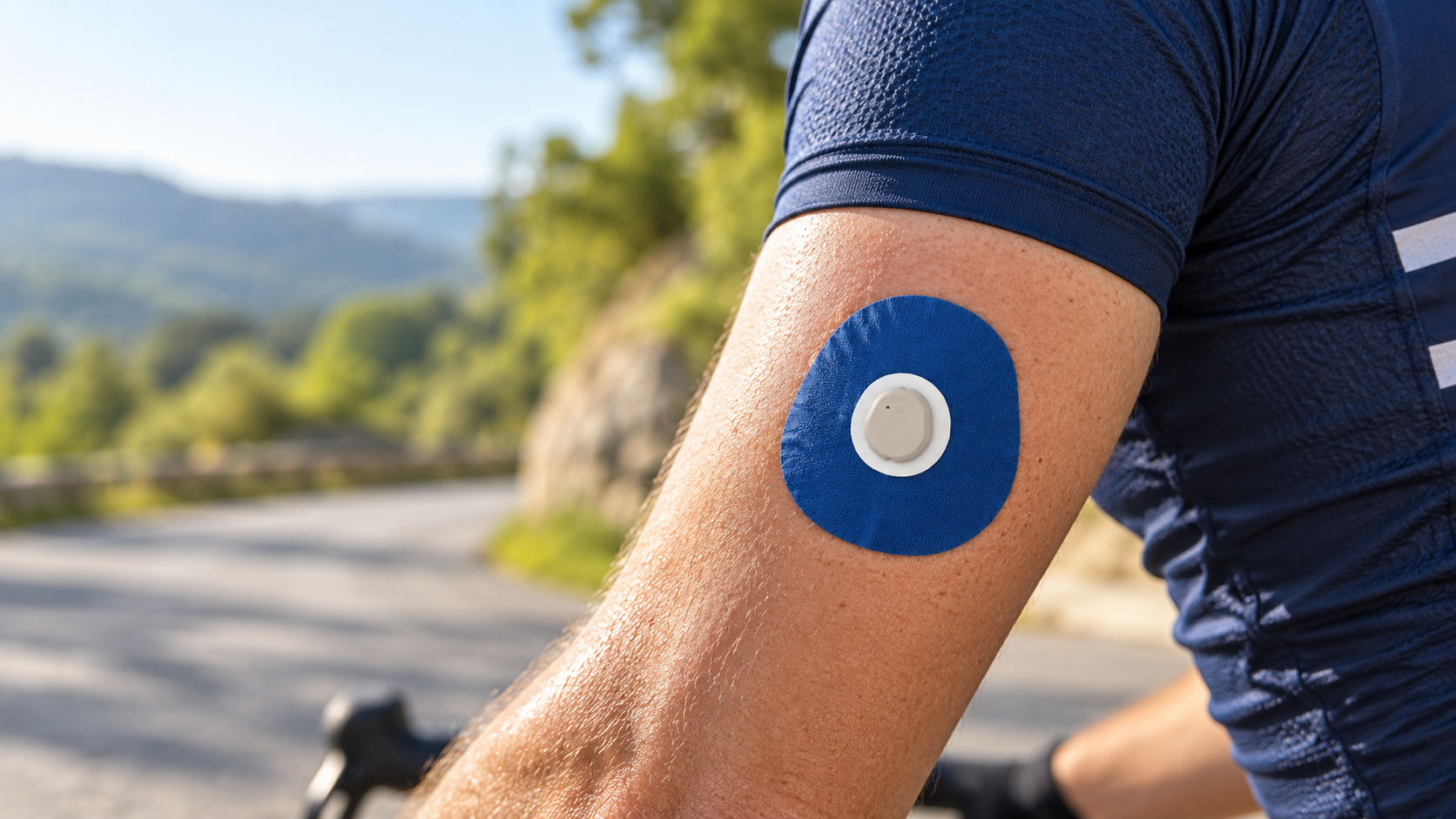
AI-assisted lifestyle illustration based on a LINKFAR blue woven patch reference. This is not a wear-time test photograph or evidence of 15-day performance or sensor compatibility.
Does a 15-day sensor mean a patch will last 15 days?
No. The sensor's labelled session does not establish the wear time of a separate overpatch. An accessory claim needs evidence for its own finished construction, device fit and stated conditions. Actual adhesion can vary. A patch also does not extend the sensor's permitted session or make a displaced sensor safe to continue using.
Our CGM materials and quality guide explains the construction behind a patch. This article addresses a narrower purchasing question: what must a wear-time statement actually mean?
For the wider roles of fixation, skin protection and removal products, start with the CGM and insulin pump accessories guide.
Three wear-time questions that should stay separate
| Question | Where the answer comes from | What it does not prove |
|---|---|---|
| How long may this sensor be worn? | The current instructions for the exact sensor and market | The durability of every third-party covering |
| What duration does the patch supplier support? | The selected patch's specification, instructions and relevant evidence | That every wearer will obtain the same result |
| What happened during this person's session? | A record of attachment, activities, skin condition and the reason wear ended | A universal product claim or the cause of every early ending |
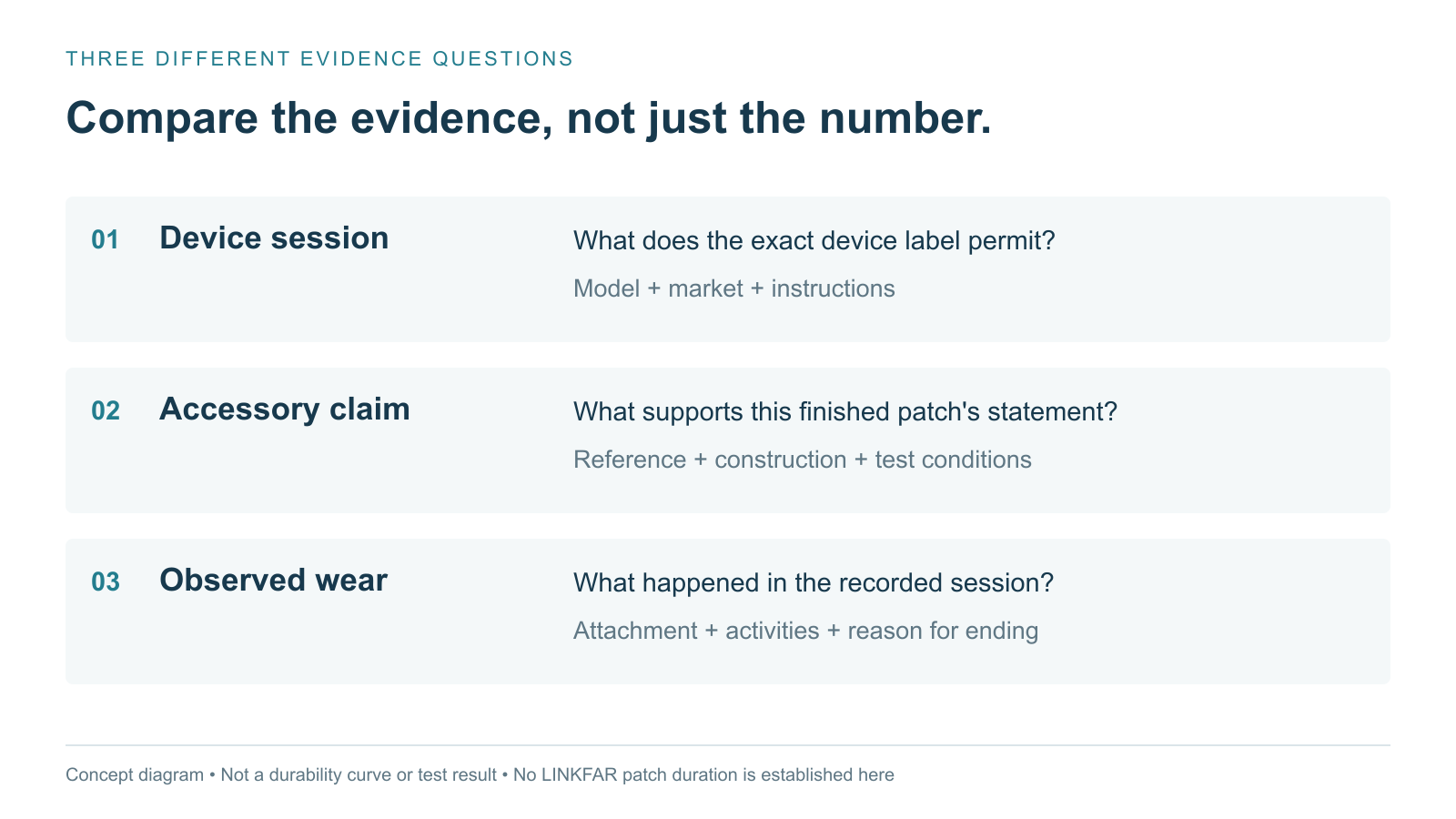
Concept diagram, not a durability curve or test result. No duration for a LINKFAR patch is established by the sensor's labelled session.
The device distinction is already important within one brand. Dexcom's US-labelled FAQ describes G7 as up to 10 days and G7 15 Day as up to 15 days, each with a 12-hour grace period. It also tells users of both systems to use the included overpatch. That is an instruction about those systems, not validation of an interchangeable third-party patch. Dexcom's G7 wear-time FAQ.
Abbott's US support page separately addresses keeping a FreeStyle Libre 3 Plus sensor attached for 15 days. A product name without its generation is therefore an incomplete starting point for a retail label or sample request. Abbott's Libre 3 Plus adhesion FAQ.
A labelled grace period is part of the named device's instructions. It should not be presented as extra time created by a patch. Nor should one market's device label be copied into another market's accessory instructions without checking the local version.
A long-wear design still meets different people and routines
Dexcom's G7 15 Day adhesion FAQ acknowledges that skin type, activity, sweat and application can affect attachment, with variation between people and between sensors. It directs users to support if a sensor comes off early. The useful point for an accessory buyer is that even a device manufacturer separates its intended duration from every individual outcome. Dexcom's G7 15 Day adhesion guidance.
Consider the difference between a desk-based working week and a holiday with repeated swimming, changing clothes and exercise. These are proposed evaluation scenarios, not evidence that a particular patch will fail in either one. A meaningful brief names the routine it needs to support rather than asking for the longest possible number alone.
Early edge lifting, complete detachment, uncomfortable skin and a sensor that stops working are also different observations. Record them separately. Calling all of them "the patch did not last" makes it harder to choose the next product or investigate a complaint.
Water resistance is not a wear-time test
A water-resistant backing does not, by itself, answer how the complete adhesive patch will behave through a series of wet and dry periods. The question concerns the finished construction and its attachment during the intended use, not just the surface of a film sample.
Dexcom's UK water-exposure guidance, for example, warns that regular heat exposure may reduce adhesive effectiveness. This is a caution from the named manufacturer's guidance, not a measured result for LINKFAR patches. Dexcom's water and patch-care guidance.
For a coastal-use brief, ask what was evaluated: occasional splashing, repeated immersion, the condition after drying, or attachment during movement. Do not replace that description with "waterproof for 15 days." The P2/P3 breathable PU article covers the separate questions of liquid water, moisture vapour and skin feel in more detail.
An overpatch does not raise the sensor's permitted depth, immersion time or temperature limits. Device limits continue to apply even if the outer patch looks intact.
Preparation matters, but it is not an explanation for every complaint
Abbott's Libre 3 Plus adhesion page emphasises clean, dry skin and avoiding oily residue. Those are relevant conditions to capture in a wear record. They are not a reason to assume that a person reporting early detachment applied the product incorrectly. Abbott's application and adhesion advice.
Record what was used beneath the adhesive, too. A barrier film, adhesive enhancer and remover have different purposes; adding several products creates a different combination to assess. Our skin barrier wipe and CGM adhesion case discusses a real football-related complaint without claiming that the wipe caused the sensor to detach.
For commercial discussions, this distinction keeps the response fair. Investigate the device, patch reference, preparation and activities together. Do not turn one report into a universal criticism of a material, or dismiss it because other users have not reported a problem.
Can the overpatch simply be changed halfway through?
There is no universal replacement schedule. Removing a covering can disturb the device or its original adhesive, so follow the instructions for the exact combination rather than planning routine mid-session replacement as a workaround for insufficient durability.
Abbott's Irish Libre 3 Plus FAQ says that an over-bandage must be applied at sensor application, kept until sensor wear ends and positioned so the central opening remains uncovered. That source does not support a blanket instruction to peel off and replace the patch during an active session. Abbott's over-bandage FAQ.
Other devices may have different directions. Our CGM overpatch compatibility guide compares named models and markets. A covered no-glue centre is not, by itself, permission to remove a patch during wear. Equally, an instruction to use supplied system tape is not automatically satisfied by adding a larger accessory.
If the sensor becomes loose or comes off early, use its manufacturer's instructions and support route. Additional tape should not be treated as proof that the sensor's position or operation is still acceptable.
What evidence should support a CGM overpatch wear-time claim?
For a buyer, "tested for 15 days" is the start of a discussion, not a complete test report. Ask for enough information to understand what the result represents.
| Evidence item | What the record should make clear |
|---|---|
| Product identity | Patch reference, backing, adhesive-coated construction, shape and revision tested |
| Device and use | Exact sensor model, intended placement and any required system tape |
| Conditions | Activities and water exposure evaluated, preparation and other products used |
| Assessment | How attachment, edge lifting, skin observations and removal were recorded |
| Completion and early endings | How many wear attempts began, how many completed, and why each stopped |
| Scope of the conclusion | Which intended conditions the result supports and which remain untested |
This is a procurement checklist, not a claim that every LINKFAR reference has completed a particular protocol. A laboratory adhesion result may help compare constructions, but it is not the same record as wearing the finished patch on people under the intended conditions.
The reason for an early ending matters. A sensor ending its session for a non-adhesion reason should not automatically be counted as proof that the patch detached. Conversely, a photograph taken on the last day does not explain what happened in earlier attempts. Ask for the reporting method, not only the most attractive completion photo.
How LINKFAR would frame the sample request
LINKFAR's CGM accessory range includes different materials and coverage layouts. We would start with the exact reference and sensor, then the intended conditions and the evidence needed for the proposed label. The fact that a sensor has a 15-day session does not establish a 15-day claim for a LINKFAR patch.
For P2/P3 and other designs, multi-day development objectives should remain separate from a final model-specific duration claim. An evaluation target is not a published guarantee, and a result for one construction should not be transferred to the whole range.
A useful sample brief identifies the intended sensor and market, the problem to improve, typical activities and the desired claim. Agree how to record attachment and removal before evaluating the samples. That makes the discussion more useful than selecting a colour and asking whether it lasts "as long as the sensor."
For a range review, contact LINKFAR with the exact device and intended wear conditions. We can discuss the current product reference, available information and what the sample evaluation needs to establish.
This article supports product selection and purchasing discussions. It does not replace device or accessory instructions or individual medical advice. Manufacturer names identify the examples discussed; they do not imply endorsement of a LINKFAR accessory. Guidance was checked on 25 October 2026 and may change.
Related guides
-
 Custom CGM overpatch development: what to decide before samples
What should a buyer decide before approving a custom CGM overpatch sample? A practical brief for device fit, material construction, evidence, revisions and purchasing.
-
 EU MDR importer obligations: importer or distributor?
Who is the EU MDR importer of an individual medical device, and what does a distributor need to check? A practical guide to Articles…
-
 Why a universal CGM overpatch may not fit every sensor
A patch can be large enough to cover a glucose sensor and still be the wrong choice for it. CGM overpatch compatibility depends on…
- Private label medical devices in the EU: from product brief to delivery If you distribute medical consumables, you may already know which products your customers need. Building your own brand raises a different set of questions:…