

Two CGM patches can have the same outline and feel quite different after a day of wear. One may feel more like fabric; another may be almost invisible. A patch that feels secure when first applied still has to cope with movement, moisture and eventual removal.
A CGM overpatch is an additional adhesive covering placed over or around a continuous glucose monitoring sensor, according to the device and patch instructions. Its main purpose is extra fixation. Its performance depends on the backing, adhesive, coating, shape and application together, rather than on any single material name.
For a wearer, those details affect which product is worth considering. For a distributor or brand developing a range, they explain why colour and price are not enough to compare two patches. This guide separates the material choices from the evidence needed to support a finished-product claim.
Cover diagram: a simplified explanation of patch construction. Layers are separated for clarity, not shown to scale. The release liner is removed before wear; optional handling supports and openings depend on the design.
This article focuses on the patch itself. For the wider distinction between fixation, skin protection, removal and pump carrying, start with our CGM and insulin pump accessories guide.
In this guide:
- What is inside a CGM patch?
- Nylon, nonwoven, cotton or PU film?
- What makes a medical adhesive work?
- Waterproof, breathable and absorbent are different
- Pre-coated materials versus in-house coating
- What does good patch quality look like?
- Choosing for everyday wear
- LINKFAR’s four patch families
What is inside a CGM patch?
Most adhesive overpatches combine a backing, a skin-contact adhesive and a release liner. Some also have a temporary application carrier, a centre opening or a non-adhesive area. These parts do different jobs: the backing supports the patch, the adhesive holds it in place, and the liner protects the adhesive until application.
| Part | Its job | A useful question to ask |
|---|---|---|
| Backing | The fabric or film that forms the patch body | How does it feel, bend and behave when wet? |
| Adhesive layer | Attaches the patch to its intended contact surfaces | Does it hold through the intended wear period and release acceptably afterwards? |
| Release liner | Protects the adhesive before use | Can it be removed without folding or contaminating the adhesive? |
| Application support, if present | Helps handle a thin or flexible patch | Which parts must be removed, and at what stage? |
| Cut-out or non-adhesive zone, if present | Defines contact around or over the device | Is the layout suitable for this exact sensor and its instructions? |
A centre opening and a non-adhesive centre are not the same thing. An opening leaves an area uncovered. A non-adhesive zone can leave material above the device while avoiding adhesion at that location. Neither arrangement is automatically suitable for every sensor.
This is why device fit is more than matching an approximate diameter. Avery Dennison’s overlay guidance also treats flexibility, the device surface and removal as part of material selection. A patch should work with the device’s design, including areas that need to remain accessible or uncovered. Avery Dennison’s overlay guide.
Nylon, nonwoven, cotton or PU film: how do CGM overpatch materials differ?
These four descriptions are useful starting points, but they are not a performance ranking. Nylon and cotton identify fibre materials. Nonwoven describes a way of forming a fibrous structure. PU film identifies a polymer film. That distinction matters when someone asks which material is the most breathable, strongest or gentlest.
| Material | What to look at first | Wear preferences worth discussing | What the material name does not prove |
|---|---|---|---|
| Nylon textile | Fabric construction, stretch, edge behaviour and surface feel | Movement, sport and repeated clothing contact | A fixed wear time, fastest drying or strongest attachment |
| Nonwoven | Fibre composition, bonding structure, softness and conformability | A soft covering that follows body contours | That every nonwoven is identical, short-lived or suitable for sensitive skin |
| Cotton textile | Fabric texture, flexibility and behaviour after wetting | A familiar cloth feel, colours and visible fabric patterns | Allergy-free wear or low-residue removal |
| Polyurethane film | Transparency, thickness, handling and moisture-vapour transmission | Discreet appearance and a low-profile covering | Unlimited waterproofing, dry skin or easy removal for everyone |
Nylon: ask how it behaves during movement
When comparing a nylon patch, look beyond the fibre name. Check how the complete patch follows a moving arm, how its edges respond to rubbing and whether the adhesive remains attached under the intended conditions.
For an active wearer, useful questions are practical: does a sleeve catch the edge? Does the patch crease when the arm bends? What changes after exercise? These questions give a sample evaluation a purpose without assuming that every nylon construction will outperform every cotton or nonwoven one.
Nonwoven: a structure, not a single ingredient
A nonwoven is a bonded fibrous structure rather than a conventional woven or knitted fabric. Its fibres and bonding method can vary, so the category includes a wide range of properties. EDANA’s definition and materials overview make that variability explicit. EDANA: what are nonwovens?.
For patch selection, examine the actual product’s softness, drape and edge feel. A nonwoven option may suit someone who prefers a conforming cover, but that preference does not establish a wear duration or a skin-tolerance result. Those need their own evidence.

Cotton: keep fabric feel separate from skin tolerance
Cotton gives buyers a recognisable textile choice. Surface texture, colour and the feel of the finished fabric can be valid reasons for preferring it. They should be described as preferences, rather than as evidence that a natural fibre is automatically safer.
The adhesive still contacts the skin. A soft cotton backing does not by itself establish low irritation, low sensitisation or painless removal. Wet feel and drying experience should also be evaluated on the complete patch, not inferred from a fabric label.
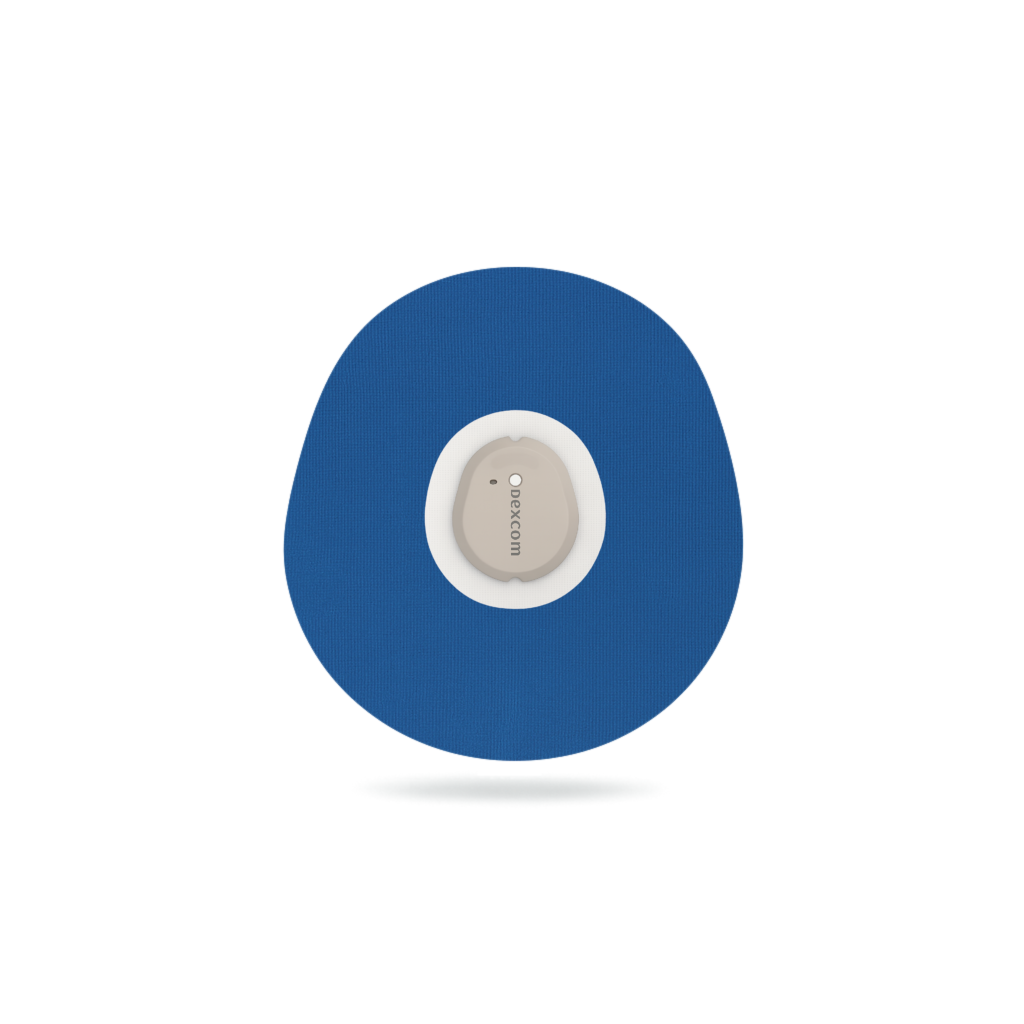
PU film: transparency is visible; breathability needs measurement
PU means polyurethane. A thin transparent film offers a different appearance from a coloured textile. Some PU formulations can resist liquid water while allowing water vapour to pass through, so waterproofing and vapour permeability are not inherently contradictory. Argotec describes this principle for its hydrophilic TPU films; that is a materials example, not a specification for every PU patch. Argotec’s hydrophilic TPU film information.
The finished patch still needs evaluation. A transparent film is not necessarily highly vapour-permeable, and adding adhesive can change the result. Thinness also introduces handling questions: can the wearer separate the liner, position the patch and remove any application support without folding the film onto itself?
What makes a medical adhesive work on a CGM patch?
For a skin-contact pressure-sensitive adhesive, pressure helps establish contact with the surface. But “sticky” is too broad a word to describe everything that must happen between application and removal.
Adhesive manufacturers distinguish tack, adhesion and cohesion; shear testing examines resistance to a sliding load. These are useful engineering concepts, not substitutes for skin-wear evaluation. tesa’s pressure-sensitive adhesive explanation.
| Term | Plain-language meaning | Why it belongs in an evaluation |
|---|---|---|
| Initial tack | How readily the adhesive forms a bond on contact | Affects the first stages of attachment and handling |
| Peel adhesion | Resistance when the patch is peeled away | Relevant to edge lift and removal, under the stated test conditions |
| Shear resistance | Resistance to sliding under a load along the bond | Relevant when a patch is pulled sideways or carries a load |
| Cohesion | Strength within the adhesive layer itself | Relevant to whether the layer holds together or leaves residue |
A strong initial impression does not answer all four questions. Nor does a peel result on a laboratory panel directly describe what every wearer will feel. Henkel’s medical-wearables brochure, for example, states the substrate and conditions alongside its adhesive data. That context belongs with any comparison. Henkel medical-wearables brochure, skin-bonding section.
For buyers, the sensible target is sufficient fixation for the intended use, alongside acceptable skin contact and removal. Specifying only the strongest possible bond leaves the end of the wear cycle unanswered. A useful evaluation asks what remains on the skin, what happens to the patch during removal and whether the process is manageable for the intended user.
Waterproof, breathable and absorbent describe different things
For a product-focused discussion of these trade-offs, see our P2/P3 breathable waterproof CGM overpatch article. It separates film characteristics, development targets and the evidence needed for the finished patch.
Water resistance concerns liquid water. Air permeability concerns air movement. Moisture-vapour transmission concerns water in its vapour phase passing through a material. Absorption concerns liquid taken up by the material. The word “breathable” should therefore be followed by an explanation of what was measured.
A fabric that takes up water is not necessarily transporting vapour efficiently. A film that resists water across its surface does not prove a watertight seal at every edge. Likewise, a patch remaining attached after a shower does not establish comfortable skin underneath it.
The adhesive coating is part of this question. Nitto identifies gaps in the coating as one way some of its tapes achieve breathability. That demonstrates a design option, not a universal rule that patterned coating is always better or that a visible dot must be a hole. Nitto’s wearable adhesive-tape overview.
A useful published example is GERGONNE’s M026 data sheet. It reports different moisture-vapour transmission results for its bare film and its adhesive-coated construction. The practical lesson is to ask which sample was tested. These are another supplier’s values, not LINKFAR performance data. GERGONNE M026 technical sheet.
When a supplier gives an MVTR or WVTR figure, ask for the method, units, temperature, humidity and complete sample construction. ASTM’s public E96/E96M summary cautions against predicting results across different methods or conditions. A bigger number from a different test is not a sound basis for declaring a better patch. ASTM E96/E96M public summary.
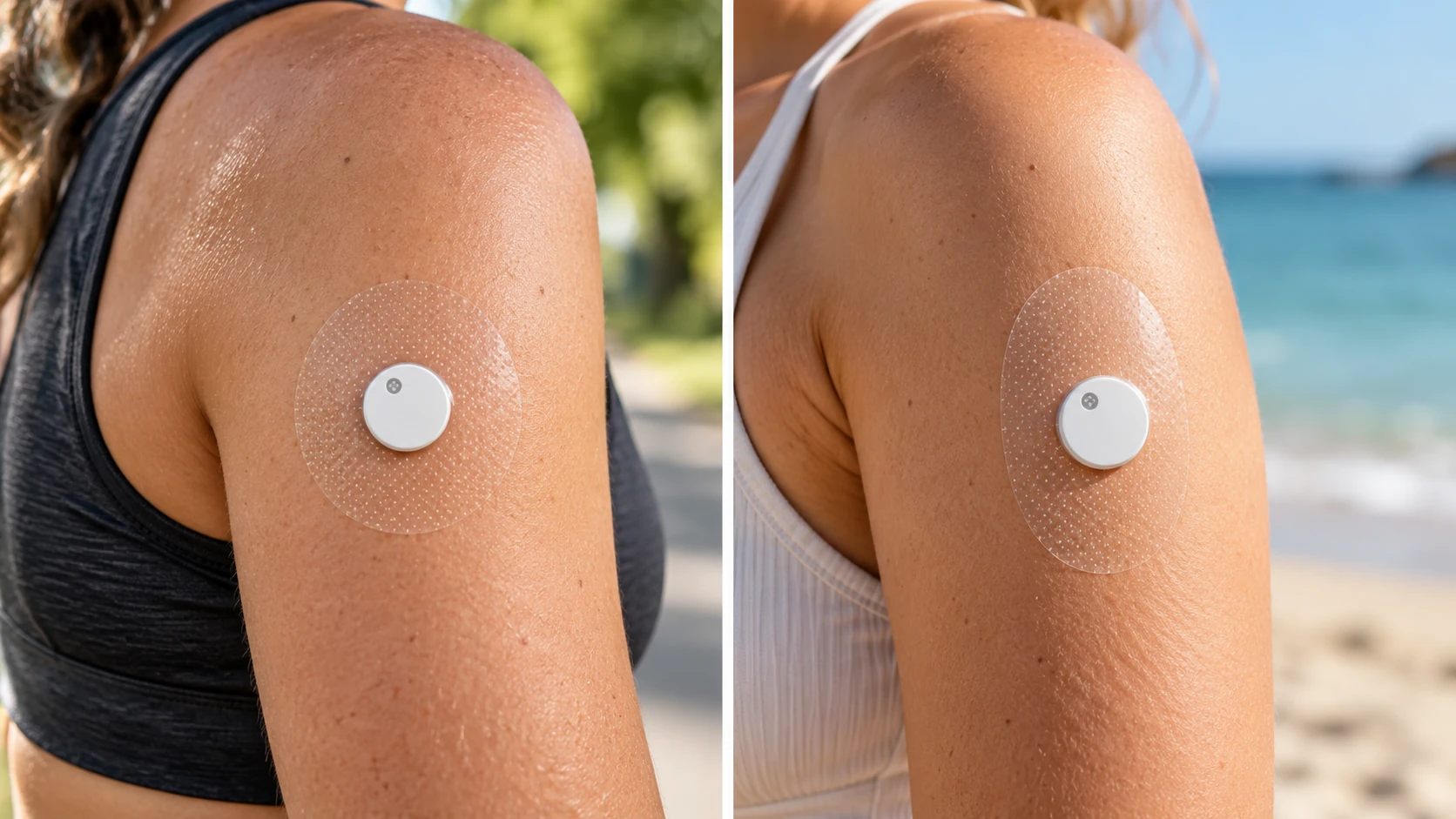
For summer and swimming, separate three checks: the patch’s response to water, its attachment during the intended activity and the CGM manufacturer’s own water-use limits. An overpatch does not authorise deeper or longer immersion than the device instructions allow. Testing a film sample alone does not answer the whole use case.
Pre-coated materials and in-house coating: what can be customised?
One route starts with a selected pre-coated roll of medical tape. Its backing and adhesive combination are already defined for that grade. A converter can then cut shapes, design liner sections and carry out other suitable converting operations within the material’s limits.
Another route starts earlier, with a backing and an adhesive to be combined through coating. This gives the development team a more direct role in the coated construction. Variables to discuss can include adhesive selection, coating weight and distribution, and how the adhesive anchors to the backing. Which adjustments are feasible depends on the equipment, materials and validation work.
Neither route is automatically superior. A suitable pre-coated material may be a good starting point with established technical information. In-house coating brings development freedom, but also responsibility for process consistency. Large material suppliers can offer custom development too; purchasing stock tape does not mean that their entire business lacks customisation.
Henkel describes coating partners combining its adhesives with different carriers and designs. That helps explain the distinction between producing an adhesive and engineering a coated patch. It does not establish any particular company’s partnership status or validate a finished product.
For an OEM project, ask what can actually be changed and what must be retested afterwards. Changing a logo is different from changing skin-contact chemistry. A new backing or coating should be evaluated as a product change, not treated as a cosmetic option.
What does good CGM patch quality look like?
Good CGM patch quality is a combination of fit, attachment, moisture handling, skin-contact suitability, removal and manufacturing consistency for a defined use. A material brand, a single test or a long list of adjectives cannot demonstrate all of these. Buyers need evidence tied to the exact finished patch and its intended wear conditions.
Ask for evidence that matches the product
“Medical-grade adhesive” describes a material’s intended application; it should not be read as approval of every finished patch that uses it. FDA’s biocompatibility explanation emphasises evaluating the final device, including relevant manufacturing effects, rather than treating component materials alone as sufficient. This is an assessment principle, not a statement that LINKFAR patches have FDA clearance. FDA: basics of biocompatibility.
For skin-contact reports, identify the tested sample, applicable model, contact conditions, method and conclusion. Sensitisation, irritation and cytotoxicity address different biological questions. FDA lists them as separate evaluation endpoints, while explaining that its framework is not a compulsory test checklist for every device. A sensitisation report is not proof of every other endpoint or a guarantee that no individual will develop a reaction. FDA’s biological evaluation endpoint framework.
Use a comparison sheet that goes beyond price
The following is a purchasing checklist, not a claim that every LINKFAR model has completed every test listed.
- Identity and fit: record the patch reference, dimensions, backing and device model, including the opening or contact layout.
- Attachment: request the intended wear conditions, laboratory methods and relevant wear evaluation. Keep initial adhesion separate from performance later in the wear cycle.
- Moisture handling: establish whether data refer to the bare backing or the adhesive-coated product, and whether any water claim covers the planned exposure.
- Skin contact: match the biological evaluation and any user evidence to the supplied construction. Check limitations rather than asking only whether a report exists.
- Removal: consider peel behaviour, residue, backing integrity and the intended removal method, not just how firmly the patch stays on.
- Application: examine liner separation, alignment and handling, including whether a person can manage the design at the intended body site.
- Consistency and storage: ask about dimensional and coating controls, lot traceability, storage requirements and the basis for shelf life.
- Changes: agree how changes to the backing, adhesive, coating, printed design or supplier will be assessed and communicated.
A documented answer can be more valuable than a higher headline specification. If two suppliers use different test surfaces, exposure conditions or definitions of failure, first make the comparison meaningful. Do not rank the numbers as though they came from the same test.
How to choose a patch for everyday wear
Start with the difficulty you want to address. A lifting edge, an uncomfortable fabric feel, dampness and a skin reaction are different problems. Choosing a stronger adhesive for all of them is unlikely to be a useful selection strategy.
For movement and clothing contact, compare fit and edge behaviour under the intended activities. For a low-profile appearance, look at a suitable transparent film. For someone who prefers a fabric surface, compare the actual cotton, nylon and nonwoven samples rather than deciding from their names alone.
Then check the exact device instructions. An accessory must not obstruct required openings or interfere with insertion, operation or removal. Do not assume that a patch can be peeled off and replaced during an active sensor session without disturbing the sensor. Follow the instructions for that combination; an overpatch is not a way to extend the sensor’s authorised life.
Skin that becomes persistently irritated needs attention, not another layer of tape. Dexcom advises people with irritated or sensitive skin to work with a healthcare professional and notes that approaches suited to one person may not suit another. Dexcom’s sensitive-skin guidance.
Barrier films and adhesive removers have separate roles. A barrier film changes the interface before attachment; a remover helps with detachment or residue when used as directed. Neither should be assumed necessary for every wearer, compatible with every sensor or a substitute for evaluating a reaction.
Read the skin barrier wipe and CGM adhesion case for a practical example, or the EASD discussion of pump adhesive reactions and underpatches for the limits of adding a separate skin-contact layer.
LINKFAR’s four patch families and coating approach
Browse the CGM accessories product directory to compare the available families and discuss the current specification for a particular model.
LINKFAR organises its patch range around four material families: ActiveFix nylon, SkinBond nonwoven, NaturHold cotton and ClearFit PU film. These give customers different starting points for discussing movement, fabric feel, conformity and appearance. The selected model’s specification remains the basis for fit and performance claims.
- ActiveFix nylon patches focus the conversation on activity and fixation during movement.
- SkinBond nonwoven patches offer a route for customers who value soft, conforming coverage in everyday wear.
- NaturHold cotton patches give customers a textile option with a familiar cotton feel and different visual choices.
- ClearFit PU film patches address low-profile appearance. P2 and P3 add transparent, fine-pattern designs to the range; their round and oval shapes should be reviewed against the intended application.
LINKFAR uses medical-grade adhesives supplied by Henkel and carries out its own coating for these patch families. This allows us to consider the backing and adhesive together during development, rather than starting every project with a fixed stock-tape construction. Relevant sensitisation documentation forms part of the technical discussion; the tested sample and scope must be matched to the proposed product.
For us, the value of coating capability is being able to work on the product behind the claim. It does not remove the need to evaluate the finished patch. A useful specification should explain both the intended experience and how it will be assessed.
If you are selecting a patch range or developing a private-label product, contact LINKFAR to discuss materials, specifications and sample availability. Include the exact device, intended wear conditions, appearance preferences and the problem you want the patch to address. That gives us a better starting point than asking for the strongest adhesive alone.
Related articles
-
 Neonatal heel lancets: why choose a shallow incision?
For a newborn, the difficult part of heel sampling is not simply making blood appear. It is obtaining an acceptable specimen while limiting the…
-
 Insulin Pump Adhesive Allergy: My EASD 2026 Takeaways
By David Zhou, LINKFAR Healthcare GmbH At EASD 2026, several insulin pump distributors asked me about underpatches. LINKFAR already has underpatch options, including versions…
-
 CGM Skin Barrier Wipes: Balancing Protection and Hold
By David Zhou · LINKFAR Healthcare GmbH Recently, a customer in Central America told us that his CGM came off during a football match…
-
 Waterproof and breathable CGM overpatches: the P2/P3 design
A CGM patch can still be attached after a swim while the skin underneath feels damp. Those are two different results, and checking only…