
A CGM patch can still be attached after a swim while the skin underneath feels damp. Those are two different results, and checking only whether the edges have lifted misses half the problem.
A breathable waterproof CGM overpatch needs to resist outside water while allowing moisture vapour from the skin to escape. LINKFAR’s new P2 and P3 clear PU patches address this balance through an ultra-thin film design with a fine point pattern. Summer wear, exercise and time near the sea are the practical situations behind the design.
For buyers comparing CGM accessories, the useful question is not simply, “Is the material waterproof?” It is, “What happens when this complete patch is worn on warm, moving skin?”
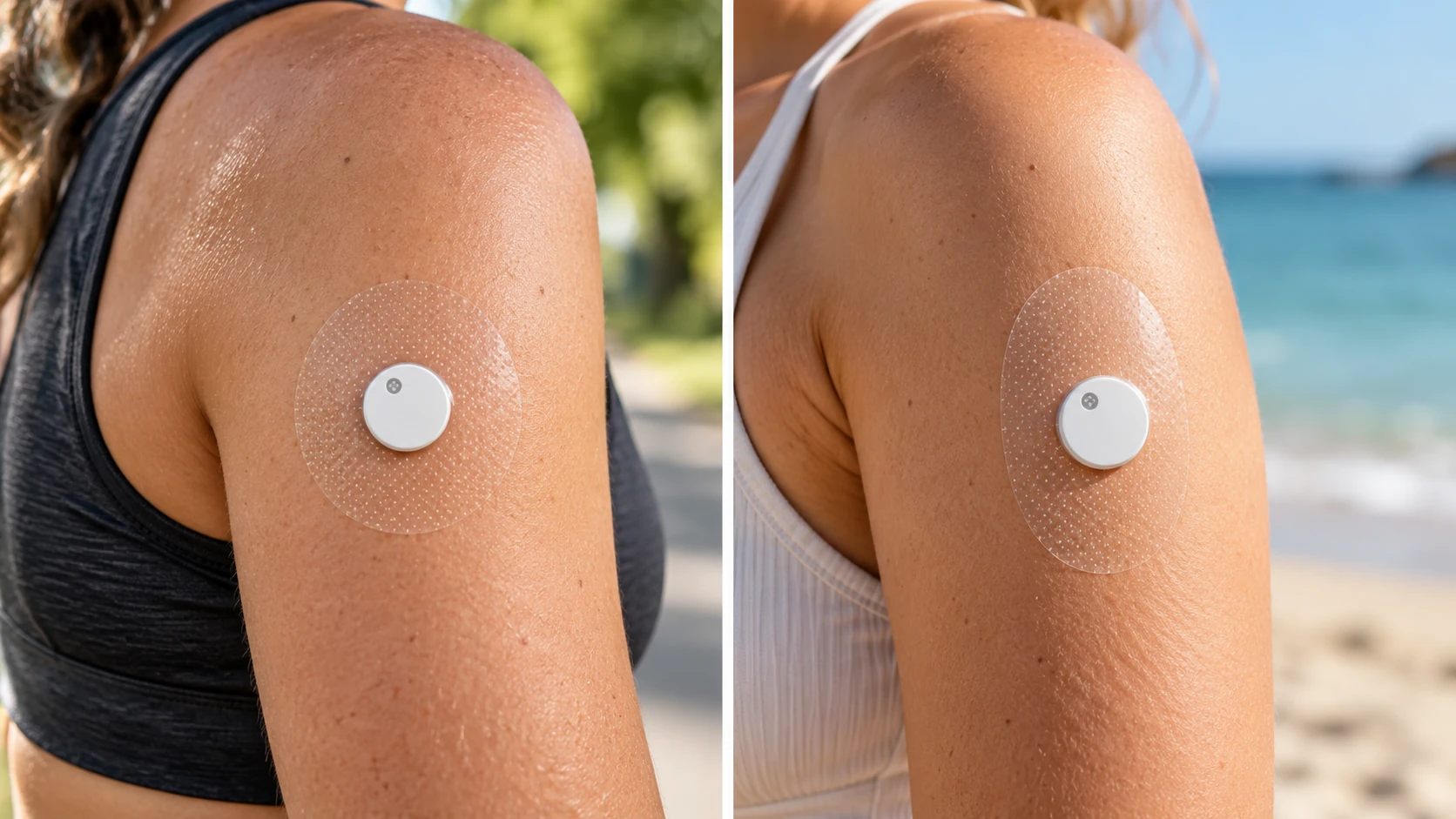
P2 round and P3 oval wearing concepts. AI-generated illustration, not a test photograph; sensor fit and final product appearance require confirmation.
For the wider choice between fixation, skin protection and removal, see our CGM and insulin pump accessories guide. Our guide to CGM patch materials, adhesives and quality explains how PU film compares with textile constructions.
Can a CGM patch be waterproof and breathable?
Yes. Resistance to liquid water and transmission of water vapour are different properties. A suitable polyurethane film can combine both. The harder task is preserving that balance after adding adhesive and forming a patch that must tolerate movement, sweat and repeated wetting. Neither property means unlimited underwater use.
This is an established materials principle, not a new invention exclusive to one patch brand. For example, film manufacturer Argotec describes thin hydrophilic TPU films used to make waterproof, vapour-permeable composites. That supports the general principle; it does not establish the composition or performance of a LINKFAR product. Argotec’s film description.
Water outside, moisture underneath
“Waterproof” and “breathable” are often printed next to each other on packaging. They answer different questions.
| Question | What it concerns | What it does not establish |
|---|---|---|
| Does the film resist liquid water? | Water reaching and crossing the film | A leak-free seal around every moving edge |
| Can water vapour pass through? | Moisture transport through the material | Liquid sweat draining through the patch |
| Does the patch remain attached? | Adhesion during the intended wear conditions | Dry, comfortable skin for every wearer |
| Can the CGM be used while swimming? | The sensor manufacturer’s device limits | A higher water rating because an overpatch was added |
The distinction matters after a hot workout. Moisture beneath a covering is not automatically proof that outside water leaked in. The skin itself contributes moisture, and the covering can change how readily that moisture leaves.
In a controlled human forearm study, Schäfer and colleagues compared moist vapour-permeable and impermeable coverings. The more permeable covering reduced moisture-related measurements under the tested conditions, while a hot, humid environment increased hydration beneath both types. This was a short-duration occlusion study, not a CGM trial or a test of P2/P3. Schäfer et al., 2002.
That is why I would not judge a summer patch only by the water droplets sitting on its surface. I also want to know what is happening underneath it.
Why a breathable PU CGM patch needs more than a good film
PU means polyurethane. Choosing a suitable film matters, but a wearer does not apply an uncoated film sample. They apply a finished adhesive product.
The adhesive can change the result
A film’s breathability figure cannot simply be transferred to the coated patch. Adhesive formulation, coating thickness and coverage need to be considered alongside the film.
GERGONNE’s published M026 technical sheet illustrates this clearly: it reports separate moisture vapour transmission results for the bare PU film and the adhesive-coated construction, with a substantially lower result for the latter. This is a different manufacturer’s material, not a P2/P3 specification. Its relevance is the engineering lesson: test the construction people will actually wear. GERGONNE M026 technical sheet.
Thinness has to work with handling and adhesion
A thin film can provide a low-profile appearance. But making a film thinner is not, by itself, evidence that the finished patch is more breathable, stronger or easier to apply.
For P2/P3, the design brief specifies a PU film approximately 15 micrometres thick. That figure describes the film layer, not the combined thickness of the film, adhesive, release liner and application aids. The practical aim is a discreet covering rather than a bulky layer around the sensor.
The edge is part of the product
A water-resistant film and a reliable on-skin attachment are not the same test. An edge that moves with the arm, rubs against clothing and repeatedly becomes wet needs its own evaluation.
This is where an attractive material sample can become a difficult product-development task. Film, adhesive, shape and application all have to work together. Improving one property without checking the others is not enough.
LINKFAR P2 and P3: transparent PU CGM overpatches
LINKFAR P2 and P3 are transparent PU CGM overpatch designs: P2 is circular and P3 is oval. Their design combines an approximately 15-micrometre PU film with a fine point-pattern appearance, aiming for discreet wear while addressing moisture management. Shape, device fit and permitted wear conditions must be checked for the selected model.
Our catalogue identifies them as ClearFit-P2, reference 08-2802, and ClearFit-P3, reference 08-2803. The two outlines offer different coverage shapes; they should not be treated as automatically interchangeable around any sensor.
Once applied, the intended appearance is transparent, with the skin visible beneath the film and a subtle pattern across it.
The point pattern deserves a careful explanation. Seeing dots does not mean the film has open holes running through it. Nor does a photograph tell us how much vapour can pass through the complete adhesive construction. The purpose of this development is to balance moisture transport and attachment; that balance needs evidence from the finished patch, not just a magnified picture.
For a distributor, that is a more useful conversation than another unqualified claim that a patch is “extra strong.” Strong attachment matters, but so do the condition of the skin underneath and the experience of removal.
Choosing a CGM patch for swimming and summer sport
An afternoon at the coast is not one exposure. It may involve sweat, immersion, drying, clothing friction and another swim. A product evaluation should reflect the intended combination rather than treating a brief splash as proof of prolonged seawater performance.
It is also important to separate the accessory from the device. An overpatch does not increase a CGM’s permitted immersion depth, duration or operating temperature. Dexcom’s current water-exposure guidance, for example, gives model-specific limits and notes that heat can reduce adhesive effectiveness. Users of any CGM should follow the instructions for their own system. Dexcom water-exposure guidance.
LINKFAR’s development brief targets multi-day wear, including a seven-day-plus wear objective, with summer activity and seawater exposure among the intended evaluation scenarios. That is not a promise of seven days of swimming or identical wear time for every person. Exact duration and water-exposure claims must follow the current model-specific instructions and supporting tests.
For me, the point of a better patch is not to encourage a wearer to ignore those limits. It is to make the accessory better suited to the conditions in which it is meant to be used.
What buyers should ask for beyond a breathability number
Moisture vapour transmission rate, often shortened to MVTR, measures vapour transport under stated test conditions. A large number without the method, temperature, humidity and sample construction is difficult to interpret.
ASTM E96/E96M explains that results from one set of conditions cannot simply predict results under another. Its public summary recommends conditions close to actual exposure where possible. That is a reason to ask for comparable data, not evidence that P2/P3 has been tested to this standard. ASTM E96/E96M-24a.
When evaluating P2/P3 or another clear PU patch, I would ask for:
- Finished-patch vapour transmission data, identifying whether the tested sample includes the adhesive.
- Water-resistance evidence that distinguishes the film barrier from the on-skin edge seal.
- Wear evaluation relevant to sweat, movement and repeated wetting, including seawater if that claim is made.
- Removal and skin-tolerance information, rather than assuming breathability means allergy prevention.
- The correct shape and fit for the intended device, including any required openings and areas that must remain uncovered.
These are separate questions. A good result on one does not answer all the others, and a visually transparent patch is not automatically a highly breathable one.
A clear patch should come with a clear specification
P2 and P3 bring our focus back to the skin beneath the patch. The design direction is a thin, transparent covering with a fine point pattern, developed around the balance between outside water exposure, moisture transport and dependable attachment.
We are not publishing a headline MVTR figure here because a figure alone would tell only part of that story. For a buying decision, the relevant information is the current specification and evidence for the exact model and intended use.
If you are reviewing transparent PU patches for your CGM accessory range, contact LINKFAR for P2/P3 specifications and sample availability. Tell us the device and the wear conditions you need to evaluate, so the discussion starts with the actual application.
Related articles
-
 Neonatal heel lancets: why choose a shallow incision?
For a newborn, the difficult part of heel sampling is not simply making blood appear. It is obtaining an acceptable specimen while limiting the…
-
 Insulin Pump Adhesive Allergy: My EASD 2026 Takeaways
By David Zhou, LINKFAR Healthcare GmbH At EASD 2026, several insulin pump distributors asked me about underpatches. LINKFAR already has underpatch options, including versions…
-
 CGM Skin Barrier Wipes: Balancing Protection and Hold
By David Zhou · LINKFAR Healthcare GmbH Recently, a customer in Central America told us that his CGM came off during a football match…
-
 CGM patches explained: materials, adhesives and quality
Two CGM patches can have the same outline and feel quite different after a day of wear. One may feel more like fabric; another…