
“Which gauge do you recommend?” is a reasonable opening question. It is not a complete specification.
A distributor may be supplying a glucose-testing programme, a haemoglobin screening service or a laboratory collecting blood into microcontainers. Each uses a small sample, but that does not make their collection requirements identical. A lancet selected from a gauge number alone can leave important questions unanswered before anyone opens the box.
Safety lancet selection should start with the test and the specimen it accepts. Needle gauge, blade width, penetration depth and safety features then become separate parts of the decision. The aim is an appropriate, usable sample within the approved workflow, not the finest needle or the largest possible drop.
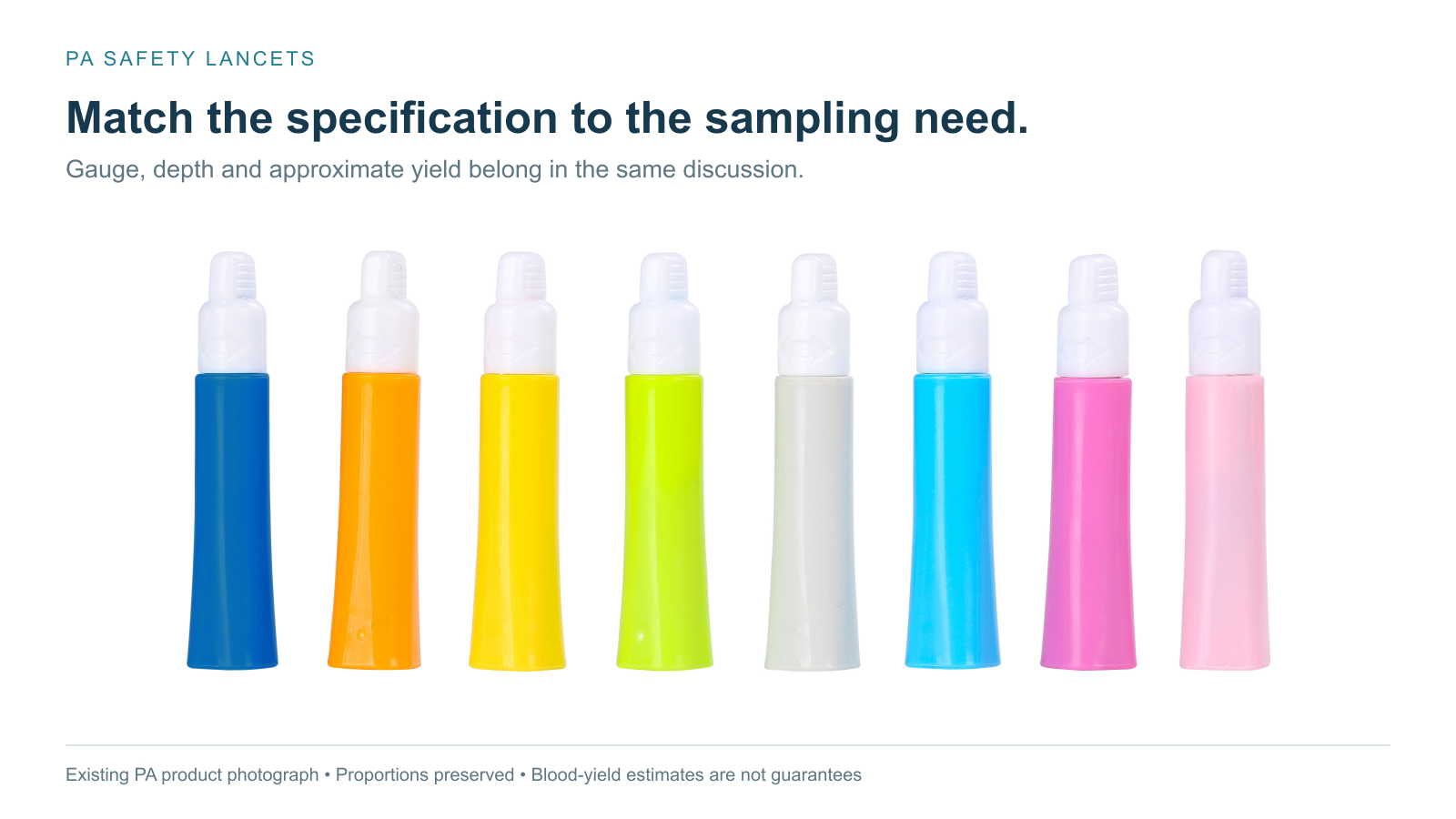
Existing LINKFAR PA product photograph, with product proportions preserved. The photograph is not a blood-yield test or a current SKU approval list. Confirm the exact reference and instructions for use.
Start with the test, not the colour of the lancet
Before comparing products, obtain the current instructions for the named analytical system. Confirm whether it accepts capillary blood, which specimen matrix it needs and how the sample must reach the test.
Whole blood, serum and plasma are not interchangeable descriptions. Neither are a drop applied directly to a test and a sample collected into a container for later processing. Our guide to blood sample collection methods explains the broader relationship between collection route, specimen matrix and testing.
One concrete example helps. HemoCue's US information for the Hb 201+ System specifies capillary, venous or arterial whole blood and an approximate sample volume of 10 µL. Those are specifications for that named system, not a universal requirement for haemoglobin tests or proof that a particular lancet will supply an acceptable sample. The current local instructions remain the reference for use. HemoCue Hb 201+ System
For procurement, distinguish the analytical sample requirement from any collection-container fill requirement or transfer requirement. Ask the clinical or laboratory team to define the complete workflow. A lancet cannot make an unsuitable specimen type suitable for an assay.
Gauge, depth and blade width answer different questions
Gauge is used to describe a needle's diameter. It does not state how far the sharp travels out of the housing, how wide a blade is or how much blood an individual collection will produce. Where dimensions matter to a tender, ask for the manufacturer's dimensional specification rather than relying on a gauge label alone.
| Specification | What the buyer needs to know | What it does not establish by itself |
|---|---|---|
| Needle gauge and diameter | The size of the needle used in the specified model | Penetration depth, guaranteed yield or pain level |
| Blade width | The width of a blade-shaped sharp | Its penetration depth or whether it makes a sweeping incision |
| Stated penetration depth | The depth specification of the exact device or setting | Suitability for every age, site or clinical protocol |
| Needle, blade or incision action | How the sharp moves and the intended collection application | That all devices described as “blade” work in the same way |
| Activation and post-use protection | How the device is triggered and how the sharp is secured afterwards | Whether the collected specimen meets the assay's requirements |
Roche's Australian page for Accu-Chek Safe-T-Pro Plus illustrates why gauge and depth need separate fields: it lists a 23G, 0.63 mm needle with three depth settings: 1.3, 1.8 and 2.3 mm. One needle diameter therefore does not identify one depth. These are that product's specifications in that market, not recommended settings for LINKFAR products or a patient-selection chart. Accu-Chek Australia
Blade specifications need the same care. SARSTEDT's Canadian catalogue page for Safety Lancet Super, reference 85.1018, separately lists a 1.5 mm blade width and 1.6 mm penetration depth. Width and depth describe different dimensions. Neither should be substituted for the other in a quotation or comparison table. SARSTEDT product specification
A blade lancet is not automatically a heel incision device
“Blade” describes a sharp's geometry; it is not a complete description of its motion. A straight puncture with a blade-shaped sharp and a guided sweeping incision should not be treated as the same sampling action merely because both use blades. Ask the supplier to describe the actual action and intended application. This distinction is a specification question, not a universal clinical ranking of products.
For an infant or neonatal application, a familiar housing colour or a shallow-looking number is not enough to establish suitability. The buyer needs the intended population, permitted collection site, exact device reference and current instructions. A general fingerstick product should not be presented as a neonatal heel solution without that support.
This is also why a catalogue needs more than a single column headed “size”. The public scope of CLSI GP42, seventh edition, addresses collection sites, puncture depth and disposable devices for collecting, processing and transferring capillary specimens. Its scope treats these as parts of a collection process rather than a gauge-only choice. The full standard is not reproduced here. CLSI GP42 scope
How much blood can a safety lancet collect?
A rough blood-volume range can help a distributor begin a sampling discussion. It needs a clear label, though. The figures below are company-supplied experience estimates, not guaranteed outputs, minimum acceptance limits or universal requirements. They are not results from a controlled comparative clinical study.
| Needle gauge | Depth in the supplied experience chart | Approximate blood yield, experience estimate only |
|---|---|---|
| 30G | 1.5 mm | 1–10 µL |
| 28G | 1.8 mm | 5–20 µL |
| 26G | 1.8 mm | 10–30 µL |
| 23G | 2.2 mm | 15–40 µL |
| 21G | 2.2 mm | 20–50 µL |
Source: the company-supplied experience reference. The ranges are discussion aids, not release specifications for every PA reference. No collection-time, population or evaluation-method data accompany this chart.
Actual collection can fall outside these ranges. Results vary between individuals, and the estimates should not be assumed to apply uniformly across age groups or populations. Skin characteristics, local blood flow, the collection site and collection conditions matter. We do not assign a fixed blood volume or a lancet size by ethnicity. WHO's capillary sampling guidance discusses age and weight in site selection and factors such as calluses and excessive compression; it does not establish race-based blood-yield rules.
Expected collected volume is also different from the volume a test consumes. A device with an estimated yield of 20–50 µL cannot be assumed to meet a test requiring 50 µL: the lower end, transfer losses and any container-fill requirements still need consideration. Check the whole collection pathway rather than comparing an assay requirement with the upper end of an experience range.
Experience-based starting points for different tests
The following are broad starting points from our product discussions, not clinical prescriptions or assay-manufacturer recommendations. They are not a current PA order list and do not map one-to-one to the chart above. Confirm that the proposed gauge-and-depth combination is available in the exact product reference, permitted by its instructions and appropriate to the intended professional workflow.
| Testing application | Experience-based configurations to discuss, not fixed requirements | What must be checked |
|---|---|---|
| Blood glucose | 30G options, or 28G × 1.8 mm | The named meter's sample requirement and current collection instructions; these options are not guaranteed to suit every person or meter. |
| HbA1c | 28G options around 1.8 or 2.2 mm, where available | The exact assay, transfer method and current product reference. HbA1c does not automatically require more blood than a haemoglobin test. |
| Haemoglobin | 26G or 23G options; approximately 1.8–2.0 mm configurations may be discussed where available | Confirm the actual depth and reference rather than assuming every 23G or 26G device has that depth. |
| HIV or syphilis rapid-testing projects | 21G × 2.2 mm as a starting point for evaluation | Whether the specific test accepts fingerstick whole blood, its required volume, any anticoagulant requirement and the ability to transfer an adequate specimen. |
| Projects requiring a larger total capillary collection | Evaluate 17G or 18G options within the exact device's permitted use | Relevant projects may include capillary CBC, lipid testing or some fluorescence-immunoassay POCT workflows, but only when that system accepts the specimen and its actual total collection requirement justifies this approach. |
The analytical system can change the discussion substantially. Roche's US page lists a 0.6 µL sample for the Accu-Chek Inform II glucose system. Abbott's US Afinion HbA1c page lists 1.5 µL and capillary blood or specified anticoagulated venous blood. These are requirements of the named systems, not evidence validating a LINKFAR lancet pairing. Together with the Hb 201+ example above, they show why test names alone do not set a reliable blood-volume hierarchy.
For HIV testing, Abbott's Determine HIV Early Detect page for selected export markets lists a 50 µL sample and fingerstick whole blood among its sample options. That is a concrete example of why an estimated upper yield of 50 µL is not a guarantee of an adequate specimen. It does not make every HIV or syphilis assay a fingerstick test, nor does it specify a universal LINKFAR needle gauge. Read the current instructions for the exact assay and market.
Likewise, a CBC or lipid test is not automatically a large-volume application. Boule lists 20 µL for the capillary MPA mode and 110 µL for the open-tube mode of its Medonic M16M. Abbott's UK Cholestech LDX page describes a 40 µL fingerstick sample. These different requirements are why we do not give all CBC, lipid or fluorescence-immunoassay projects a blanket 17G or 18G recommendation.
Evaluate the usable sample and the collection experience
If a blood-volume claim is intended to become a product specification, agree the evaluation conditions: exact device, population, site, collection time and method. Another manufacturer's chart or a similar gauge number cannot establish a LINKFAR product's performance. A visible drop also does not confirm correct transfer or analytical acceptance.
A gauge number alone cannot substantiate “painless” or a comparative comfort claim. Ask what was measured, against which comparator and in whom. Dimensional and mechanical data should not be converted into an unsupported clinical benefit.
During an appropriately authorised evaluation, record whether the specified test receives an acceptable sample, not just whether the device fires. Inadequate fills, transfer difficulties and the need for another collection are useful observations to investigate with the clinical team. They are not a reason to improvise a deeper setting or change the approved procedure.
Safety requirements belong in a separate part of the brief
A lancet may meet a dimensional requirement and still be unsuitable for the intended service if its safety design or use conditions do not match the setting.
For assisted blood glucose monitoring, CDC recommends single-use, auto-disabling fingerstick devices, selection of single-use lancets that permanently retract after puncture, and disposal at the point of use in an approved sharps container. This guidance addresses infection prevention in that setting; it is not a gauge or depth recommendation for every capillary test. CDC infection-control guidance
Keep these requirements visible in the purchase specification. They should not disappear into a general statement such as “safety type”. Likewise, training, sharps disposal and the analytical system's instructions remain necessary even when the lancet includes a protective mechanism.
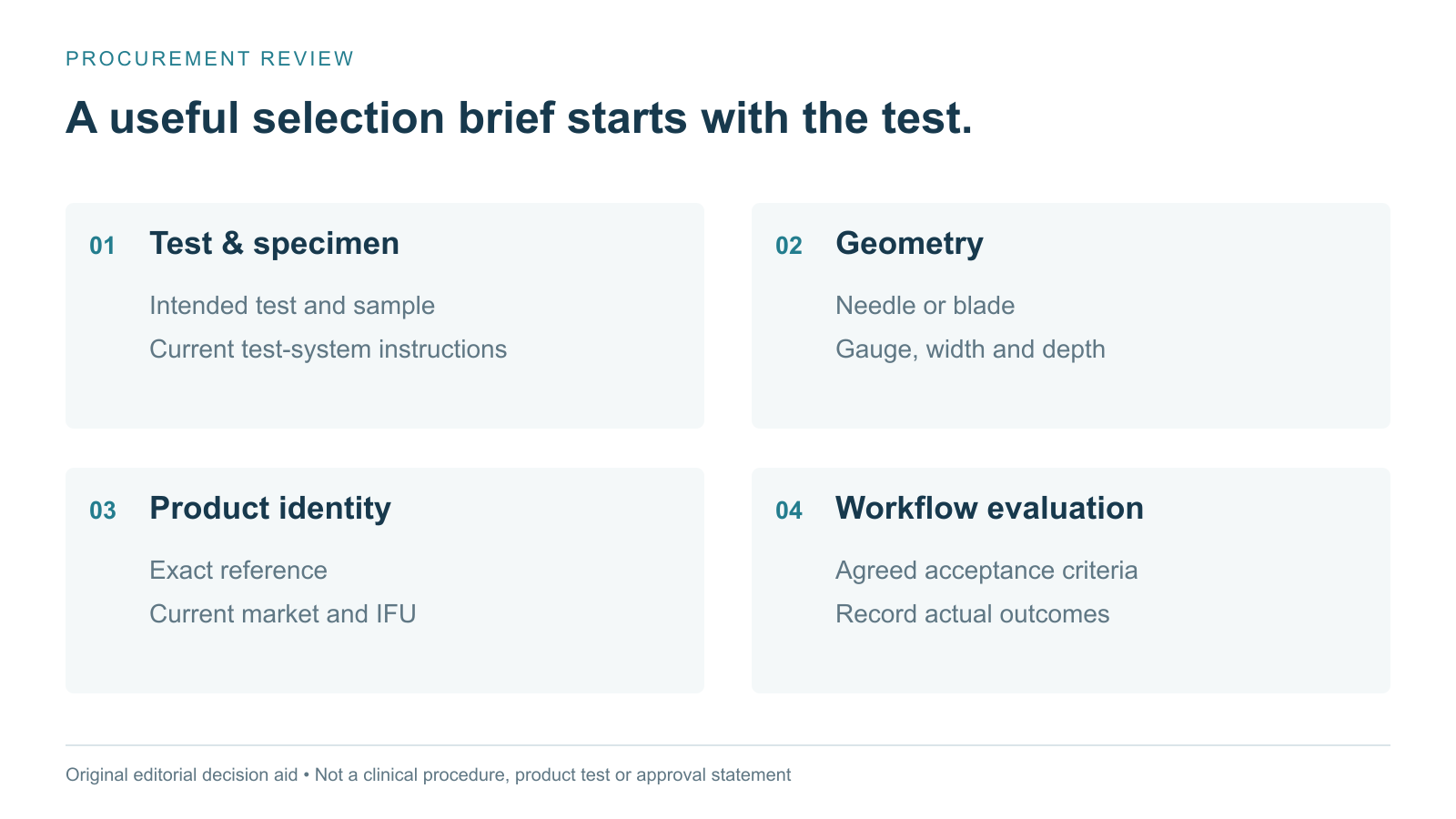
A procurement decision aid, not a clinical selection chart. The evaluation criteria must be agreed with the responsible clinical or laboratory team.
Give the supplier a brief that can be checked
For a distributor, the most useful enquiry is specific enough to compare like with like. A practical brief contains:
- Test and specimen: the named system, accepted specimen, required sample and relevant container or transfer requirements.
- Use setting: the intended professional workflow, patient group and collection site, as determined by the responsible team.
- Exact geometry: needle or blade, gauge or width, stated depth and reference number. Record adjustable settings separately where applicable.
- Safety and documentation: activation type, post-use protection, current label and IFU, packaging, shelf life and market-specific regulatory documents for that reference.
- Evaluation criteria: what counts as an acceptable sample and which handling, fill or safety observations the service will record.
Keep the final approved reference attached to the brief. If the device, specification, label or analytical system changes, review the fit again instead of assuming that the replacement is equivalent because its colour or gauge matches.
Where LINKFAR fits
LINKFAR's PA and PA2 safety lancet pages provide starting points for a product discussion. The next step is to match a current reference and its documentation to the customer's actual sampling brief. Product-family names are not a substitute for that review.
If your question concerns the firing and return mechanism rather than selection dimensions, our separate article on PA and PA2 dual-spring safety lancets covers that topic. It does not replace assay-specific or clinical selection requirements.
Contact LINKFAR with the test system, intended setting and required specification. That gives both teams a useful basis for reviewing suitable options and samples, rather than trying to answer a clinical collection question with one gauge number.
For professional product and procurement education. This article is not an individual medical recommendation or a collection procedure. Follow current local device instructions, analytical instructions and institutional protocols.
Related guides
-
 Blood Sample Collection Methods: Venous, Capillary and Arterial Blood Collection Explained
Compare venous, capillary and arterial blood collection routes, specimen types, devices and handling considerations for reliable blood sampling.
-
 Safety lancet cost: unit price or usable sample cost?
A quotation makes safety lancet cost easy to compare: the price is written beside the quantity. The cost of obtaining a usable sample is…
- Private label medical devices in the EU: from product brief to delivery If you distribute medical consumables, you may already know which products your customers need. Building your own brand raises a different set of questions:…
-
 Dual-spring safety lancets: why PA and PA2 use two springs
The unit price of a safety lancet is easy to compare. The motion of the needle inside it is harder to see, yet that…