
A CGM patch can stay attached as intended and still be difficult to take off. For a wearer, the end of a sensor session matters too: releasing the adhesive, dealing with leftover glue and deciding what the skin needs before the next application.
A CGM adhesive remover belongs in that discussion. Its purpose is to help with adhesive release or residue removal, according to the particular product's instructions. It is not an extra fixing layer and it is not a treatment for every skin complaint.
For a distributor building an accessory range, that distinction changes the buying brief. Asking only how strongly an overpatch sticks leaves the removal experience unanswered. Asking for a remover without specifying its intended use, precautions and cleanup requirements leaves a different gap.
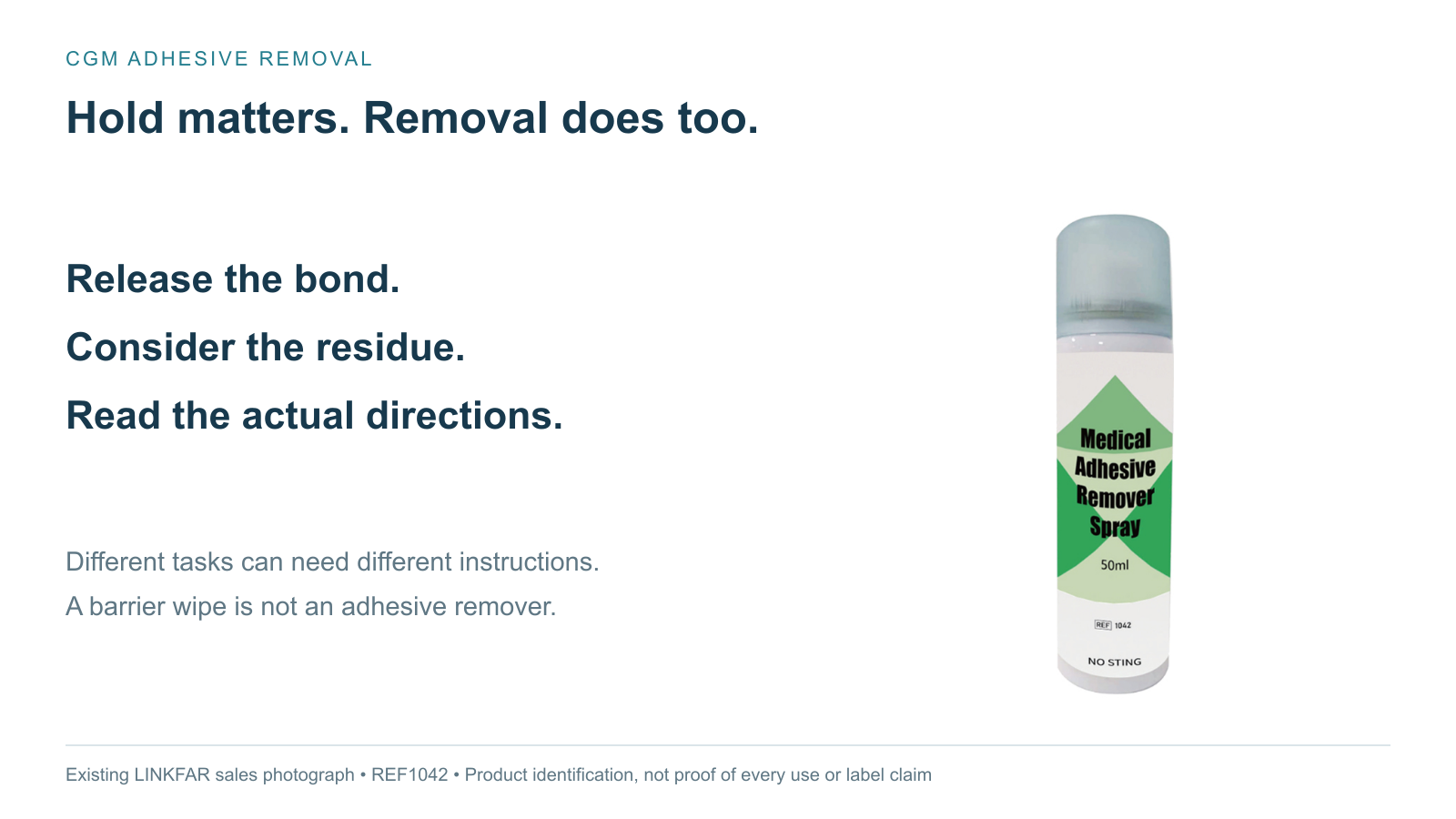
*Existing LINKFAR sales artwork, shown for product identification. Packaging and appearance do not establish compatibility with every sensor or individual skin type.*
What does a CGM adhesive remover do?
A CGM adhesive remover helps release an adhesive bond or remove adhesive left on the skin. Select it using both its own instructions and those of the exact sensor or accessory. A skin barrier wipe forms a protective interface; an overpatch supports fixation. These products have different jobs and are not interchangeable.
Our CGM and insulin pump accessories guide explains the wider categories. This article focuses on the end of wear, rather than on how to make a sensor stick more firmly.
Release and residue removal are two separate jobs
There are two situations worth naming clearly in a customer conversation.
The first is adhesive that is still holding the patch to the skin. Here, the task is planned release of the patch or device in accordance with its removal instructions. The second is glue remaining after the patch has come away. Here, the task is cleanup of the remaining adhesive, with attention to the condition of the exposed skin.
Those situations can occur together, but the product and method still need to fit each one. Smith+Nephew describes REMOVE wipes as addressing adhesive products and residues, while Convatec distinguishes the uses of its ESENTA spray and wipes. These are examples of why a supplier should explain the intended task, not merely use the word "remover." REMOVE product information, ESENTA product information.
| Product category | Question it addresses | What should not be inferred |
|---|---|---|
| CGM overpatch | Is additional external fixation appropriate for this device? | It will make removal comfortable or treat irritation |
| Skin barrier wipe | Is a labelled protective interface appropriate before attachment? | It will dissolve glue or prevent every allergic reaction |
| Adhesive remover | How can this adhesive be released or its residue removed? | It will improve adhesion during wear |
| Site-cleaning product | How does the device instruct the user to prepare the next site? | Every remover is also a cleaner or antiseptic |
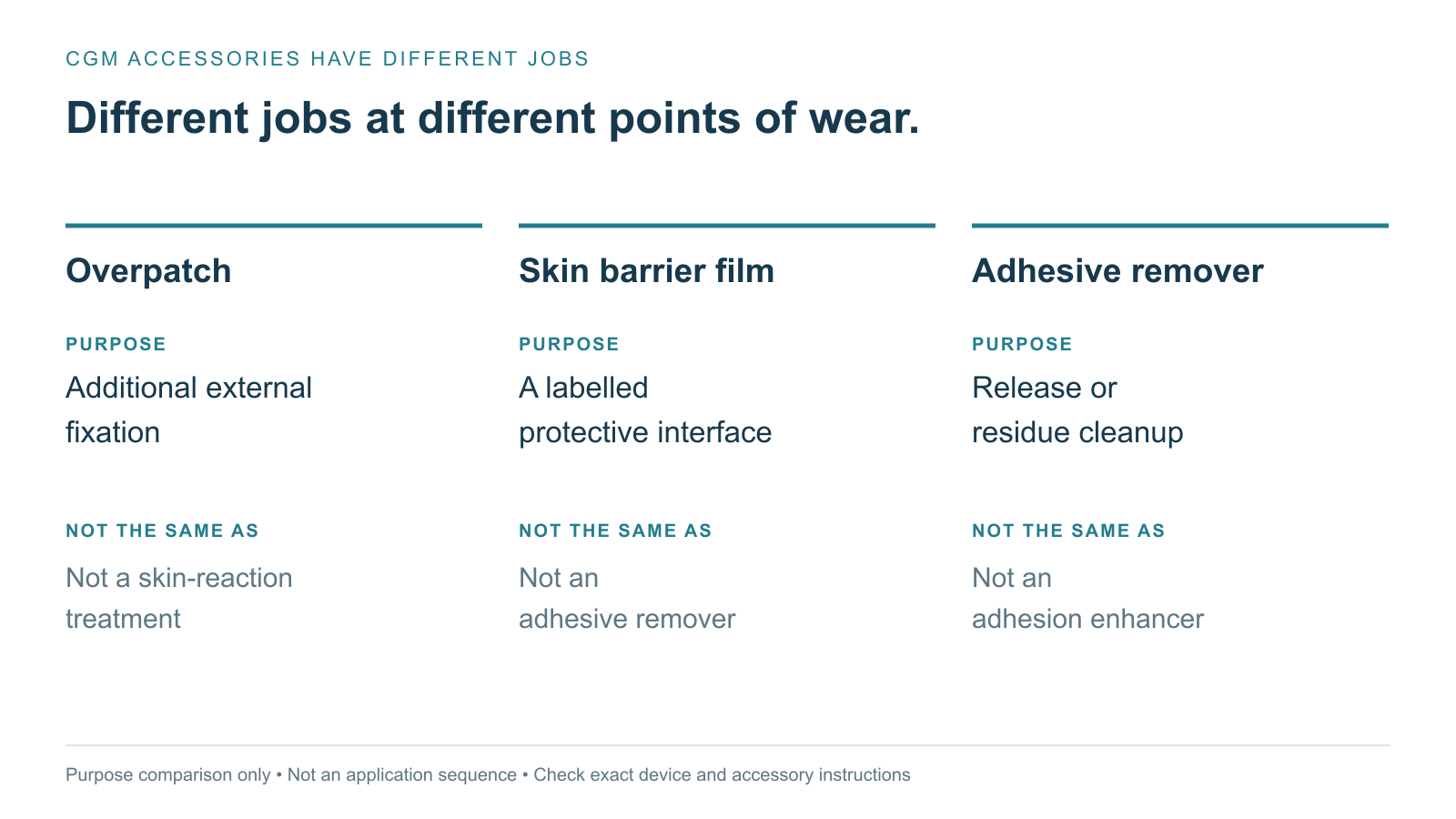
*A comparison of functions, not an application sequence or a recommendation to combine all categories.*
Start with the sensor's removal instructions
The first decision is what is being removed and when. Removing an additional overpatch during an active sensor session is not necessarily the same operation as taking off the sensor at the end of wear. The coverage arrangement and the risk of disturbing the device differ. Our CGM overpatch compatibility article compares the model-specific instructions that make a universal replacement rule unsuitable.
Dexcom's US removal FAQ discusses slow removal, skin support and different techniques for different tape constructions. It also explicitly says that the approaches it summarises were not tested or endorsed by Dexcom, and points users to the device guide for detailed instructions. A useful technique mentioned on a support page is not proof that every remover or accessory combination has been validated. Dexcom removal guidance.
Abbott's US FreeStyle Libre 3 Plus FAQ lists optional products that may help with difficult removal, but includes its own non-endorsement statement and says to follow each product's instructions. That is model- and market-specific guidance, not approval of every third-party spray. Abbott Libre 3 Plus removal FAQ.
For buyers, the practical lesson is to supply clear, consistent information about the device, the accessory and the stage of use. Do not turn a scheduled-removal aid into advice to loosen an actively worn sensor, reattach a dislodged device or extend the sensor's authorised life.
Residue is not a diagnosis
Sticky material after patch removal and a skin reaction are different observations. A residue report asks what remains and how the labelled remover is intended to address it. It does not establish whether someone has an allergy, whether a particular ingredient caused a reaction or whether the skin has been injured.
Likewise, discomfort should not automatically be dismissed as "just glue." Persistent redness, soreness or other skin concerns deserve discussion with a healthcare professional rather than repeated experimentation with stronger adhesive or more cleaning products. Dexcom's sensitive-skin guidance emphasises individual differences and healthcare-professional involvement; it does not treat a barrier product as a guaranteed solution. Dexcom sensitive-skin guidance.
A support record is more useful when it separates the observations: difficulty releasing the patch, visible residue, the condition of the skin, and which products were used. Record the exact sensor model, patch reference and remover name. Avoid diagnosing the cause from a photograph or from the fact that several products were used together.
This is also why we keep the skin barrier wipe and adhesion case separate from this guide. A product used before attachment and a product used for removal should not be presented as two names for the same liquid.
Read the formulation's directions, not only the front label
Two products can both be called medical adhesive removers and still have different instructions.
Smith+Nephew's Australian REMOVE page directs users to cleanse with water and pat dry after use. It also lists product-specific restrictions, including avoiding use in children under 12, open wounds and mucous membranes, along with flammability precautions. Those details matter more than assuming that all remover wipes are suitable for every CGM user. REMOVE directions and warnings.
Convatec's Singapore ESENTA information describes silicone evaporation and says the dried product does not leave a coating that requires cleaning before a new appliance. That statement belongs to the specified formulation and application context. It must not be transferred to another remover or treated as overriding a CGM's site-preparation instructions. The same source also includes flammability cautions. ESENTA formulation information.
These examples do not create a ranking between the products. They show why "wipe or spray?" is only part of the selection question. Permitted application areas, user groups, drying, cleanup, storage and precautions belong in the comparison too.
Think about the next application without rushing it
A remover's job is release, not preparation for a stronger bond. Do not use it as an adhesive enhancer beneath a fresh patch. After removal or residue cleanup, follow the remover's aftercare directions and the new device's instructions for site selection and preparation.
There is no single cleanup sentence that fits every formulation. Nor does a general statement about evaporation mean the same site is immediately suitable for another sensor. The condition of the skin, the permitted site and the device's own instructions still matter.
For distributors, this is a packaging and education issue as much as a product-selection issue. Keep a remover's instructions with that remover. Do not replace them with a generic accessory leaflet that combines barrier films, removers and cleaners into one routine. If a proposed bundle contains more than one liquid product, review their separate roles and compatibility before describing how they should be used together.
A purchasing brief for adhesive-removal products
Before comparing prices, ask the supplier to answer six questions against the current product reference:
- What is the intended task? Distinguish release of an attached adhesive product from cleanup of residue after removal. Identify the intended contact area and application context.
- Which instructions apply? Obtain the current label and instructions for the target market, not just a photograph of the carton or a sales claim.
- Who may use it? Check age limits, skin-condition restrictions, warnings and any need for professional advice. Do not infer suitability for children from a small pack size.
- What happens after use? Confirm required drying or cleansing and how the directions relate to the device's own preparation instructions.
- What does the evidence actually cover? Match claims to the specified formulation and tested product. A different supplier's data or a familiar ingredient name is not a finished-product result.
- What will the customer receive? Confirm the reference, format, amount, pack information and language. Keep removal instructions distinguishable from those for protective wipes and overpatches.
This brief helps keep a range understandable. Customers need to know which problem a product addresses and what its limits are, not simply that it sits beside CGM patches in a catalogue.
How LINKFAR fits into the discussion
LINKFAR's existing sales material includes a Medical Adhesive Remover Spray, alongside the wider CGM accessory range. The product artwork shown here identifies that item. It is not a claim that the spray is suitable for every sensor, age group or skin condition.
When evaluating the current product reference, request its intended-use information, target-market instructions and sample details. Keep packaging descriptions separate from verified results. A label such as "no sting" should not be expanded into a promise of painless removal or freedom from reactions for every person.
Our view is that hold and removal belong in the same purchasing conversation. The CGM patch materials and quality guide covers the attachment side; a complete brief should also explain the intended end of wear.
Questions buyers should resolve
Is an adhesive remover compulsory with every CGM?
No universal requirement is established by the sources discussed here. The need depends on the device, adhesive, removal difficulty and permitted product use. An accessory range should offer a clear option without implying that every wearer needs an additional product.
Does less visible residue mean the patch was better?
Residue is one observation, not a complete quality score. Evaluate it alongside intended fixation, skin contact, removal and consistency. Compare products under defined conditions rather than judging their whole performance from a photograph after removal.
Can the same wipe protect skin before wear and remove adhesive afterwards?
Do not assume so from the word "wipe." Protective films and adhesive removers have different intended functions. Only the actual product's labelling can establish whether it has more than one permitted role.
For a sourcing discussion, send LINKFAR the exact device, target market and removal problem you want to address. That gives us a useful basis for reviewing the current product information and sample requirements.
*This article explains product-selection questions. It does not replace device or accessory instructions, diagnose a skin condition or provide individual medical advice. Named manufacturers and products are source examples, not evidence of endorsement of LINKFAR.*
Related guides
-
 CGM and Insulin Pump Accessories: A Guide to Patches, Skin Care and Secure Wear
A sensor that starts lifting after exercise and a patch that hurts to remove create different problems. Buying a stronger adhesive may help with…
-
 CGM overpatch wear time: why 15 days is not a universal promise
Compare CGM overpatch wear time with sensor life. Learn what 15-day claims need, how real wear differs and which evidence to request before choosing…
-
 Custom CGM overpatch development: what to decide before samples
What should a buyer decide before approving a custom CGM overpatch sample? A practical brief for device fit, material construction, evidence, revisions and purchasing.
-
 Why a universal CGM overpatch may not fit every sensor
A patch can be large enough to cover a glucose sensor and still be the wrong choice for it. CGM overpatch compatibility depends on…