

By David Zhou, LINKFAR Healthcare GmbH
At EASD 2026, several insulin pump distributors asked me about underpatches. LINKFAR already has underpatch options, including versions for Medtrum pumps, but the reasons behind those enquiries deserved more attention than a simple product recommendation.
These distributors were hearing from people who struggled with itching or skin reactions where their pumps were attached. They described the problem as insulin pump adhesive allergy, and wanted something that could sit between the original pump adhesive and the skin.
That led me to look more closely at a question I have also discussed with pump manufacturers: how can a device using tested materials still cause trouble for some of the people wearing it?
I work on the supplier side, not as a clinician. My interest is practical: understanding what we can reasonably offer, what a distributor should ask before recommending an accessory, and where a skin problem needs clinical investigation rather than another layer of tape.
The conversations at EASD are the starting point for this article. They are not a clinical survey, and they do not tell us how many pump users have a confirmed allergy.
Cover photograph: LINKFAR Healthcare GmbH at EASD 2026, stand F.10. Diabetes-care supplies and adhesive patches on display. Exhibition context, not a product compatibility demonstration.
What is insulin pump adhesive allergy?
Insulin pump adhesive allergy usually refers to allergic contact dermatitis associated with materials in a pump or its attachment system. It involves an immune response to a particular substance. A rash under a pump is not automatically an allergy: irritation can also cause skin symptoms, and the distinction may require clinical assessment.
LINKFAR supplies diabetes-care accessories and already has insulin pump underpatch options, including Medtrum-specific versions. The appropriate configuration depends on the exact pump model and its instructions. Our role is to discuss those product requirements with distributors and device teams, without presenting an underpatch as a guaranteed treatment for allergy.
The American Academy of Dermatology distinguishes allergic contact dermatitis from irritation that damages the skin’s protective barrier. Those are different mechanisms, even though people may use the same word, allergy, when describing their discomfort. AAD: contact dermatitis causes
The question behind the underpatch enquiries
For a distributor, the initial request sounds like a compatibility question: do you have a patch for this pump? After EASD, I think it deserves a second question: what is the customer hoping that patch will change?
Someone looking for extra hold during activity has a different requirement from someone who develops a recurring rash. An accessory catalogue should make that distinction easy to understand before a buyer starts comparing shapes, colours or prices.
In our CGM and pump accessory range, the product category is only the beginning of the conversation. A useful recommendation still needs the device model, the intended position of the accessory and a clear description of the problem it is meant to address.
An enquiry with a named pump model and specific skin-contact requirements gives us much more to work with than an order based only on a photograph. It tells us what information the buyer needs, as well as which product shape they have in mind.
There is also a communication issue here. When a customer says a product caused an allergy, a sales team should take the report seriously without turning the customer’s description into a diagnosis.
The practical response is to record what was reported, preserve the product details and direct clinical questions to the appropriate healthcare professional. A complaint does not become less important because its medical cause has not yet been identified.
Why can tested pump materials still cause skin reactions?
A biocompatibility report is important evidence. It is not a promise that every person will tolerate every combination of materials in every wearing situation.
The FDA’s 2023 guidance places biological evaluation within a risk-management process that considers materials, manufacturing and the nature and duration of contact. It also addresses the device in its final finished form, rather than assuming that an individual component necessarily represents the whole product. FDA: biological evaluation guidance
For me, the buying question is therefore more specific than whether the tape comes from a familiar supplier. I want to know what was tested and whether that evidence applies to the actual accessory being offered.
- Does the report identify the same material and product configuration?
- Is the evidence about a raw material, a component or the finished product?
- Are the intended application and contact conditions covered by the evaluation?
- Who can explain the link between the tested sample and the item being supplied?
These questions should be answerable without dismissing the value of testing. Equally, a recognised tape brand should not become a substitute for the answers.
I have not established that most insulin pumps use one particular tape manufacturer’s products, and I would not use that claim to explain an individual reaction. The relevant evidence is the evidence for the device and material involved.
There is a related detail that surprised me in the research. In a 2018 investigation of four patients reacting to an Omnipod device, researchers identified the allergen isobornyl acrylate, with the highest concentrations in the device unit rather than the adhesive patch. Raison-Peyron and colleagues, 2018
That was a study of particular historical devices, not a statement about the composition of today’s pump models. Its relevance here is narrower: investigating only the tape may miss part of the explanation.
As a supplier, I take that as a reason to ask about the complete product. The adhesive’s reputation matters, but I would not want it to end an investigation into a customer’s complaint.
Why might a reaction start after months of comfortable use?
One of the hardest situations to explain is a product that seemed fine before symptoms appeared. It is tempting to describe this as the body beginning to reject the pump, but that wording does not identify a cause.
A 2022 clinical report described a patient who developed eczema after five years of previously uneventful Omnipod use. Diagnostic testing and chemical analysis identified a relevant allergen; different protective pads did not allow that patient to continue using the same device. Raison-Peyron and colleagues, 2022
This single case cannot tell us how often that happens. It does show why past tolerance does not settle the question, and why a barrier accessory is not always enough.
I would not explain such a history simply by saying that the person’s immunity had become weak. A clinical explanation such as acquired sensitisation needs investigation; a general assumption about someone with type 1 diabetes does not provide one.
For product teams, the useful information is the sequence: which device and accessories were used, when symptoms began, and whether anything changed. That is more useful to a subsequent investigation than a label such as sensitive skin on its own.
What about heat, sweat and the pump battery?
Heat was one possibility I wanted to investigate after my discussions with manufacturers. The evidence supports a more limited statement than “the battery causes allergy.”
DermNet identifies friction, sweating and heat among factors that can contribute to irritant contact dermatitis. Exposure duration, repeated contact and the condition of the skin also matter. This supports considering the wearing environment, but does not establish a particular pump battery as the cause of an allergic response. DermNet: irritant contact dermatitis
I have not found enough evidence to make that battery claim in this article. Nor would I describe an underpatch as a cooling or thermal-protection product without specific testing.
If a device team suspects a heat-related problem, I would want temperature measurements under defined operating and wearing conditions, linked to a proper investigation of the reported symptoms. That is a proposed investigation, not a result we already have.
This is where commercial language can get ahead of engineering. An extra layer sounds reassuring, but its actual effect needs to be established for the combination being used.
Underpatch, overpatch or skin barrier wipe?
These names describe different approaches. They should not be treated as interchangeable products simply because all are used around a wearable device.
Our CGM and insulin pump accessories guide places these options in the wider category. For a separate real-world attachment question, see skin barrier wipes and CGM adhesion during sport.
| Option | Where it is used | Main purpose | Important limitation |
|---|---|---|---|
| Underpatch | Between the skin and the device’s original adhesive, according to the intended configuration | Change the skin-contact interface and reduce direct contact with the original adhesive where covered | Introduces another material; suitability and device function still need assessment |
| Overpatch | Over or around an already attached device | Provide additional fixation | Does not generally separate the original adhesive from the skin |
| Skin barrier wipe or film | On the skin, forming a thin film as directed | Provide a protective interface | Effect depends on the formulation and application; not a universal allergen barrier |
| Adhesive-enhancing wipe | At the attachment interface as directed | Improve adhesion | Stronger attachment is not evidence of better skin tolerance |
Insulet’s own adhesion guide separates products for attachment support from options intended to limit irritation and advises discussion with a healthcare professional. It also highlights insertion considerations when a barrier is used. That is useful manufacturer guidance, not an endorsement of LINKFAR accessories. Omnipod adhesion guide
LINKFAR also has a skin barrier wipe product page. For an actual pump application, the wipe’s current instructions and the pump instructions need to be considered together; the words barrier wipe alone do not establish compatibility.
For enquiries, I recommend writing out the intended arrangement instead of relying only on the product name. For example: an underpatch below the original pump adhesive, or an overpatch used for additional fixation.
That simple description helps prevent a purchasing error before samples are evaluated. It also makes it easier to separate a request about adhesion from a request about skin contact.
Can an underpatch help with adhesive allergy?
There is evidence that a barrier approach can help selected patients, but the details matter. A small study by Kamann and colleagues evaluated hydrocolloid plasters beneath a glucose sensor in eight people with allergic contact dermatitis.
All eight were able to continue using that sensor; seven completed the full 14-day wearing period. One stopped at 11 days because of adhesion, and another reported intermittent itching and redness at the edges. These were specific CGM users and specific plasters, not a trial of LINKFAR underpatches or insulin pump compatibility. Kamann and colleagues, online 2019; journal publication 2020
I find the result encouraging as a reason to investigate a defined barrier option. I do not read it as evidence that any underpatch will work for anyone who has reacted to a pump.
The earlier case in which protective pads did not solve the problem is equally important. Both findings belong in the discussion when a distributor is deciding how to describe this category to customers.
My position is that an underpatch should be presented as an option with a defined application and evidence, not as an allergy cure. The commercial claim should become more specific as the product information becomes more specific.
For LINKFAR, that means discussing the exact configuration. It does not mean promising that a person who reacted to one adhesive will necessarily tolerate another.
What I would ask before adding an underpatch to a pump range
If I were evaluating this category for a distributor, I would start with the customer problem and then ask for a short, usable technical dossier. A long list of generic certificates would not be my preferred starting point.
Start with the model, not just the brand
A brand name is not a complete compatibility specification. I would ask for the exact model designation, the accessory reference and the instructions that apply to that combination.
For Medtrum enquiries, that means identifying the actual pump configuration before selecting an underpatch. I would use the same approach for any other pump family, rather than assume that a similar outline proves suitability.
Ask what will touch the skin
I would want a clear description of the skin-contact side, including whether it uses an adhesive. If the proposed benefit is a change in skin contact, the description should make that change understandable.
Material names, construction and limitations are more useful here than an unqualified sensitive-skin slogan. The supplier should also be able to say which statements are documented and which remain design intentions.
Review the complete wearing arrangement
My evaluation checklist would include the intended opening or insertion arrangement, secure attachment and the relevant wearing conditions. These are questions for documented product evaluation, not an invitation for users to improvise a new placement method.
I would not recommend cutting, piercing or repositioning a barrier from a general blog illustration. The model-specific instructions and the person’s diabetes care team should govern use.
Agree how feedback will be recorded
I would ask a distributor to distinguish reported itching, observed skin changes, attachment problems and clinician-confirmed allergy in its feedback. Combining them into one allergy total makes the information harder to interpret.
The record should preserve the product reference and batch, while handling any personal health information through an appropriate confidential process. Public comments are not the place for identifiable medical records or photographs.
Make the sample discussion useful
Before sending samples, I would agree what the recipient needs to evaluate: model fit, handling, packaging or documented material information. A commercial sample review should not be presented as a clinical investigation of allergy.
This is especially important when the distributor’s request began with a patient complaint. The buyer may need both a product discussion and a route back to clinical support; one should not be mistaken for the other.
Barrier products are not the only avenue
I do not think the answer should stop at “try a wipe or an underpatch.” If symptoms persist, identifying the cause can be more useful than repeatedly changing accessories without a clear reason.
The AAD describes diagnosis through examination, history and, when appropriate, diagnostic patch testing. Its treatment guidance emphasises identifying and avoiding the cause, with treatment tailored by a dermatologist. Diagnostic patch testing is a medical assessment, not the same thing as trying a new wearable patch at home. AAD: diagnosis and treatment
A diabetes team and dermatologist may therefore need to consider a different material or device arrangement, alongside treatment of the skin condition. An accessory supplier can contribute product information, but should not make that clinical decision.
For users with an ongoing or worsening reaction, seeking clinical advice is more appropriate than relying on this article. Changes to pump use must follow the individual’s diabetes care plan; this article is not a recommendation to interrupt insulin delivery.
Questions about insulin pump underpatches
Does a passed sensitisation test mean nobody will react?
No. It is evidence about the tested article under the specified conditions, not a guarantee for every wearer. A buyer should confirm that the evidence applies to the product being supplied and its intended use.
Is an underpatch the same as an overpatch?
No. An underpatch sits beneath the original device adhesive in its intended configuration, while an overpatch is primarily used for additional fixation over or around the device. Buying one in place of the other may fail to address the original request.
Can an underpatch guarantee that an existing allergy will disappear?
No. Evidence from selected patients cannot establish a universal result, and protective pads have not worked in every reported case. Persistent reactions need clinical assessment rather than a stronger product promise.
What information should I send LINKFAR about a Medtrum underpatch?
Send the exact pump model, the intended accessory position and whether your enquiry concerns fixation or skin contact. Ask for the corresponding product specification and instructions before choosing a configuration. Do not include identifiable patient information in a public enquiry or comment.
My takeaway from EASD
The underpatch enquiries at EASD have made me more interested in the quality of the product conversation, not just the number of shapes we can offer. I want a distributor to leave that conversation knowing what an accessory is intended to do and what it cannot promise.
LINKFAR already has underpatch options, and I welcome enquiries about them. I also welcome practical feedback from distributors and device teams: which compatibility details are difficult to obtain, which instructions are unclear, and what questions keep coming back from users?
If you are assessing an underpatch for your pump range, contact LINKFAR with the exact model and your requirements. That gives us a useful starting point for discussing the appropriate version and supporting product information.
Related guides
-
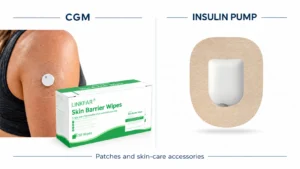 CGM and Insulin Pump Accessories: A Guide to Patches, Skin Care and Secure Wear
A sensor that starts lifting after exercise and a patch that hurts to remove create different problems. Buying a stronger adhesive may help with…
-
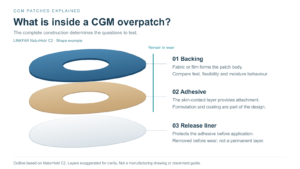 CGM patches explained: materials, adhesives and quality
Two CGM patches can have the same outline and feel quite different after a day of wear. One may feel more like fabric; another…
-
 Waterproof and breathable CGM overpatches: the P2/P3 design
A CGM patch can still be attached after a swim while the skin underneath feels damp. Those are two different results, and checking only…
-
 CGM Skin Barrier Wipes: Balancing Protection and Hold
By David Zhou · LINKFAR Healthcare GmbH Recently, a customer in Central America told us that his CGM came off during a football match…