
A supplier can match a colour, print a logo and send an attractive sample without resolving the questions that matter during wear. A custom CGM overpatch needs a brief that explains which sensor it is for, what the accessory must do and how the finished design will be assessed.
For distributors and private-label brands, that brief is also a purchasing tool. It gives the buyer and supplier something more precise to approve than "make it like this picture". The aim is to turn an intended use into a versioned product specification, then evaluate samples against that specification before treating packaging artwork as the final step.
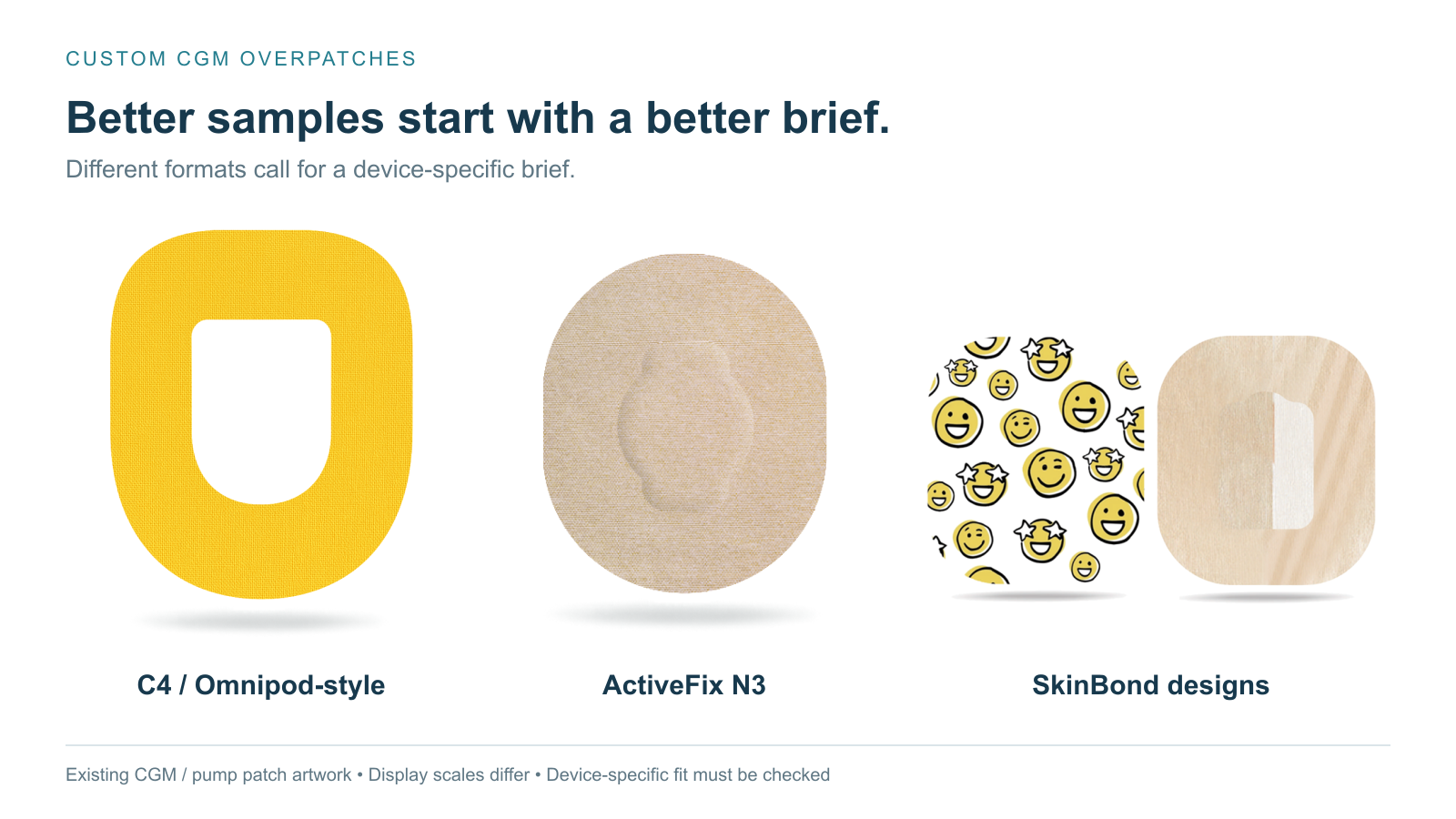
Existing LINKFAR CGM and pump patch artwork: NaturHold C4, ActiveFix N3 and SkinBond designs. These show format choices, not interchangeable fit or tested performance. Display scales differ.
What belongs in a custom CGM overpatch brief?
A custom CGM overpatch brief should identify the exact sensor and market, intended wearing conditions, coverage geometry, backing and adhesive construction, application and removal requirements, and the evidence needed for the proposed claims. Agree sample acceptance criteria and revision control before approving the design for production.
Our CGM patch materials and quality guide explains the available material choices. This article covers a different question: how to turn those choices into a useful development and purchasing brief. For the wider accessory categories, see the CGM and insulin pump accessories guide.
Start with the device version, not the brand logo
Record the full sensor model, generation and country of use. Include the current device instructions and a clear drawing of the proposed patch. A brand name alone does not identify the areas that must remain uncovered, the required fixation arrangement or the permitted removal timing.
For example, Abbott's Irish guidance for FreeStyle Libre 3 Plus requires its central opening to remain uncovered and gives specific timing instructions for an additional covering. That is a design constraint for the named system and market, not a universal rule for every CGM. It also does not establish that a particular third-party patch has been validated. Abbott Libre 3 Plus over-bandage guidance.
Before requesting tooling, distinguish a physical opening from a covered, adhesive-free area. They do different things. If a supplier proposes one patch for several sensors, ask for the basis for each combination rather than accepting a list of logos. Our CGM overpatch compatibility article sets out those device-specific checks without assuming that similar dimensions mean interchangeable designs.
Describe the problem the custom patch is meant to address
"For active users" is a starting point, not a test condition. Discuss the relevant activities, body location permitted by the sensor instructions, climate and exposure to clothing or equipment. A summer swimming brief and a discreet everyday-wear brief may lead to different design discussions.
Keep the desired experience separate from a performance promise. "We want a low-profile transparent appearance" is a design preference. "It will remain attached throughout a stated swimming programme" is a claim requiring evidence under defined conditions. An accessory must not be presented as extending the sensor's own water-use limits or authorised wear period.
| Buyer input | Useful detail to agree | What remains to be evaluated |
|---|---|---|
| Device and market | Exact sensor version, applicable instructions and country | Coverage and use instructions for that combination |
| Wearing conditions | Relevant movement, sweating, water exposure and clothing contact | Finished-patch attachment under the agreed conditions |
| Appearance and feel | Transparent film or textile, colour, texture and print | Handling, conformity and the actual wearing experience |
| Wear objective | Intended period and how success will be defined | Evidence supporting any stated duration |
| Removal needs | End-of-wear removal and any permitted accessory replacement | Removal behaviour, residue and risk of disturbing the sensor |
| Commercial format | Individual pack, pack count, languages and traceability needs | Final artwork, applicable documentation and storage specification |
This is a development checklist, not a claim that a selected LINKFAR product has already passed every evaluation in the table.
Specify the finished construction, not only the fabric
The drawing should identify the outside contour, opening or covered zone, adhesive layout and liner sections. Record dimensions and agreed tolerances in the controlled specification. Do not extract manufacturing dimensions from a marketing photograph.
The material brief should go beyond "cotton" or "PU". Identify the selected backing, adhesive grade where applicable, coating specification and any printing or temporary application support. Decide which parts remain during wear and which are removed during application. A handling tab should not be mistaken for a permanent product feature.
Avery Dennison's overlay guidance treats conformity to the device, compatibility with its surface and removal without damage or residue as material-selection questions. Those are useful considerations for the brief; its material guidance is not proof of a LINKFAR finished product's performance. Avery Dennison: protecting a device with an overlay.
There are different manufacturing starting points. A selected pre-coated tape grade already has a defined backing and adhesive combination. An own-coating route allows more direct involvement in that combination, within the available materials, equipment and evaluation work. Neither route removes the need to assess the final patch.
Henkel describes coating partners combining its adhesives with different carriers and designs. That supports the distinction between an adhesive material and the coated construction made from it. It does not identify a particular LINKFAR glue grade or establish a partnership status. Henkel medical-wearables brochure, page 14.

Development decision map, not a clinical testing protocol. Each gate needs an agreed record; a design change may require returning to an earlier evaluation.
Agree what a sample approval actually means
A sample can answer one question while leaving another open. A shape prototype may be useful for an initial dimensional review but unsuitable for evaluating the final adhesive. A printed sample may demonstrate colour while using a different liner from the intended production version.
Ask the supplier to identify the sample revision and any differences from the proposed finished construction. Then separate the evaluation into three decisions.
1. Does the documented design match the brief?
Check the drawing, reference, materials and intended coverage against the exact device requirements. Confirm the opening and any non-adhesive zone. Record unresolved questions before commissioning a different print or pack format.
2. Can the finished design be handled as intended?
Review liner separation, alignment, folding and the removal of any temporary support. Assess the design in its intended configuration, not just flat on the release paper. Define what counts as a handling failure so that buyer and supplier do not interpret the same sample differently.
3. What evidence supports wear and removal claims?
Agree the relevant evaluation plan, responsibilities, conditions and acceptance criteria. Laboratory adhesion data, documented fit assessment and appropriate wear evidence answer different questions. A result on a test panel is not automatically a prediction of an individual's skin experience.
Any evaluation involving wearers needs an appropriate safety and oversight framework. A distributor should not ask customers to improvise a clinical study or disregard sensor instructions. This article is a purchasing framework, not a protocol for testing an accessory on people.
Request reports that describe the proposed product
When skin-contact evidence is discussed, ask which sample was evaluated, what it contained and how it represents the proposed finished patch. FDA explains that its biocompatibility assessment considers the final finished device, including relevant manufacturing effects, rather than treating component materials alone as sufficient. This is a useful evaluation principle, not a statement that a LINKFAR patch has FDA clearance. FDA biocompatibility basics.
A test-report title or supplier logo is not enough to compare evidence. Ask for the method, sample identity, conditions, endpoints, results and acceptance rationale. FDA's reporting guidance specifically calls for test parameters and acceptance criteria in its submission context. Do not turn this into a universal test checklist or assume that every product needs the same test programme. FDA: what to include in a test report.
Different claims need different support. A skin-sensitisation report does not establish a wear duration, waterproof rating or a guarantee that no user will react. Similarly, a transparent film's appearance does not establish the moisture behaviour of the adhesive-coated product.
Keep the applicable reports and their scope linked to the controlled product reference. If the proposed construction differs from the test sample, the supplier should explain the difference and the basis for applying the evidence.
Finish the brief with change control and purchasing details
Sample approval should identify the approved revision and the scope of that approval. It should not silently approve a later substitution of the backing, adhesive, coating, printing process or liner. Agree how proposed changes will be reviewed and which evidence may need updating.
Commercial details also belong in writing: quantities, quotation assumptions, packaging, language requirements, artwork responsibilities and the process for agreeing delivery dates. Discuss the applicable market and responsibilities with the supplier. A finished logo does not settle product classification, labelling obligations or which company fulfils a regulated role. Our EU private-label development guide explains why those questions should be resolved separately.
Our view is that a short, controlled specification is more useful than a long list of adjectives. It should let both parties identify what has been agreed, which evidence applies and what would trigger another review.
Discuss a specific brief with LINKFAR
LINKFAR's patch range includes ActiveFix nylon, SkinBond nonwoven, NaturHold cotton and ClearFit PU film. For these patch families, LINKFAR uses medical-grade adhesives supplied by Henkel and carries out its own coating. That provides a basis for discussing the backing and adhesive together; it does not mean every requested construction is already available or validated.
Start with the current CGM accessory range and identify the model reference you want to discuss. Ask which changes are feasible and what sample and documentation work would be required. Relevant sensitisation documentation must be matched to the proposed construction and its intended contact conditions.
To develop a custom CGM overpatch, send LINKFAR your device version, target market and intended wearing conditions, together with the appearance and packaging requirements. We can review the brief and the relevant product options before a sample is treated as ready for approval. Capability, compatibility, performance claims and commercial terms require confirmation for the specific project.
This article is product-development and purchasing information, not individual medical advice or a device application guide. Device names identify the systems discussed and do not imply manufacturer affiliation or endorsement. Follow current device and accessory instructions.
Related guides
-
 EU MDR importer obligations: importer or distributor?
Who is the EU MDR importer of an individual medical device, and what does a distributor need to check? A practical guide to Articles…
-
 Why a universal CGM overpatch may not fit every sensor
A patch can be large enough to cover a glucose sensor and still be the wrong choice for it. CGM overpatch compatibility depends on…
- Private label medical devices in the EU: from product brief to delivery If you distribute medical consumables, you may already know which products your customers need. Building your own brand raises a different set of questions:…
-
 Insulin pen needle design: why the base matters too
Two insulin pen needles can have the same gauge and length on the box and still be quite different products. LINKFAR's wide, flat-base design…