
The unit price of a safety lancet is easy to compare. The motion of the needle inside it is harder to see, yet that motion deserves a place in the purchasing decision. LINKFAR's PA and PA2 use a dual-spring safety lancet design: one spring drives the lancet forward, while a separate spring returns it into the housing.
For distributors and testing programmes, this gives the product discussion a more useful starting point than price alone. How is the puncture controlled? How does the needle withdraw? What evidence would show that the device performs consistently?
The value of this design is the separation of two mechanical jobs. It gives engineers distinct components to match to forward travel and retraction, although those components still have to work together. It does not mean that two springs automatically outperform every single-spring device, or that the strongest spring produces the most comfortable fingerstick.
This article focuses on fingerstick devices. For the wider distinction between venous, capillary and arterial sampling, see our blood sample collection methods overview.
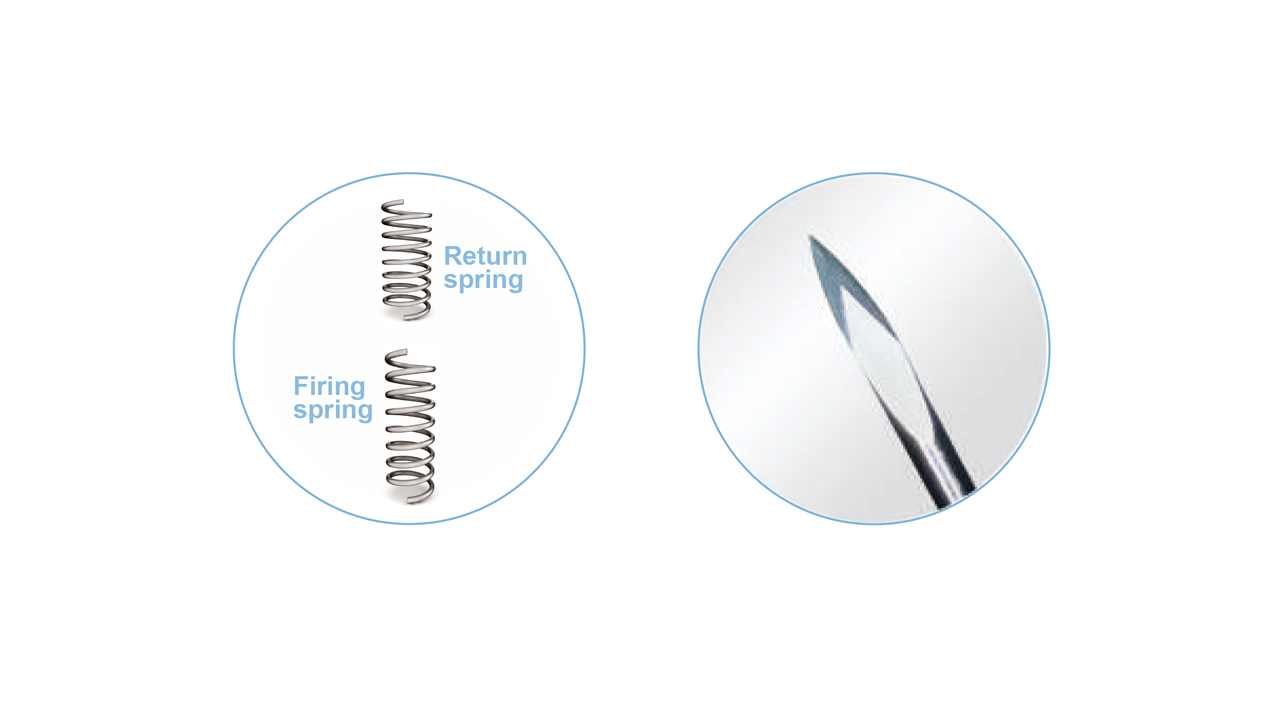
Existing LINKFAR PA2 illustration. The springs are shown separately to identify their functions; this is not a dimensioned assembly drawing or a comparison of spring forces.
What is a dual-spring safety lancet?
A dual-spring safety lancet uses separate springs for forward motion and needle retraction. The firing spring supplies the drive for the puncture; the return spring brings the needle back into the housing afterward. This separates the two functions within one disposable mechanism, but performance depends on the complete design, not spring count alone.
LINKFAR PA and PA2 are pressure-activated safety lancets with a firing spring and a return spring. Their documented operating sequence combines forward needle movement with automatic withdrawal into the housing after activation. The PA safety lancet and PA2 safety lancet product pages both identify this double-spring design.
Inside PA and PA2: one puncture cycle, two spring functions
Both springs belong to the same moving system. Describing them as separate does not mean that they operate independently of each other, the needle carrier or the housing.
The manufacturer's device description sets out the PA and PA2 mechanism as follows. This is an explanation of the internal design, not a substitute for the instructions for use:
- Pressure on the activation component compresses the firing spring as the mechanism moves toward its release position.
- At the release position, the needle carrier enters the firing channel and the firing spring drives it forward.
- During the forward movement, the return spring is compressed, storing energy for the return movement.
- After the puncture, the return spring moves the needle tip back into the housing; the used mechanism cannot be reset for another use.
The user initiates the action, but does not manually pull the needle out. Forward movement and withdrawal are part of the device's mechanical sequence.
Compression springs store energy when compressed and push back as they recover their length. Their behaviour depends on their design and working compression, not simply on how large they look. Lee Spring's explanation of compression springs provides the underlying engineering principle.
For PA and PA2, the product feature worth explaining is therefore the dedicated return function. Retraction is assigned to a specific component within the mechanism, rather than being left as an unexplained phrase on a feature list.
What does “consistent activation” actually mean?
“Stable firing” can sound persuasive without telling a buyer much. A clearer expression is consistent needle motion: the device releases predictably, the needle follows its intended path, reaches its specified maximum projection and then withdraws as intended.
These are different properties. A lancet can feel easy to activate without that observation proving anything about its penetration-depth variation or retraction time.
The following are useful evaluation criteria, not a claim that PA or PA2 has achieved a particular numerical advantage:
| Property to evaluate | What it means | Useful evidence to request |
|---|---|---|
| Activation consistency | The force and travel needed to release the mechanism stay within specified limits | Force-versus-travel results across multiple units and lots |
| Needle guidance | The needle carrier follows its intended direction without excessive lateral movement | Design review and suitable motion measurements |
| Maximum needle projection | The needle tip extends from the device by the specified amount | Projection measurements, tolerances and sampling method |
| Motion profile | Forward movement and withdrawal follow the intended sequence | Displacement-versus-time recording, where available |
| Retraction and disabling | The needle finishes inside the housing and the device cannot be used again | Functional checks on finished devices, including relevant conditioning |
Maximum needle projection is not identical to the depth reached in a person's skin. Contact pressure and tissue deformation are part of the clinical situation; a bench measurement cannot reproduce every patient or operator.
For a buyer, asking for the specification and test method is more informative than asking whether the spring is “powerful.” It also makes comparisons fairer: two suppliers may use the same word, such as “stable,” to describe entirely different observations.
Where the second spring helps the design discussion
In engineering terms, separate firing and return springs provide separate design variables for two different parts of the motion. The forward drive can be considered alongside the return force, rather than treating withdrawal as an incidental effect of the forward action.
This is a design rationale, not a measured comparison. The springs remain coupled through the moving components, so changing the return spring can also affect forward motion; guidance, friction and the release geometry still matter.
That distinction makes the PA and PA2 explanation more precise. The benefit being offered is a deliberately divided mechanism with a defined return function, not a claim that adding a second component solves every source of variation.
Does a return spring make a safety lancet less painful?
A return spring gives the mechanism a dedicated way to withdraw the needle. Whether a particular design retracts faster than another device, or causes less pain, needs comparative evidence from the finished products.
A 2019 study comparing three lancet types in 100 participants reported the lowest pain scores for devices with a spring mechanism that retracted the lancet soon after penetration. That supports interest in retraction as a design consideration, but the study does not establish that PA or PA2 is less painful than a named single-spring alternative. Dubey and colleagues, Transfusion Medicine.
Depth also deserves attention. In a study involving 90 people with diabetes and 360 lancing procedures, deeper settings produced more blood and more pain overall; device type also influenced pain. The products studied were other lancing systems, not a PA/PA2 comparison. Mianowska and colleagues, Journal of Diabetes Science and Technology.
These findings make “more spring force means less pain” an unreliable explanation. A meaningful comfort assessment has to consider the complete device and the selected puncture specification.
- Retraction is one part of the motion, not a complete measure of comfort.
- A deeper puncture may provide more blood but also affect discomfort.
- A pain claim needs patient-reported results under a defined comparison, not just an internal component photograph.
For PA and PA2, a defensible description is that the dual-spring mechanism is designed to control forward movement and automatic withdrawal. A claim of lower pain than another product should identify that product, the tested configurations and the study conditions.
Faster motion: what should a buyer ask to see?
“Fast” needs a definition. It could mean the time from activation to needle emergence, forward needle velocity, the interval outside the housing or the time until complete retraction. These measurements are not interchangeable.
An engineering study published in 2016 examined experimental high-speed lancing mechanisms using animal skin, a load cell and microscopic wound assessment. It shows how motion, puncture force and wound characteristics can be investigated, but those experiments are not human pain results for LINKFAR products. Chang and colleagues, National Taipei University of Technology research record.
Our recommendation for a technical comparison is to request a time-based record with the test conditions stated. A clear recording of needle position can answer questions that a video of the outside casing cannot.
Ask which event starts the measurement, which event ends it and whether the same method was used for both products. Also ask whether the result describes one selected unit, an average or the variation across a set of units.
A fast demonstration is useful for understanding the action. It is not, on its own, proof of consistent production performance or lower patient discomfort.
Why a larger or longer spring is not automatically better
The length of a spring is not a reliable way to rank safety lancets. For a conventional helical compression spring, wire thickness, coil diameter, active coil count and material all influence stiffness; the force also depends on how far it is compressed.
For example, increasing the number of active coils while holding the other relevant properties constant reduces spring stiffness. Increasing wire thickness has a different effect. The compression spring rate explanation from Acxess Spring sets out these relationships and the distinction between force and stiffness.
This is why “a longer spring must fire harder” is not a sound product claim. Nor does a smaller housing tell a buyer, without testing, that the device has inadequate drive or weak retraction.
The more useful questions are:
- Is the available travel sufficient for the intended mechanism?
- Are the forward and return actions matched to the needle carrier and its guidance?
- Does the assembled device meet its specification across normal manufacturing variation?
- Does it continue to meet the relevant requirements after storage and transport conditions have been evaluated?
Compact design can be worthwhile. The concern is cost reduction without adequate verification of the changed device, whether that change involves the spring, the housing, the material or the assembly process.
The same standard applies to a larger dual-spring product. More space and more components do not excuse poor tolerances or incomplete testing.
What PA and PA2 bring to a product evaluation
PA and PA2 give distributors a concrete mechanical feature to discuss with clinical and procurement teams. There is a visible distinction between the firing and return components, supported by an operating description, rather than a general promise about comfort.
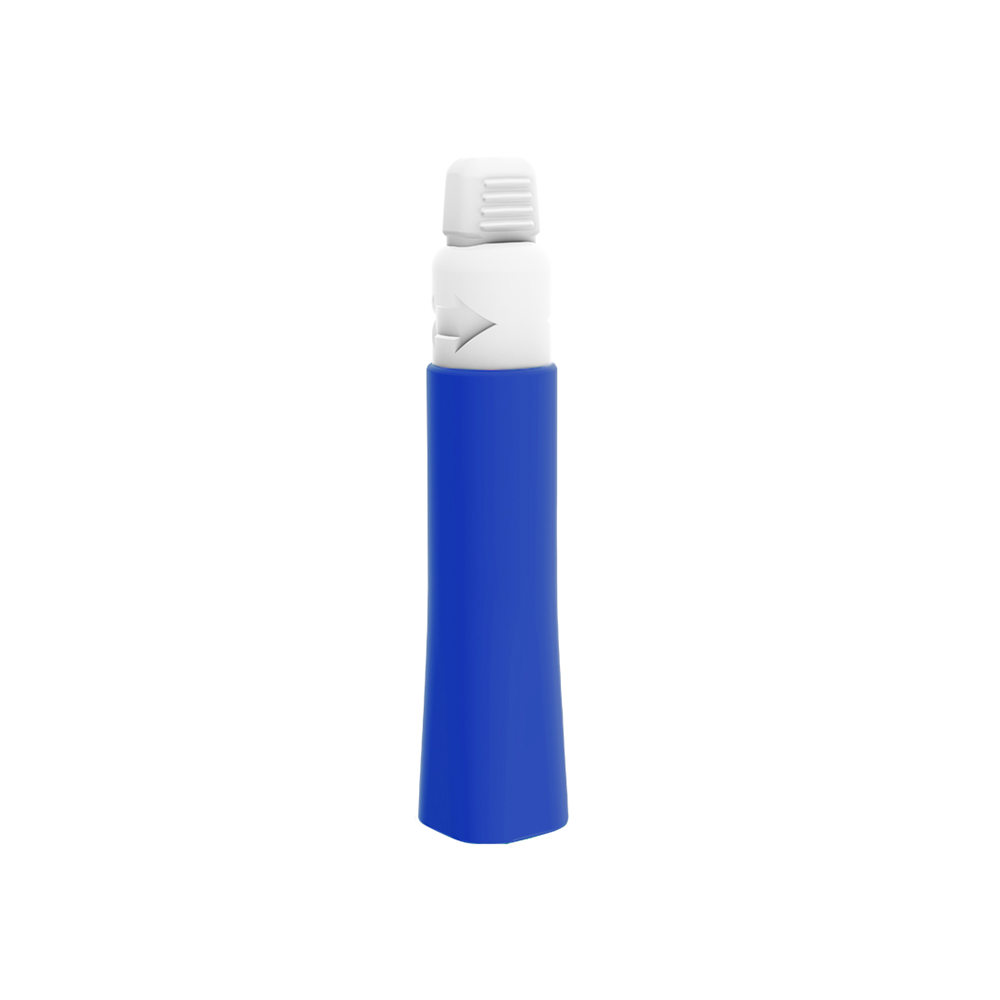
PA safety lancet, shown using an existing LINKFAR product image. Colour is illustrative; confirm the ordered configuration separately.
The two spring functions support a product conversation around controlled motion and automatic needle withdrawal. Buyers can connect that explanation to the evidence they need: activation behaviour, projection tolerances, retraction checks and, where a comfort comparison is proposed, an appropriate clinical assessment.
PA and PA2 should still be evaluated as their own product configurations. Sharing a mechanical principle does not make every specification, cap design, user interaction or market label interchangeable.

PA2 safety lancet, shown using an existing LINKFAR product image. The separate PA and PA2 photographs are not a scale comparison.
For an initial evaluation, identify the test, intended users and sample requirement before choosing a configuration. Then compare the relevant product documentation and handling, rather than selecting a model because its casing appears smaller or its needle is described as finer.
A useful evaluation request should specify:
- The PA or PA2 configuration being considered.
- The testing application and required sample volume.
- The people who will operate the device.
- The destination market and documentation needed.
- The criteria by which the buyer will accept or reject the sample.
This turns “send us your best lancet” into an assessment that both parties can interpret. It also avoids treating a sample chosen for one application as proof of suitability for every fingerstick test.
Safety after the puncture is a separate requirement
Comfort and safe handling should be assessed separately. Even if a device produces acceptable blood volume and a good user experience, the used needle still needs to be contained and the device disposed of correctly.
For assisted blood glucose monitoring, the CDC recommends single-use, auto-disabling fingerstick devices and selecting lancets that permanently retract after puncture. It also calls for disposal at the point of use in an approved sharps container. This guidance concerns safety functions and practice; it does not endorse a particular spring count or brand. CDC blood glucose monitoring guidance.
In a PA or PA2 evaluation, the return movement and the used device's disabled state belong in the assessment alongside the puncture itself. Neither a smooth activation nor a low price substitutes for those checks.
Product training should follow the instructions supplied for the actual configuration and destination market. This article explains the mechanism and purchasing questions, rather than providing a clinical sampling protocol.
Compare the cost of a usable sample, not only the cost of a lancet
Price matters to a distributor. A product that does not fit the customer's budget will not reach the sampling station, however interesting its mechanism may be.
But a quotation only gives the purchase cost. A useful procurement review also considers what happens when a collection attempt does not provide the required usable sample: another device may be needed, staff time may increase and the patient may face another puncture.
These are costs to measure in the buyer's own workflow, not savings that can be attributed to PA or PA2 without data. A low-cost product that performs well may be good value; a higher-priced product needs a reason for its premium.
For a practical review, keep the following records separately:
| Purchasing record | What to capture | Why it helps |
|---|---|---|
| Device identity | Model, configuration and lot | Prevents unlike products from being treated as the same test |
| Purchase cost | Comparable supply terms and usable quantities | Makes the unit-price comparison meaningful |
| Sample outcome | Whether the required usable sample was obtained | Connects the device assessment to the test workflow |
| Repeat collection | Reason for any additional attempt | Separates device, technique and application issues |
| User feedback | Handling observations and appropriately collected discomfort feedback | Adds information not visible in a quotation |
| Documentation | Instructions, specifications and relevant supporting records | Helps explain and investigate the results |
The objective is not to make the most expensive lancet win. It is to avoid choosing a device on a number that leaves out the work it has to do.
For distributors and private-label teams
A distributor needs an explanation that sales staff can use without exaggerating. “Separate springs for forward drive and needle return” describes an identifiable feature; “less painful than all cheaper lancets” is a different claim and needs different evidence.
For a private-label project, put the agreed configuration and evaluation requirements into the approval record. Do not assume that an image, colour or generic description will be enough to identify the product after packaging changes.
For POCT and clinical procurement teams
Begin with the sample the test requires, then assess whether the selected lancet configuration and collection process fit that requirement. More blood is not automatically a better outcome if the test does not need it, and the smallest puncture is not useful if it repeatedly fails to provide the required sample.
A sensible comparison uses the same acceptance criteria for every candidate. Record the selected configuration, collection conditions and any reasons for repeat attempts so that a difference in workflow is not mistakenly attributed to spring design.
For teams reviewing a lower-cost redesign
Ask what changed. A smaller housing, different spring or revised assembly method should trigger a review of the affected performance requirements, not an assumption that the product must be better or worse.
Our position is that cost reduction should preserve the functions the customer is buying. In PA and PA2, the dual-spring structure is part of that discussion because it makes forward drive and needle return explicit design responsibilities.
Questions buyers ask about dual-spring safety lancets
Does PA2 have a better spring mechanism than PA?
The documented operating principle uses a firing spring and a return spring in both PA and PA2. The PA2 name alone is not evidence of faster motion, lower pain or tighter tolerances than PA. Compare the specific configurations and their supporting evidence rather than treating the model number as a performance ranking.
Can a dual-spring lancet be activated a second time?
PA and PA2 are single-use safety lancets whose mechanism is disabled after use. The presence of a return spring does not mean that the device is rechargeable or reusable. Follow the supplied instructions and dispose of the used device appropriately.
Can I choose a PA or PA2 specification by colour alone?
Do not rely on a photograph or housing colour to identify an ordered configuration. Check the product reference, puncture specification and supplied labelling together, especially when comparing samples with private-label artwork. Confirm the configuration for the intended application and market.
What would substantiate a claim that PA or PA2 is less painful?
A meaningful claim needs a defined comparator, comparable puncture configurations and a suitable human assessment of pain. Mechanical measurements can explain needle motion, but cannot replace patient-reported outcomes. Evidence from another brand or an experimental mechanism should not be presented as a PA or PA2 result.
Evaluate PA and PA2 on the complete puncture cycle
The reason to examine a dual-spring safety lancet is not that two must be better than one. It is that forward drive and needle return have different jobs, and PA and PA2 assign those jobs to separate springs within a defined mechanism.
That is a useful feature for a buyer to investigate alongside needle specification, handling and finished-device performance. It also provides a more substantial basis for a product discussion than continually reducing the price without asking what the change means for sampling.
Contact LINKFAR to arrange a PA and PA2 sample evaluation. Tell us your testing application, required sample volume and destination market so that the discussion starts with the configuration and evidence you actually need.
Related articles
-
 LINKFAR upper-arm blood collection enters clinical-stage development
For a patient who needs a small blood sample, the collection appointment can involve more effort than the test itself. Travel, waiting and arranging…
-
 Blood Sample Collection Methods: Venous, Capillary and Arterial Blood Collection Explained
Compare venous, capillary and arterial blood collection routes, specimen types, devices and handling considerations for reliable blood sampling.
-
 Skin Barrier Wipe for European Distributors and Importers
Skin Barrier Wipe can help European distributors evaluate a skin-friendly wipe for CGM accessories, dressings, and adhesive support applications. This guide helps small B2B…
-
 Blood Sampling Lancet for European Distributors: LINKFAR NPA Safety Lancet
For distributors, dealers and importers in Europe, the LINKFAR NPA Blood Sampling Lancet offers multiple gauge and depth options for channel planning. This guide…