
English · Deutsch · Français · Italiano · Español · Română · Nederlands · Dansk · Svenska · Polski · Čeština · Slovenčina · Slovenščina · Hrvatski · Српски · Български · Русский · Українська · Lietuvių · Latviešu · Eesti · Suomi · Magyar · Türkçe
“70% alcohol, individually packed.” For a component that occupies one line in a test-kit component list, that description can seem sufficient.
It is not enough to approve the purchase. A distributor may need a skin-cleansing wipe, a clinical customer may specify a skin antiseptic, and another buyer may be asking for a medical-device disinfectant. Similar sachets can have very different purposes, documents and supply requirements.
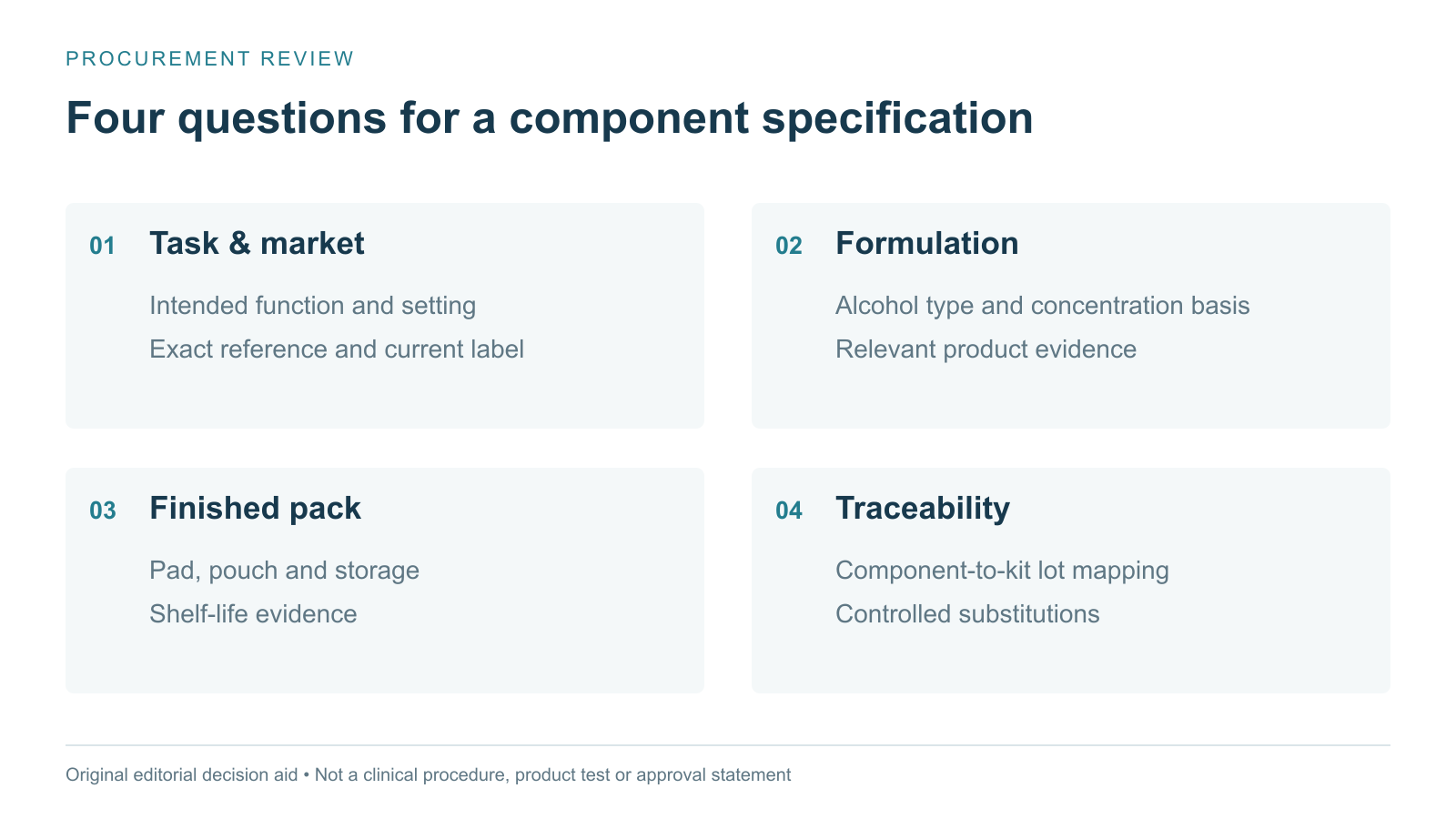
Alcohol prep pad quality starts with a match: the exact product must suit the intended procedure and destination market. Concentration matters, but so do the declared function, pad construction, pouch integrity, shelf life and traceable product reference. Each element must match the intended use.

First separate cleaning and skin antisepsis
These terms answer different questions.
- Cleaning concerns the removal of unwanted material. A physical skin-cleansing purpose is not automatically a validated antiseptic claim.
- Skin antisepsis concerns reducing microorganisms on living skin. It needs the appropriate product claims, evidence and regulatory route.
For buyers, the useful question is specific: What does this reference claim to do, and what evidence covers it? A document supporting disinfection of a medical device does not, by itself, support use on a patient’s skin.
Alcohol prep pad regulations: why the market changes the brief
There is no single worldwide category called “the alcohol wipe.” The following examples explain why the destination market belongs in the first enquiry, not in the paperwork discussion after an order.
United States: a skin-antiseptic drug is not simply a CE-marked consumable
FDA treats topical antiseptic products within its drug framework. For an alcohol prep pad marketed as a skin antiseptic, buyers should review the applicable drug pathway and exact claims rather than assume that medical-device documents from another market are sufficient.
FDA’s OTC drug import requirements cover establishment registration and drug listing, lawful marketing under the applicable pathway, labelling and CGMP requirements. Registration or an NDC listing is not FDA product approval.
China: a defined Class II product scope
China’s CMDE registration-review guidance for disinfectant pads, swabs and cotton balls, issued in 2022, addresses Class II products under classification code 14-16-10. Its described purpose includes intact-skin disinfection before injection or infusion.
That is a defined product scope. It is not a rule for every wipe containing alcohol, it does not replace a product-specific assessment. For procurement, check the exact reference, current registration documentation, intended use, technical requirements, label and supplied state together.
A historical certificate or a certificate for a different size or formulation is not a substitute for a current, product-specific file.
European Union: intended use comes before classification
In the EU, “Class I,” “cosmetic” and “disinfectant” are not interchangeable options that a supplier can choose for the same claim. Qualification depends on the product’s purpose, composition, principal action and applicable rules; borderline questions can also require destination-market review.
Ireland’s HPRA provides a useful example. Its guidance on defining a human medicine, section 6.8, explains that some pure-alcohol pre-injection swabs for unbroken skin are regulated as devices on the basis of physical action. It also acknowledges differences between Member States. This supports a product-specific assessment—not a conclusion that all EU alcohol pads are Class I.
Some products with an appropriate physical-cleansing purpose may follow a medical-device route; Class I is possible only where qualification and the applicable classification rules support it. A primarily cosmetic skin-cleansing purpose is different again. The EU’s Cosmetic Products Notification Portal is a notification system, not approval of skin-antiseptic efficacy. Commission guidance on hand cleaners and disinfectants illustrates the boundary between cleansing and a primary biocidal purpose; it is not a classification decision for all pre-injection swabs. Medicinal-product rules may also matter.
The practical rule is simple: approve the intended use and supporting documents for the actual product, not a category name alone.
Does every blood collection or injection procedure need an alcohol pad?
No single answer covers every setting. Cleaning and antisepsis should not be collapsed into one requirement, but neither should an alcohol-free instruction from one procedure be applied to all others.
WHO’s 2010 capillary blood-sampling chapter includes alcohol skin preparation and drying in its adult sampling instructions. It would therefore be wrong to attribute “fingerstick sampling only needs cleaning, never antisepsis” to WHO.
Other defined settings use different instructions. WHO’s 2010 injection toolkit, Table 2.3, distinguishes injection types and lists soap-and-water preparation without alcohol for several categories, including subcutaneous injections and immunisation. It also flags unresolved evidence for therapeutic intramuscular injections. These are context-specific recommendations, not permission to disregard a current local protocol.
| Setting in the cited source | What the source says | What it means for a kit buyer |
|---|---|---|
| Adult capillary sampling in WHO’s phlebotomy guidance | Alcohol preparation and drying are included | Do not remove an indicated antiseptic step on the assumption that all fingersticks require cleaning only |
| Selected injection categories in WHO’s injection toolkit | Preparation differs by injection type | Agree the exact intended procedure with the clinical customer before choosing a component |
| Blood glucose meter use in FDA consumer guidance | Wash and dry hands before testing; follow the meter instructions | A home glucose-testing workflow cannot be specified from a generic clinical kit list alone |
| England’s newborn blood spot screening programme | Plain-water heel cleaning; no alcohol wipes | A familiar alcohol sachet may be the wrong component for a defined collection programme |
The last two examples come from FDA’s blood glucose monitoring guidance and England’s newborn blood spot sampling guide. The newborn example applies to that programme; it is not a worldwide rule for every neonatal procedure.
For professional users, the decision belongs with the current device instructions, product directions and applicable clinical or infection-prevention protocol. A component supplier should help identify a mismatch, not replace the clinical customer’s procedure with a general Blog recommendation.
What a useful alcohol pad specification should contain
Once the purpose and market are settled, concentration and packaging can be evaluated in context.
Start with the alcohol type and concentration basis. “70%” without identifying the ingredient and whether the figure is by volume or another basis is an incomplete specification. Higher concentration is not a substitute for evidence supporting the finished product and its labelled use.
Then examine the pad and pouch as a system. A buyer needs to know the unfolded pad dimensions, substrate, liquid loading, seal specification and how the unopened pack performs through the claimed shelf life. A bulk-liquid result does not automatically establish the condition of the pad after packaging, storage and transport.
Ask for a usable file—not just a certificate
A certificate of analysis can report results for a batch. It is most useful when the buyer can connect those results to an agreed specification, acceptance limits and test methods. A page saying only “pass” leaves too much unexplained.
The same applies to other documents. A safety data sheet addresses chemical-safety information; it is not, by itself, evidence of the product’s authorised intended use. A company certificate does not automatically cover each formulation, pack size or market claim.
| Review item | What the buyer should establish |
|---|---|
| Exact identity | Product reference, formulation, pad size and pack configuration match across the sample, label and documents |
| Intended function | Skin cleansing, skin antisepsis or device disinfection is stated clearly and consistently |
| Destination market | Current documents support the applicable route and the roles of the parties supplying the product |
| Quality specification | Defined characteristics, acceptance limits and methods—not only a generic “complies” statement |
| Shelf life and packaging | Evidence relates to the finished pad and pouch, with appropriate storage conditions |
| Traceability and changes | Component lots can be connected to kit lots; relevant formulation, material, site or label changes are reviewed before substitution |
For a test-kit programme, this file also needs to fit the kit’s instructions. Adding a familiar component does not make the overall workflow correct, and changing the wipe supplier is not necessarily an administrative change only.
How LINKFAR supports alcohol-pad and test-kit projects
Our view is that an alcohol pad should be specified as carefully as the other components in the kit. The customer’s market and procedure deserve a precise answer.
For alcohol-pad and test-kit projects, we start with the destination country, intended function, required product characteristics and exact reference. The next discussion is about the formulation, pad and pouch specification, artwork, supporting documents and lot traceability. That gives the customer a clear basis for deciding what can be supplied and what still needs verification.
It is a more useful conversation than offering one universal sachet for every country. It also avoids treating cleaning and disinfection claims as interchangeable or extending one product’s documentation to an entire range.
If you are developing a collection kit, explore our capillary blood collection consumables and our discussion of private-label medical-device projects. The component brief should connect to the complete procedure and to the responsibilities of the parties placing it on the market.
Planning an alcohol-pad or test-kit project? Contact Linkfar with your destination market, intended use, preferred pad and pack format, documentation needs. We can review the brief with you and identify the product-specific evidence required before the project moves forward.
Professional procurement information, reviewed 25 October 2026. This article is not a clinical procedure guide or a product-specific regulatory classification or authorisation. Current local requirements and the exact product’s instructions govern supply and use.
Frequently asked questions
Can a device-disinfection wipe be used to prepare a patient’s skin?
Device-disinfection documents alone do not support skin use. The intended site of use, label, evidence and applicable route must support the proposed purpose. The same alcohol concentration does not make the uses interchangeable.
Is cosmetic notification approval as a skin antiseptic?
No. Cosmetic notification and a skin-antiseptic claim answer different questions. Check the product’s purpose and applicable route rather than treating notification as evidence of antiseptic efficacy.
Should every fingerstick test kit contain an alcohol pad?
Not automatically. The cited WHO adult clinical capillary guidance includes alcohol preparation, while other defined testing and screening instructions differ. Confirm the exact workflow and current local instructions before finalising kit contents.
Related guides
-
 Newborn blood spot quality: collection is not finished when blood appears
Evaluate heel-collection devices as part of the pathway to an acceptable newborn screening specimen, rather than judging blood yield alone.
-
 Insulin pen needle sizes: why finer is not the full specification
Gauge is only one part of a pen needle specification. A practical guide to length, inner diameter, delivery evidence and exact pen compatibility for…
-
 Safety lancet cost: unit price or usable sample cost?
A quotation makes safety lancet cost easy to compare: the price is written beside the quantity. The cost of obtaining a usable sample is…
-
 Safety lancet selection: why gauge alone is not enough
Start with the assay and specimen, then discuss gauge, depth and approximate yield. Includes clearly labelled experience ranges and PA product photography.