
A request for the finest insulin pen needle sounds specific. For a supplier, it still leaves several questions unanswered. How long should the patient-end needle be? What is the bore? Which pen models will it connect to? Which configuration is documented for the intended market?
These are separate parts of a purchasing specification. A higher gauge number describes a finer outside diameter; it does not, by itself, tell a buyer the flow performance, clinical suitability or compatibility of the finished product.
For distributors building an insulin-care range, the useful question is not simply, “How fine can we go?” It is, “Can we explain and verify the configuration we are offering?”

What do insulin pen needle sizes actually describe?
Read gauge and length together, then look beyond the two-number label.
| Specification | What it describes | What it does not establish alone |
|---|---|---|
| Gauge, shown as G | Nominal outside diameter of the needle tube | Inner diameter, injection force or comfort |
| Patient-end length, in mm | The specified needle length on the skin-facing side | The appropriate choice for an individual patient |
| Inner diameter and wall specification | The fluid passage and surrounding tube wall | Finished-system delivery performance |
| Attachment and compatibility | The documented pairing of a needle configuration with a pen | Suitability for every pen from the same brand |
| Product reference and instructions | The exact product being supplied and its conditions of use | Approval for every country or every application |
The technical gauge chart distinguishes outside diameter, inside diameter and wall thickness. Its laboratory-needle dimensions should not be copied into a medical pen needle specification.
Gauge and needle length answer different questions
Gauge runs in the opposite direction to everyday expectations: a higher G number means a smaller outside diameter. Length is a separate measurement. A change in gauge does not automatically mean a change in length, and a short needle is not necessarily the finest one.
This matters commercially. If an enquiry asks for a “smaller needle,” establish whether the customer means a finer tube, a shorter patient-end needle, a different hub or a smaller package. Treating those requests as interchangeable can produce the wrong sample before anyone has evaluated it.
Length also has a clinical context. In a randomized crossover trial, a particular 4 mm × 32G pen needle met the study’s glycaemic-equivalence criteria against tested 5 mm and 8 mm × 31G products. The study involved adults in the United States and short treatment periods. It supports evaluating shorter configurations through clinical evidence, not assuming that a longer needle is automatically more effective. It does not establish that every product with the same label performs identically. Hirsch et al., 2010
A distributor should therefore keep clinical selection separate from range planning. The product catalogue can explain the available configurations; an individual’s choice belongs with the relevant healthcare professional and product instructions. This article is a procurement guide, not an injection tutorial.
Inner diameter: the part the gauge label leaves out
A needle is a tube. The outside diameter describes its external size, while the inner diameter describes the passage through it. Wall thickness connects the two.
At a comparable outside diameter, a thinner wall can allow a larger bore. That is why “fine needle” and “small internal passage” are not interchangeable descriptions. Equally, a thin-wall label without the actual specification and supporting evaluation gives a buyer little basis for comparison.
There is product-specific research behind this distinction. Aronson and colleagues compared extra-thin-wall pen needles with usual needles of the same or similar size. Their work combined bench testing with three named pen platforms and a short, open-label crossover study. The tested extra-thin-wall products showed improvements in measured delivery characteristics and user ratings. These were results for the products and systems studied, not proof that any thin-wall needle will deliver the same benefit. Aronson et al., 2013
For a purchasing discussion, ask for the wall designation and bore information associated with the exact reference. If the proposed advantage is easier delivery, ask how it was measured and which pen was used. A gauge number cannot answer that question.
Flow, injection force and dose accuracy are not the same claim
Faster flow can sound like a straightforward advantage. It still needs a defined test: the fluid, test pressure or pen, delivered volume and measurement method all belong in the comparison.
The public introduction to ISO 11608-2:2022 explains that inner diameter can influence delivery time but is not a direct measure of dosage precision. It distinguishes flow from dose accuracy and addresses the needle as part of an injection system. A flow result should not be relabelled as proof of more accurate dosing. ISO 11608-2:2022, public preview
Keep the claim and evidence aligned. “Lower measured operating force on this pen under these conditions” is a testable proposition. “Higher gauge means better insulin delivery” skips both the bore specification and the system evaluation.
Pen compatibility requires more than a thread that fits
Attaching a sample to a pen is not the same as establishing its functional compatibility. ISO’s public preview describes why the old Type A interchangeability designation was removed and identifies testing for specific pen-and-needle pairings, including dose delivery and hub removal force. Referencing the standard does not itself show that a supplier’s product has passed those tests. ISO public preview
The embecta Australia and New Zealand website gives an example of documented compatibility: named pen models, a versioned supporting document and the pen instructions. Its list applies only to the embecta products identified there; it is not evidence of compatibility for LINKFAR products.
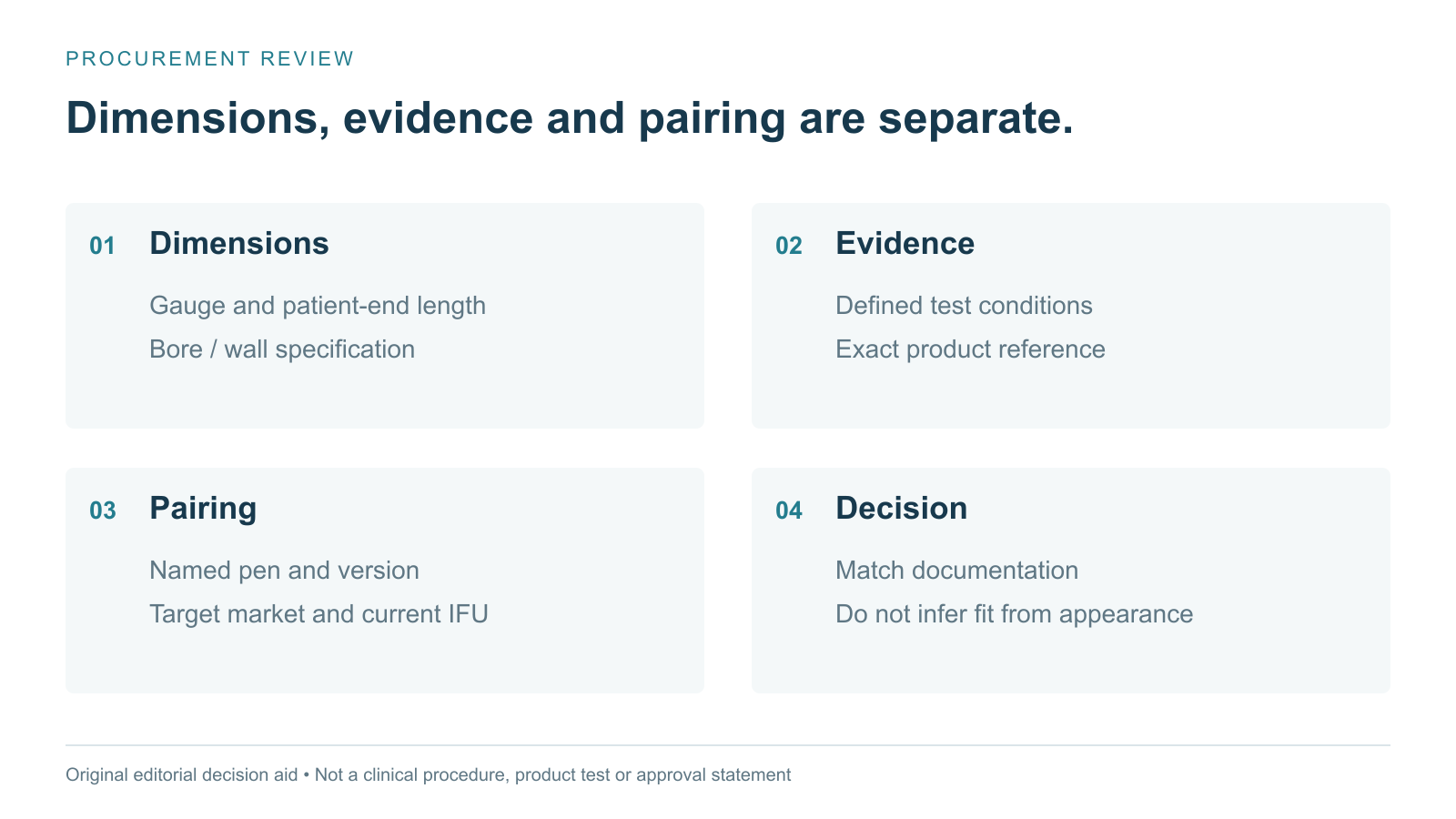
For a distributor, “compatible with Brand X” is therefore too vague. Record the pen model and version, the needle reference, the intended market and the supporting document revision. Keep the pen’s instructions alongside the needle’s instructions when assessing the pairing.
A better brief for an insulin pen needle supplier
Include these fields in the enquiry:
- The exact product reference. Samples, specifications, labels and reports should identify the same configuration.
- Gauge and patient-end length. State both dimensions rather than asking only for “fine” or “short.”
- Bore or wall requirement. If delivery performance matters, request the relevant specification and test conditions.
- Named pen models. Include versions and the supporting compatibility evidence required for the project.
- Target market and documentation. Align intended purpose, current instructions and applicable market documentation.
- Pack and supply requirements. Specify unit presentation, language needs, traceability and the agreed configuration before artwork is finalized.
Compare documented configurations carefully. Similar descriptions can conceal differences in needle length, wall construction or the specific pen-and-needle pairing.
Keep the single-use boundary visible in customer-facing information. ISO 11608-2 covers single-use double-ended pen needles. Neither a fine tip nor a favourable bench demonstration changes a product’s instructions or establishes safe reuse. ISO scope
Where LINKFAR fits into the selection process
LINKFAR’s disposable insulin pen needle product page lists multiple gauge-and-length combinations within the insulin care supplies range. That provides a starting point for a portfolio discussion, not a substitute for matching the selected reference to its current specification, instructions and market documentation.
There are other design questions after size selection. Our separate article on flat-base insulin pen needle design discusses the contact face, tip geometry and evaluation of those features. Those considerations complement gauge, length and bore; they do not replace them.
For a distribution or private-label project, bring the intended pen models and target market into the conversation early. A clearly defined configuration is more useful than a promise to offer the finest needle on the shelf.
Contact LINKFAR with your proposed gauge and length, pen models, market and documentation requirements so the discussion can focus on the exact product you need.
Frequently asked questions
Does a higher gauge number establish better flow?
No. Gauge describes outside diameter. Inner diameter, wall thickness and the evaluated pen-and-needle combination need separate evidence; flow is not a direct measure of dose accuracy.
Does a matching thread establish pen compatibility?
No. Check the exact pen model and version, needle reference, current instructions and supporting compatibility documentation. Mechanical attachment alone is insufficient.
Related guides
-
 Alcohol prep pad quality: match the product to the procedure and market
Match an alcohol prep pad to its procedure and market, then review formulation, pad and pouch quality, shelf life and traceable documentation.
-
 Newborn blood spot quality: collection is not finished when blood appears
Evaluate heel-collection devices as part of the pathway to an acceptable newborn screening specimen, rather than judging blood yield alone.
-
 Safety lancet cost: unit price or usable sample cost?
A quotation makes safety lancet cost easy to compare: the price is written beside the quantity. The cost of obtaining a usable sample is…
-
 Safety lancet selection: why gauge alone is not enough
Start with the assay and specimen, then discuss gauge, depth and approximate yield. Includes clearly labelled experience ranges and PA product photography.