
For a newborn screening programme, a successful heel collection must produce a specimen the receiving laboratory can use. Seeing blood is only the beginning. The collection card, its identification, the way the sample is handled and the journey to the laboratory all matter.
Newborn blood spot quality is a whole-process question, not a claim that can be established by a lancet’s blood yield alone. A suitable heel-incision device supports collection, but it cannot compensate for an unsuitable card, missing information or damage after collection.
For distributors and procurement teams, that changes the buying question. Rather than asking only how much blood a device can produce, ask how it fits the programme’s requirements for an acceptable specimen.
What makes a newborn blood spot specimen acceptable?
The receiving screening laboratory defines the applicable acceptance criteria. They cover more than the apparent size of the blood spot: correct identification, an appropriate collection card, the condition of the specimen and the required information must also be considered.
Michigan’s newborn screening programme describes unsatisfactory specimens as a cause of repeat collection, additional work and screening delay. Its rejection examples include insufficient, layered, contaminated and damaged samples, as well as identification problems. These are different failure routes, and buying a different lancet will not necessarily solve all of them. See the programme’s guide to avoiding unsatisfactory newborn screening specimens.
The useful endpoint for a procurement evaluation is therefore not simply “blood was obtained.” It is a documented collection outcome, followed by the receiving laboratory’s actual assessment. Keep those two records separate so that a problem can be traced to the right part of the process.
A blood spot is a laboratory specimen, not just a red circle
Drying blood on a card does not make every visible spot equivalent. Distribution through the paper and the condition in which the laboratory receives it are relevant to whether it can be processed.
Alder Hey’s specimen collection guide illustrates several distinct quality problems, including small, multi-spotted, compressed and wet specimens. It is a useful training reference, not a substitute for the instructions of another screening programme. Nor should an attractive photograph in a product brochure be treated as evidence that a finished collection system consistently produces acceptable cards.
In a purchasing discussion, ask the supplier which part of that system it actually controls. A device supplier can provide device information. A card supplier can provide information about the collection material. The receiving programme establishes its own sample requirements. Useful support connects these responsibilities rather than blurring them.
Where the heel-incision device contributes—and where it does not
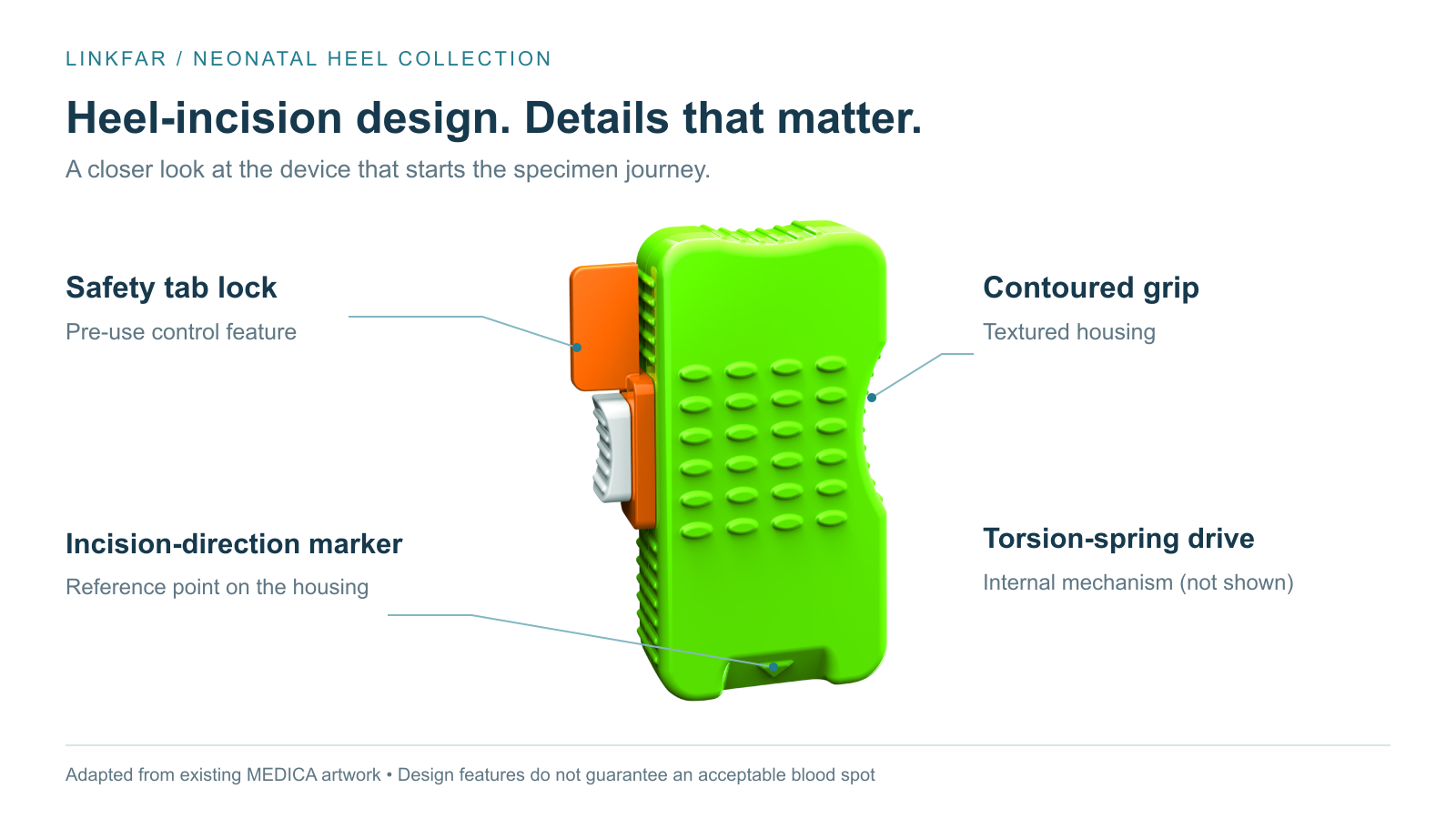
A neonatal heel-incision device creates a controlled incision according to its design. Device selection must still follow the current instructions, the infant population and the local professional protocol. It is not a matter of selecting the largest incision available.
England’s newborn blood spot sampling quick-reference guide specifies an age-appropriate automated incision device. It also addresses specimen handling and drying. That combination is important: the device is one part of a defined collection process, not the entire quality system. Requirements elsewhere must be checked locally.
Our earlier article explains why neonatal heel-incision devices differ from straight-puncture lancets. This article addresses the next question: after collection, what makes the resulting specimen useful to the laboratory?
There is no LINKFAR rejection-rate comparison or guaranteed first-attempt yield presented here. A claim that one device reduces repeat collections needs an appropriate evaluation, not an inference from blade geometry.

Build the purchasing brief around the complete specimen pathway
A short, shared brief is more useful than collecting unrelated certificates from each supplier. It should identify the programme, the components and the outcome being evaluated.
| Review area | A useful purchasing question | Evidence to request or record |
|---|---|---|
| Screening programme | Which laboratory will receive the specimen? | Current programme instructions and acceptance criteria |
| Heel-incision device | Does this exact reference suit the intended professional workflow? | Current device instructions and reference identification |
| Collection card | Is this the card required by the programme? | Card specification, identification and storage information |
| Handling and transport | Who controls the specimen after collection? | Responsibilities, instructions and handover arrangements |
| Outcome review | Why was a repeat requested? | Laboratory reason, collection record and relevant component lots |
This is a procurement framework, not an additional clinical protocol. The staff collecting the sample should follow their approved training and the applicable programme instructions.
It also helps define a meaningful device evaluation. If cards, operators, transport conditions or acceptance rules change between groups, a difference in repeat collections cannot automatically be attributed to the lancet. Record those differences before drawing a product conclusion.
Not every repeat collection means poor collection
Avoid combining all repeat requests into a single “device failure” figure. A repeat may arise from an unsatisfactory specimen, a programme requirement or a screening result that needs further investigation.
The US HRSA explanation of screening results and follow-up distinguishes screening results from diagnosis and describes situations requiring further testing. An out-of-range result must not be dismissed as a collection problem. Equally, a repeat requested because of a damaged card should not be presented as evidence that a lancet malfunctioned.
For a local review, separate device activation problems, laboratory-reported specimen problems, identification or transport problems, and follow-up for clinical or programme reasons. Use the laboratory’s terminology where possible. If the cause is uncertain, preserve that uncertainty rather than assigning it to a component without supporting evidence.
Laboratory quality assurance answers another question
Specimen acceptance and laboratory testing quality belong in the same system, but they are not interchangeable evidence.
The CDC Newborn Screening Quality Assurance Program supports laboratories with dried blood spot materials, training and technical assistance. Those resources address laboratory performance. They do not establish the clinical performance of a particular heel lancet, and a supplier should not imply that participation in a laboratory quality programme validates its device.
For buyers, the practical distinction is straightforward: ask for the evidence that answers the question in front of you. Device documentation, collection acceptance records and laboratory quality assurance each have a role. None replaces the other two.
Where LINKFAR fits
LINKFAR offers a heel blade safety lancet product family for professional capillary collection. For a screening project, the discussion should start with the exact product reference, current instructions, infant population, receiving programme and collection-card requirements—not a promise that one incision always produces an acceptable specimen.
We can use that brief to discuss the relevant product information and the scope of an evaluation. Any model-specific dimensions, market documents or comparative performance statements should be checked against the current controlled documentation before being used in a tender or a publication.
If you are sourcing neonatal collection consumables, contact LINKFAR with your screening workflow. The objective is a collection system that supports an acceptable specimen, with clear responsibilities from the device to the laboratory handover.
For professional procurement education. This article does not replace screening-programme instructions, clinical training or the current device instructions for use.
Frequently asked questions
Does obtaining enough blood establish specimen quality?
No. The receiving laboratory also considers identification, the required collection card, specimen condition and programme information. Blood yield alone does not establish that a specimen is acceptable.
Does every repeat collection indicate a device problem?
No. A repeat may concern specimen quality, identification, transport, programme requirements or further clinical investigation. Record the laboratory reason separately from device performance.
Related guides
-
 Alcohol prep pad quality: match the product to the procedure and market
Match an alcohol prep pad to its procedure and market, then review formulation, pad and pouch quality, shelf life and traceable documentation.
-
 Insulin pen needle sizes: why finer is not the full specification
Gauge is only one part of a pen needle specification. A practical guide to length, inner diameter, delivery evidence and exact pen compatibility for…
-
 Safety lancet cost: unit price or usable sample cost?
A quotation makes safety lancet cost easy to compare: the price is written beside the quantity. The cost of obtaining a usable sample is…
-
 Safety lancet selection: why gauge alone is not enough
Start with the assay and specimen, then discuss gauge, depth and approximate yield. Includes clearly labelled experience ranges and PA product photography.