
A quotation makes safety lancet cost easy to compare: the price is written beside the quantity. The cost of obtaining a usable sample is less visible. It sits across collection records, staff activity, stock management and waste disposal.
That does not mean the more expensive lancet is the better purchase. A price premium needs evidence. It means that two quotations are only part of the comparison when a clinic, laboratory or distributor is evaluating a change.
What should safety lancet cost be compared against?
Compare the purchase price alongside the attributable cost of obtaining a specimen that meets the requirements of a defined test and collection workflow. Keep safety and suitability as minimum requirements. Then use local, comparable records to understand resource use. A lower unit price is a saving only to the extent that other relevant costs do not cancel it out; a higher price does not establish a better outcome.
WHO's procurement resource guide considers appropriate goods, price and quality together. The framework below is our suggested purchasing worksheet, not a WHO costing method.
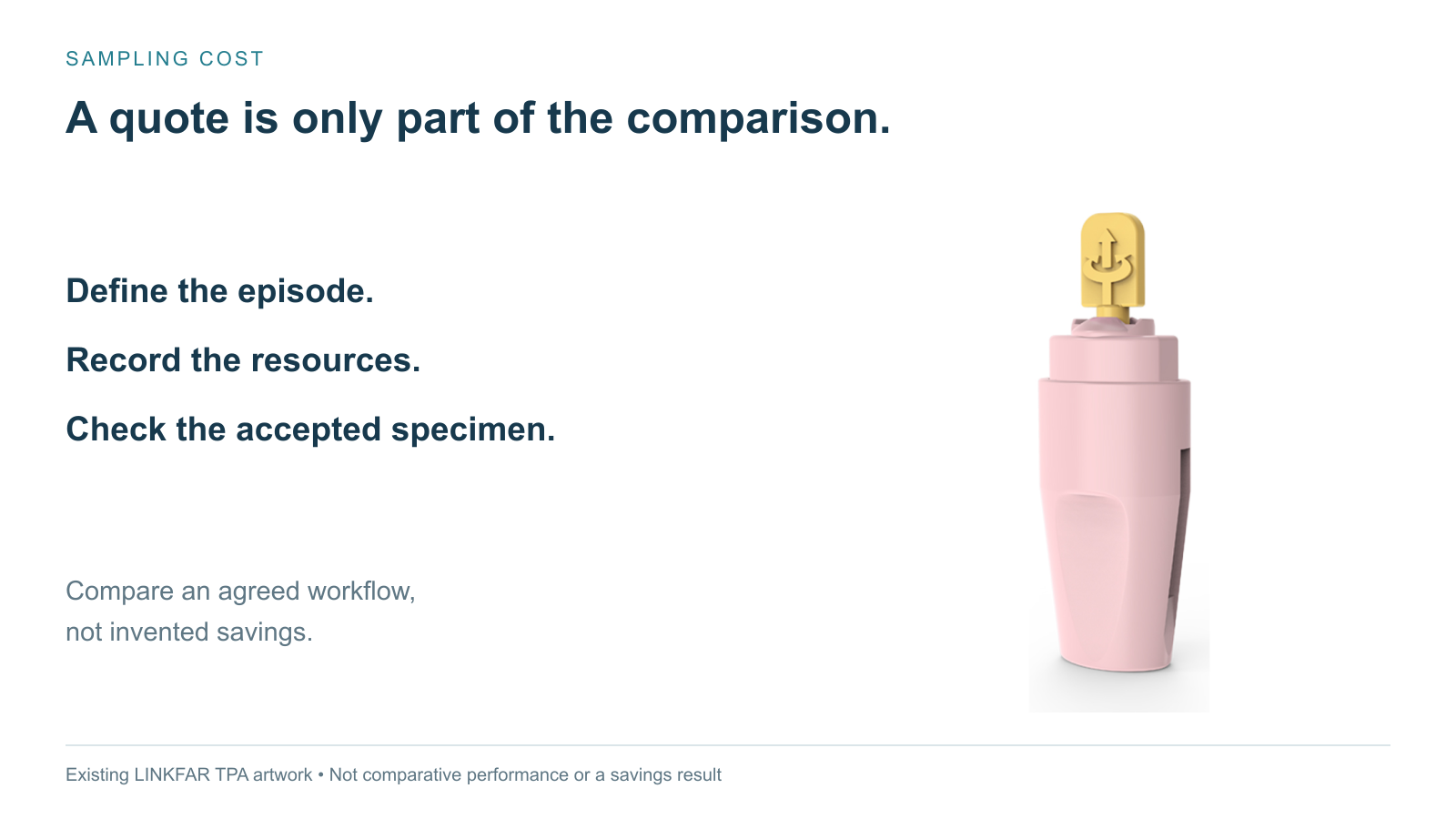
*An existing product image illustrates the device being purchased. It does not demonstrate comparative sampling performance or savings.*
Define the sampling episode before calculating a cost
Start with one clinical application. A fingerstick for assisted blood glucose monitoring is not interchangeable with collection for a different laboratory test, a different sample volume or a neonatal heel procedure. Our blood sample collection guide explains those broader distinctions.
For the purchasing review, define a sampling episode: one intended collection for one person, one specified purpose and an agreed observation window. Link additional attempts for that same collection to the original episode. Do not count each repeat attempt as a new success opportunity just to improve the figures.
Define “usable” before starting. This might mean a specimen meeting the receiving laboratory's acceptance requirements, or the specimen requirements of a particular point-of-care test. It does not mean merely seeing blood. It also does not establish diagnostic accuracy or clinical benefit.
An episode that ends without an acceptable specimen still consumed resources. Keep those costs in the review and report the unsuccessful episodes separately. Identify episodes still open at the reporting cut-off. Do not silently drop them or compare a completed cohort with an unfinished one.
Which costs belong in the comparison?
Use a consistent boundary for both products. A distributor's landed-cost calculation and a clinic's collection-workflow calculation answer different questions; show them separately when necessary.
| Cost area | What to record | Important boundary |
|---|---|---|
| Lancets consumed | Units opened or used, valued at the agreed landed unit cost | Do not charge the same unit again under repeat collection |
| Freight and inventory losses | Freight only if excluded from the unit cost; separately identified expired or damaged stock | Count each unit and charge once; allocate losses over the relevant stock period rather than making one short pilot carry an unrelated annual loss |
| Other consumables | Collection items actually consumed in the episode | Exclude items used equally elsewhere unless the comparison includes them consistently |
| Staff activity | Collection, additional attempts, documentation and relevant handling time | Distinguish measured working time from waiting time and released capacity from cash savings |
| Training and changeover | Actual training, assessment and implementation effort | State the allocation period; separate one-off changeover from routine operation |
| Sharps disposal | The facility's actual collection and disposal arrangement | Volume, container use or a waste contract may matter more than a simple charge per lancet |
Keep loss categories mutually exclusive: if a discarded unit has already been costed in consumption, do not add its purchase cost again under inventory losses.
For internal costing, the agreed hourly staff rate may help translate time into a resource cost. That is an accounting assumption. Minutes released do not automatically reduce payroll, and patient waiting time should not be priced as staff time. If patient experience matters to the decision, record it as a separate outcome rather than inventing a financial value for it.
A practical cost-per-usable-sample framework
For a defined, comparable cohort, use:
Cost per accepted sampling episode = agreed attributable workflow costs ÷ episodes meeting the predefined specimen-acceptance criteria.
The numerator includes resources consumed by unsuccessful episodes and additional attempts within the agreed boundary. If no episode meets the criterion, report that outcome; do not manufacture a meaningful average by changing the denominator.
Keep the supporting counts beside the result: eligible episodes, accepted episodes, unresolved episodes, devices consumed and reason-coded additional attempts. Otherwise, a single average can conceal a collection problem or a difference in patient mix.
Use the framework to ask questions, not to declare a winner from a small uncontrolled trial. A review can find no observed difference, which is useful information but does not establish equivalence or rule out a difference in a larger evaluation.
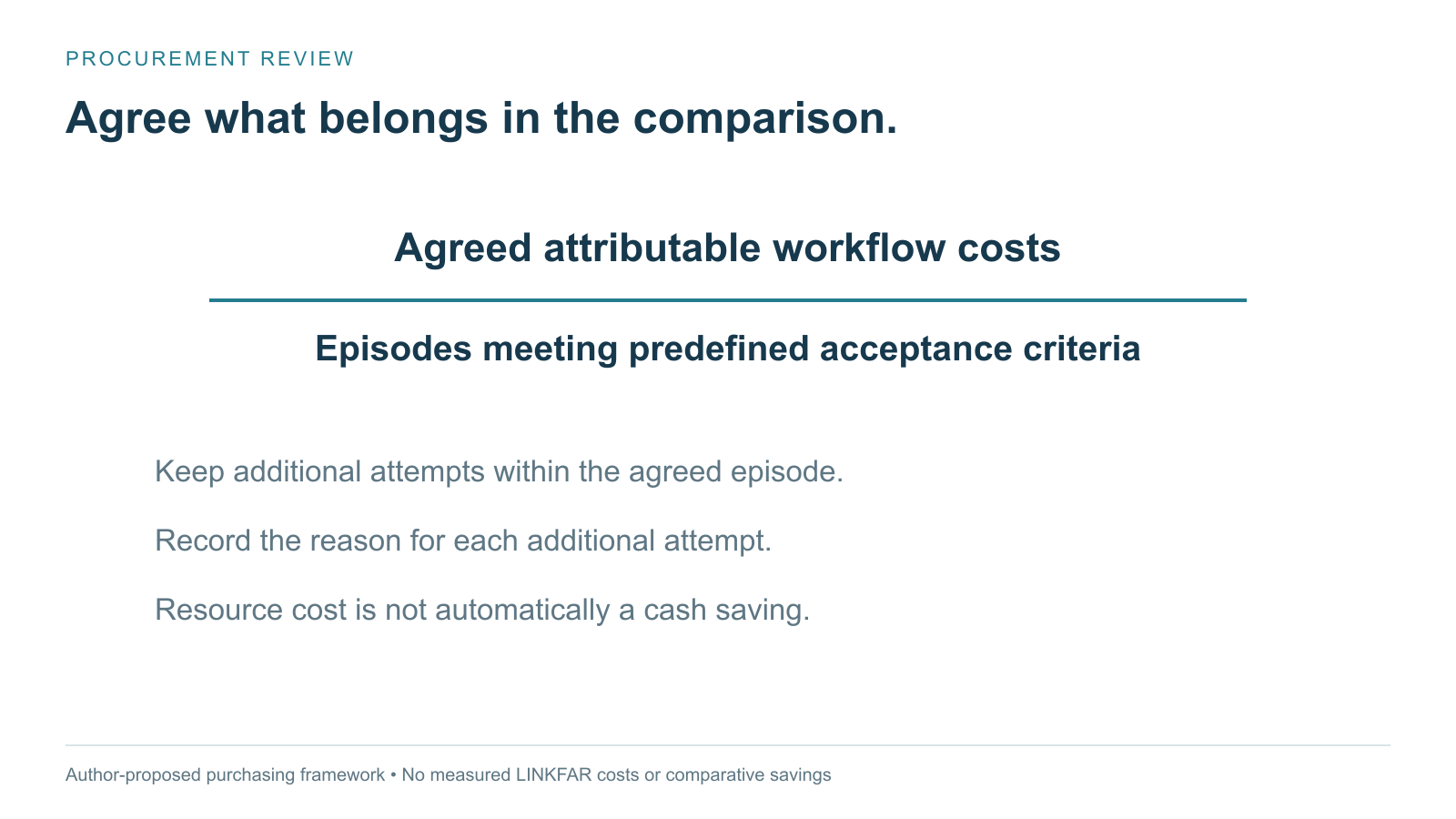
*A purchasing framework, not measured LINKFAR performance. Agree the comparison boundary before collecting data.*
An additional attempt is not automatically a lancet failure
Use separate reason codes. These events should not be treated as one interchangeable “failure rate.”
- Device-function issue: for example, a reported activation problem requiring investigation. Retain the lot identity and follow the complaint process; do not assume the cause from an incomplete report.
- Collection issue: the required specimen was not obtained. Device configuration, collection technique and patient-related factors may need separate assessment.
- Specimen-acceptance issue: a collected specimen was unsuitable because of an identified problem, such as integrity, identification or handling. This is not automatically attributable to the lancet.
- Test or analyser issue: the testing process did not produce an acceptable result. Keep this separate from specimen collection unless an investigation establishes a connection.
- Clinically necessary repeat: another collection was required for a legitimate clinical reason. Do not label all repeat testing as avoidable waste.
WHO's capillary sampling guidance addresses collection technique as well as device selection. For example, excessive squeezing can affect specimen quality. “Insufficient blood” alone is therefore not a complete root-cause finding.
The WHO laboratory quality checklist also distinguishes specimen acceptance and rejection and calls for recording reasons and subsequent action. For procurement, that discipline helps separate a possible device problem from a wider process issue. It does not justify assigning every rejected sample to the supplier.
Make the quotations genuinely comparable
Ask each supplier to identify the exact model and configuration, intended application, units per pack and case, shelf life at delivery, storage requirements and relevant market documentation. Record the quotation date, currency, delivery terms and which freight, taxes or other charges are included.
Specify the test and specimen requirement when requesting samples. “A safety lancet for our clinic” is too broad for a useful comparison. This article does not prescribe a universal needle size, penetration depth or blood volume; those decisions belong to the applicable device instructions and clinical workflow.
Check whether a lower quote changes the packaging, configuration or supply terms. Those differences may be acceptable, but they should be visible. Neither a cheaper product nor a more elaborate mechanism should receive an automatic quality score.
Collect a small amount of useful, comparable information
A supervised evaluation should follow the organisation's normal clinical, infection-control and quality procedures. Do not alter patient care to generate a procurement result.
Before starting, agree the application, population, operators, training, acceptance criteria and review period. Use a defined cohort with comparable follow-up windows; distinguish unresolved episodes from final outcomes. Record product and lot identity, devices consumed per episode, additional-attempt reasons and the resources within the chosen boundary. Identify meaningful differences in patient or operator mix instead of pooling unlike groups.
Review the reasons before interpreting the average cost. An identification error needs a different action from a device-function complaint. A documented clinical need for another test is different again. Where attribution remains uncertain, leave it uncertain.
Safe use is not a cost-saving option to remove
For assisted blood glucose monitoring, CDC recommends single-use, auto-disabling fingerstick devices and devices whose lancets retract permanently after puncture. Its guidance also addresses staff training and disposal at the point of use. A purchasing calculation must not create an incentive to reuse a device or share it between people.
A protective housing does not eliminate sharps-waste responsibilities. FDA guidance for healthcare facilities includes lancets among sharps and directs facilities to appropriate disposal arrangements. Use the applicable local requirements and actual waste-service costs, not an assumed universal disposal price.
What to discuss with LINKFAR
LINKFAR's safety lancet range includes PA and PA2, alongside other models. Different applications require a specific product discussion. Our PA/PA2 dual-spring article explains a mechanism-design question; it is not evidence that those products deliver a lower cost per sample in your setting.
For a meaningful sample evaluation, bring the intended application, current collection workflow, specimen requirement and acceptance criteria. Ask for the exact proposed configuration and the documentation applicable to your market. For private-label projects, the OEM guide covers the wider responsibilities that sit beyond a unit-price quotation.
If you are reviewing a safety lancet purchase, contact LINKFAR with those requirements. The useful starting point is a comparable specification and a workable evaluation plan. Any claim of lower total sampling cost should come after the evidence, not before it.
Related guides
-
 Blood Sample Collection Methods: Venous, Capillary and Arterial Blood Collection Explained
Compare venous, capillary and arterial blood collection routes, specimen types, devices and handling considerations for reliable blood sampling.
-
 Safety lancet selection: why gauge alone is not enough
Start with the assay and specimen, then discuss gauge, depth and approximate yield. Includes clearly labelled experience ranges and PA product photography.
- Private label medical devices in the EU: from product brief to delivery If you distribute medical consumables, you may already know which products your customers need. Building your own brand raises a different set of questions:…
-
 Dual-spring safety lancets: why PA and PA2 use two springs
The unit price of a safety lancet is easy to compare. The motion of the needle inside it is harder to see, yet that…