
Recently, a customer in Central America told us that his CGM came off during a football match after he had used our skin barrier wipe. He lives in a tropical climate and enjoys playing football. That raised a question for us: had the wipe made the sensor less secure?
It is a fair question for anyone considering CGM skin barrier wipes. We told him an effect on adhesion was possible. The report alone, though, does not tell us why the sensor detached.
Can a skin barrier wipe affect CGM adhesion?
A skin barrier wipe changes the surface beneath an adhesive. Its suitability depends on the particular film, adhesive and device instructions. Not every barrier weakens the bond: some formulations also support adhesion. A sensor coming off after a wipe was used does not establish that the wipe caused it.
For example, Smith+Nephew describes SKIN-PREP as protecting skin during adhesive removal while also supporting adhesion of some acrylic-based products. That is evidence about a particular formulation, not a result we can transfer to LINKFAR or every CGM. Smith+Nephew product information
This distinction matters. “It forms a film” is an explanation of what the product does. It is not, by itself, proof that the sensor will stick better or worse.
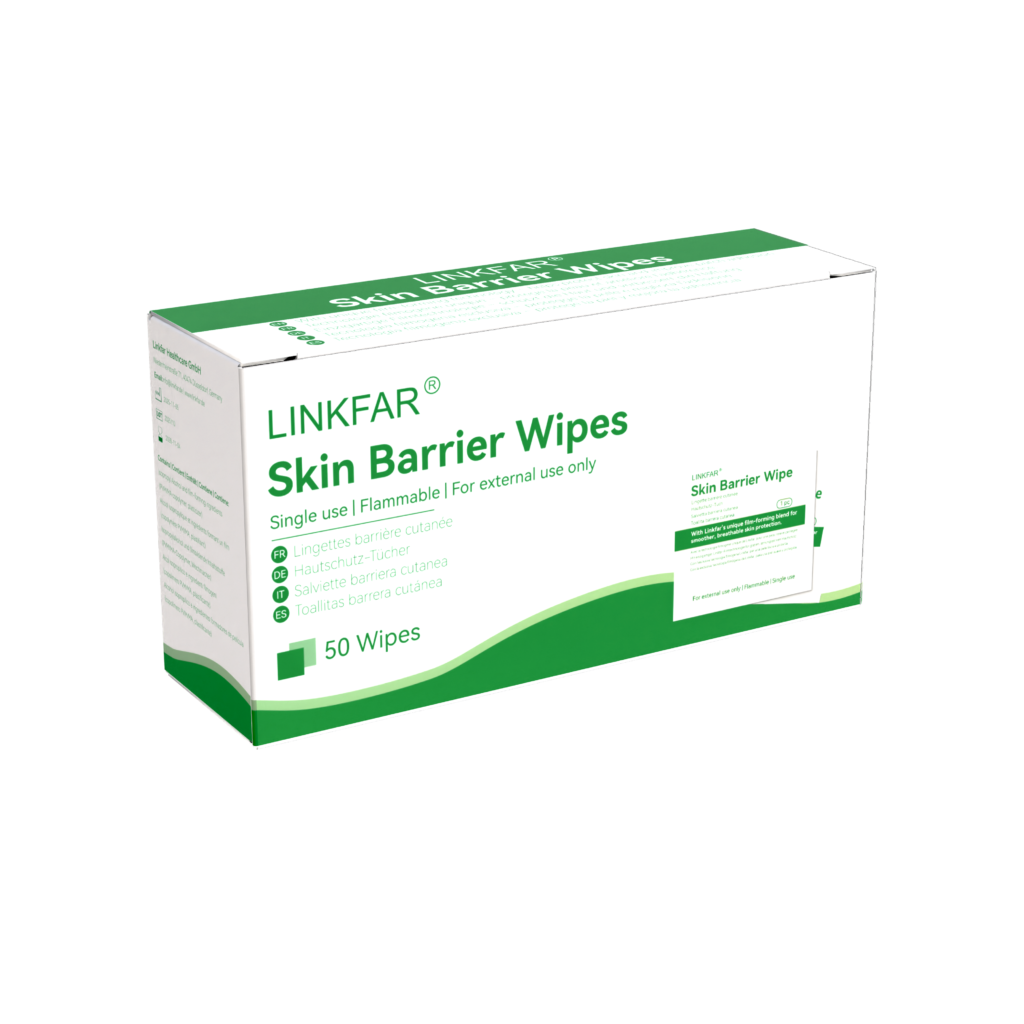
Cover image: LINKFAR Skin Barrier Wipes packaging artwork, shown for product identification, not as evidence of compatibility with a particular CGM.
What skin protection should mean
The reason for using a film-forming barrier is to place a protective layer between the skin and materials contacting it. Depending on the formulation and intended use, this can include protection against skin stripping when adhesive is removed. Protection during removal is not the same as deliberately making the sensor easy to detach during wear. SKIN-PREP protective-film information
I would also be careful with the word “anti-allergy.” A barrier should not be presented as a guarantee against an allergic reaction. Dexcom’s skin-care information says barrier films have not been tested by Dexcom for CGM use, advises discussion with a healthcare professional, and notes that ingredients in some products can themselves irritate skin. Dexcom skin-care guidance
So the question is not simply whether a wipe is gentle. It is whether the specific product is suitable for the person’s skin, the device and the way it is being used.
Four CGM accessories, four different jobs
These products are sometimes discussed as if they were interchangeable. Their main jobs are different, even though some formulations combine functions.
For the wider category overview, see our guide to CGM and insulin pump accessories. For the construction of an overpatch itself, our CGM patch materials and adhesive guide explains what to compare.
| Accessory | Main purpose | What it should not be assumed to do |
|---|---|---|
| Skin barrier wipe | Form a protective film on the skin, where permitted by the relevant instructions | Guarantee freedom from allergy or improve every adhesive bond |
| CGM overpatch | Provide additional external fixation around or over a sensor, according to its design | Treat a skin reaction or make a dislodged sensor safe to reuse |
| Adhesive enhancer | Increase adhesion where its use is permitted | Replace skin protection or solve every cause of early detachment |
| Adhesive remover | Help release adhesive during planned removal and remove residue | Improve hold during wear |
This is a comparison of purposes, not a recommendation to use all four together. Dexcom discusses extra fixation and adhesive aids in its G6 wear guidance, and removal aids separately. Compatibility and application details still need to come from the relevant instructions. Dexcom G6 adhesion guidance, Dexcom removal guidance
Start with the problem the user actually has
If the sensor comes off too soon
Retention is the first issue to investigate. Sweat is a plausible factor: Abbott notes that moisture from perspiration can reduce sensor adhesion. That makes the football match and tropical setting relevant questions in this case, but not proof of the cause. Abbott on perspiration and adhesion
A suitable overpatch may be an option where the CGM manufacturer permits it. The exact model matters. Abbott’s UK guidance for Libre 3 and Libre 3 Plus, for example, sets conditions for when an over-bandage is applied and requires the sensor’s central opening to remain uncovered. Those details cannot automatically be applied to another CGM. Our guide to which overpatch fits which sensor compares these model-specific checks. Abbott Libre 3 over-bandage guidance
I would not answer every early-detachment complaint by immediately recommending more adhesive. First, we need to understand what detached and which products were already in use.
If removal is difficult
This is a different problem. The user may be satisfied with the hold but struggle when it is time to remove the sensor or patch. An appropriate adhesive remover is a more direct category to discuss than assuming a barrier wipe must make removal easy. Dexcom’s removal guidance explains that removal wipes may help loosen adhesive and reduce discomfort; it does not endorse individual third-party products. Dexcom removal guidance
Removal products belong to the removal stage. Before the next sensor is applied, follow its preparation instructions, including removal of residue and drying. Dexcom G6 preparation guidance
If the skin reacts
A persistent or worsening reaction needs assessment, not just stronger tape or another layer. In its Dexcom G6 safety notice, the UK MHRA distinguishes hypersensitivity from simple irritation and advises users with skin reactions to contact their healthcare professional. MHRA safety notice
There is a limit to what an accessory supplier can determine from a message or photograph. We can help identify the product used and provide its information. We cannot diagnose the reaction or promise that adding our wipe will resolve it.
What I would want to know about the football complaint
Before drawing a conclusion, I would ask:
- Which CGM model was used, and how long had it been worn?
- Which wipe and other skin products were used, including their batch details?
- Was the skin and any permitted film fully dry before application, and how much time passed before football?
- Did the adhesive edges lift first, did the whole patch release, or was the sensor knocked off?
- Was there itching, redness or discomfort, and had the user experienced similar detachment before?
These are questions for investigating the report, not assumptions that the customer made a mistake. Dexcom’s G6 guidance notes that an adhesive patch may need time to dry and bond and advises avoiding sweaty activity during that period. The appropriate preparation and timing still depend on the actual device and accessory instructions. Dexcom G6 adhesion guidance
For this complaint, the honest answer is that the cause is not yet established. The customer’s experience still deserves investigation.
Device instructions come before accessory advice
Adding a layer under a sensor deserves particular care. A 2021 UK MHRA notice for Dexcom G6 advised against untested barrier methods because they could affect device performance. It is a model-specific warning, not a conclusion about every barrier product, but it shows why current instructions for the exact device and market must take priority. MHRA notice, 6 April 2021
If a sensor has actually fallen off or become dislodged, adding an overpatch is not proof that it can still function correctly. Follow the manufacturer’s replacement and backup glucose-monitoring instructions and contact its support team when needed. Abbott explicitly states that removed or fallen-off Libre 2, Libre 2 Plus, Libre 3 and Libre 3 Plus sensors cannot be reused. Abbott sensor replacement FAQ
My view as an accessory supplier
I do not think every CGM user needs the same collection of accessories. Someone who struggles with removal has a different need from someone whose sensor comes off during sport. A person with a skin reaction needs more than a claim that a product is “skin-friendly.”
That is how I want us to discuss our LINKFAR Skin Barrier Wipes and wider CGM accessories range: start with the problem, explain the product’s role, and be clear about the limits. An accessory should support CGM use. Buying more accessories is not the goal.
If you are evaluating accessories for your customers, contact LINKFAR with the CGM model and the problem you are trying to address: early detachment, difficult removal or skin discomfort. We can discuss product information and questions that need checking, without assuming that one combination will suit everyone.
This article shares an anonymized customer report and general product information. The cause of the reported detachment has not been established. It is not individual medical advice or a substitute for the current instructions supplied with a CGM or accessory.
Related guides
-
 CGM and Insulin Pump Accessories: A Guide to Patches, Skin Care and Secure Wear
A sensor that starts lifting after exercise and a patch that hurts to remove create different problems. Buying a stronger adhesive may help with…
-
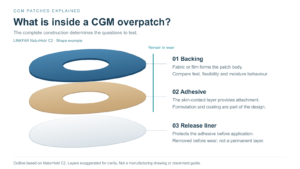 CGM patches explained: materials, adhesives and quality
Two CGM patches can have the same outline and feel quite different after a day of wear. One may feel more like fabric; another…
-
 Waterproof and breathable CGM overpatches: the P2/P3 design
A CGM patch can still be attached after a swim while the skin underneath feels damp. Those are two different results, and checking only…
-
 Insulin Pump Adhesive Allergy: My EASD 2026 Takeaways
By David Zhou, LINKFAR Healthcare GmbH At EASD 2026, several insulin pump distributors asked me about underpatches. LINKFAR already has underpatch options, including versions…