
For a patient who needs a small blood sample, the collection appointment can involve more effort than the test itself. Travel, waiting and arranging time away from work can make a routine blood draw inconvenient, especially when testing has to be repeated.
LINKFAR is developing an upper-arm blood collection system to broaden the options available for low-volume sampling. The project has entered the clinical stage, and we are preparing for a planned near-term launch, subject to completion of the necessary validation and market-specific requirements.
Our aim is to give laboratories, diagnostic partners and healthcare providers another collection option alongside venous draws and fingerstick sampling. Advances in in vitro diagnostics (IVD) make this particularly relevant: selected testing workflows can now obtain useful results from smaller samples, provided the collection method and the laboratory process are designed to work together.
This development update explains where upper-arm sampling could fit, what the research supports, and why we welcome conversations with potential partners before launch.
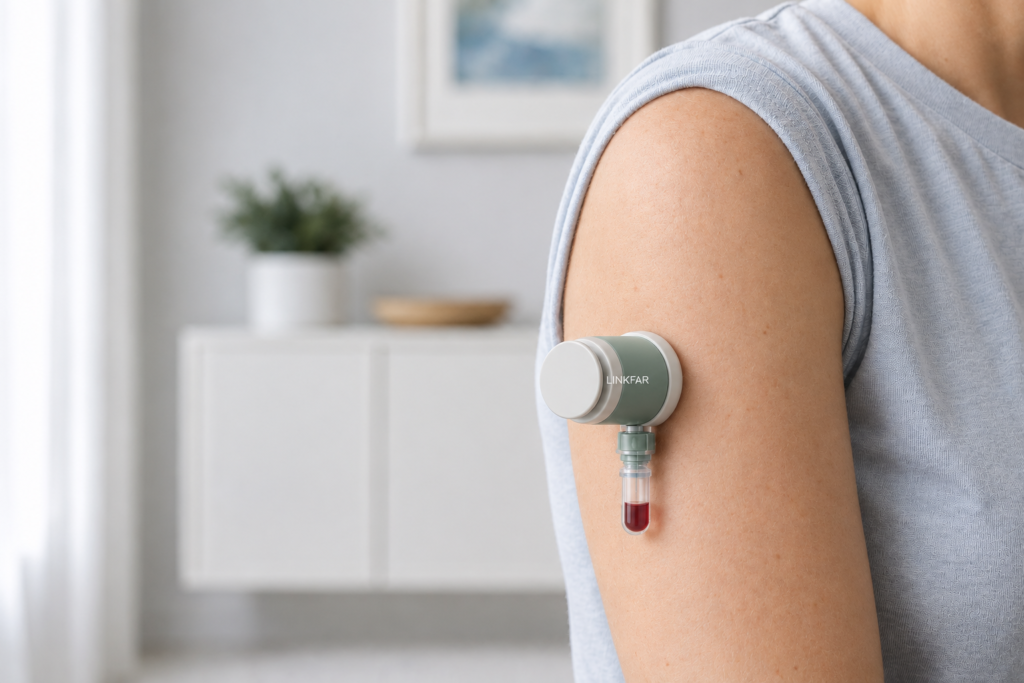
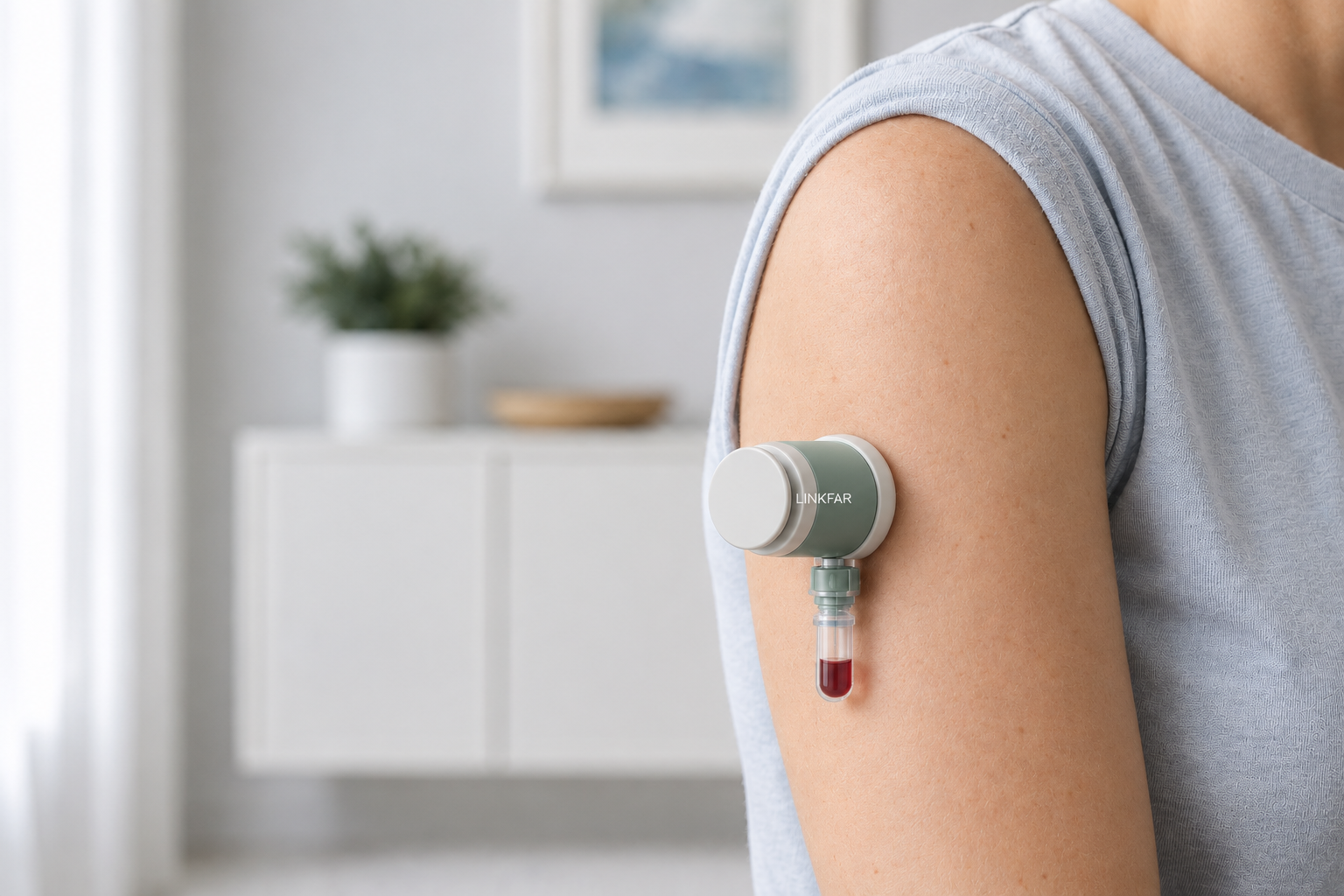
*LINKFAR development visual. Illustrative application scene, not a clinical study photograph. Final product configuration and instructions may differ.*
What is upper-arm blood collection?
Upper-arm blood collection is a form of capillary microsampling. An on-body device collects a small blood sample through a controlled opening in the skin, usually into a connected container. It provides a different collection site and experience from fingerstick sampling, while the specimen remains capillary blood.
An established example of the category is described in the FDA’s Tasso+ device summary: the device creates a small incision and uses slight vacuum assistance to help blood flow into a compatible tube. That description concerns the named device; it does not establish LINKFAR’s performance or regulatory status.
For the broader distinctions between specimen sources and sampling approaches, see our guide to blood sample collection methods.
A third practical option alongside venous draws and fingersticks
From a patient’s perspective, upper-arm sampling can offer a third practical choice: a venous blood draw, a fingerstick, or an upper-arm collection device. These are different ways of obtaining a sample, rather than three separate biological types of blood.
Fingerstick and upper-arm sampling both belong to capillary blood collection. Arterial blood collection remains a separate route used for different clinical purposes. Keeping that distinction clear helps laboratories assess an alternative collection method without assuming it produces a venous specimen.
| Practical question | Venous blood draw | Fingerstick sampling | Upper-arm capillary collection |
|---|---|---|---|
| Where is the sample collected? | A vein | A skin puncture at the finger | A controlled skin opening on the upper arm |
| Where does it commonly fit? | Established laboratory workflows, including larger-volume requests | Point-of-care testing and selected microcollection workflows | Selected low-volume laboratory and remote-sampling workflows |
| What is its main practical strength? | Supports multiple tubes and broad testing requirements | Familiar approach for tests needing small samples | Offers an alternative to both a venous puncture and finger-based collection |
| What determines suitability? | The ordered tests, patient and collection procedure | The device, specimen requirements and test method | The device, intended user and validated collection-to-result process |
The purpose is to expand choice where it is useful. A patient needing several specimen types or a larger test panel may still be best served by venipuncture. A fingerstick remains appropriate for many established tests requiring only a small amount of blood.
Upper-arm collection becomes interesting when a laboratory needs a liquid microvolume and the service would benefit from a different collection experience or location. That is the opportunity LINKFAR is pursuing.
Why smaller blood samples can support a broader test menu
Collecting less blood is only useful if the laboratory can still report reliable results. The opportunity therefore depends on developments on both sides: better collection and handling of small samples, and analytical methods that use those samples efficiently.
A 2025 study in The Journal of Applied Laboratory Medicine evaluated 20 miniaturised assays and specimen comparisons across 39 analytes using a particular capillary collection and processing system. It reported equivalence under the conditions tested, with analyte-specific comparisons rather than one blanket conclusion for all blood tests.
This was a trained-operator collection workflow, not a validation of LINKFAR’s upper-arm device or of home self-collection. Its relevance is narrower and useful: reducing the analytical volume requirement can make a small capillary specimen more practical for selected laboratory panels.
Separate research from University Medical Center Utrecht, published in 2025, compared fingerstick and venous samples for 34 routine chemistry analytes. Of 33 analytes with available desirable total allowable error criteria, 30 met those criteria. The findings support broader investigation of capillary testing, while the exceptions show why each analyte needs assessment.
For an IVD partner, the development question is specific: which tests can be supported by the available specimen volume, and what changes are needed to make that reliable?
A low-volume programme should consider:
- the volume actually available after sample preparation;
- the amount consumed by each assay and any repeat measurements;
- the sample the analyser cannot aspirate, often called dead volume;
- the tube, additive and processing method required for the selected tests;
- the stability of the relevant analytes before analysis.
These considerations give practical meaning to the idea of testing more with less blood. They do not imply that a small tube can replace every conventional blood draw. They do create room to design focused test panels around a smaller specimen, rather than assuming that the collection volume must always stay the same.
For LINKFAR, this makes upper-arm microsampling a relevant development project for laboratory and IVD partners, as well as for distributors of collection consumables.
The LINKFAR project: clinical stage, with launch in preparation
LINKFAR’s upper-arm blood collection project is in advanced development and has entered the clinical stage. We are preparing for a near-term launch and welcome enquiries from laboratories, IVD companies, healthcare service providers and distribution partners. Commercial availability will depend on the remaining validation work and the requirements of each intended market.
The current development goal is a whole-blood collection volume of 500 μL, equivalent to 0.5 mL. This is a development target, not a final validated specification or a guarantee that every collection will yield the same amount.
It is also not a promise of 500 μL of serum or plasma. Where a test requires a separated specimen, the usable volume will be smaller than the original whole-blood volume and will depend on the sample and processing method.
We are interested in the applications that this scale of collection could support. A partner with a defined test panel can help establish the required specimen, minimum usable volume and acceptance criteria. That is a more productive starting point than making a general claim that one sample will support a fixed number of tests.
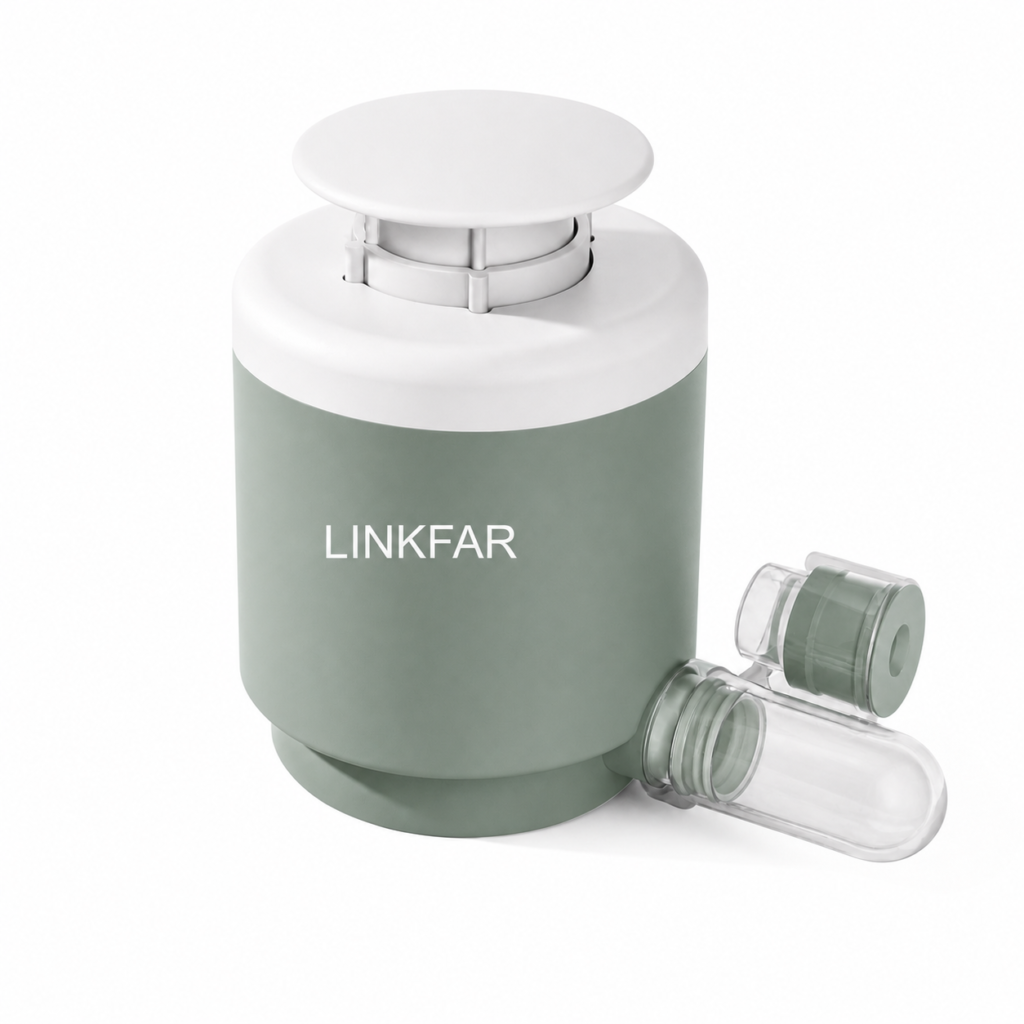
*LINKFAR product development visual. Colour and configuration shown are illustrative and do not establish final specifications or market authorisation.*
Where upper-arm microsampling could make a difference
The benefits depend on the application. The studies below concern other devices and specific research settings; they explain the interest in the category, not clinical results for LINKFAR’s product.
A collection option away from the fingertip
Some people would welcome a blood sample that does not require pricking a finger. Whether they find an upper-arm device more comfortable or easier to use needs to be measured with the actual product and intended users.
In a randomised study of 50 patients with rheumatoid arthritis, willingness to collect blood at home was higher in the upper-arm group than in the finger-prick group: 60% versus 32%. The study evaluated a specific device and selected inflammation and autoantibody tests, so these figures should not be applied to every population or product.
For development teams, the lesson is to evaluate the experience as well as the blood volume. Instructions, confidence in applying the device and the need for assistance all deserve attention. A method that works in trained hands still needs assessment for the people expected to use it.
Fewer collection-only visits in suitable services
An approved home-sampling pathway could allow some patients to provide a sample without attending a clinic solely for collection. The laboratory would still perform the test, and the responsible healthcare professional would still interpret the result.
This distinction matters for remote care: home sample collection is not the same as home diagnosis. A complete service needs a suitable test request, a collection process the user can follow and a reliable route back to the receiving laboratory.
A 2024 PLOS ONE study investigated capillary self-collection and its implementation in clinical trials. Across its studies and phases, the reported median collected volume was 425 μL, and device failures and minor adverse effects also occurred. Those findings show both the practical potential and the need to plan for unsuccessful collections.
For LINKFAR, home and remote sampling are application areas for discussion, subject to validation and the eventual intended-use scope. They are not a statement that the developing device is already authorised for unsupervised home use.
More flexibility for repeat sampling and research
For a study coordinator, collecting a sample at an agreed time can be as important as collecting it at a central site. A suitable remote-sampling process could make repeat collections easier to arrange when participants live far from the research centre or have limited flexibility during working hours.
The relevant outcome would be a usable sample collected within the study’s required window. A research plan should therefore assess completion, timing accuracy, participant support and the proportion of samples accepted by the laboratory.
This is a potential advantage to investigate, not a claim that an upper-arm device automatically improves study retention or data quality. A process that reduces travel but produces more rejected samples may not benefit the study. Those trade-offs should be measured together.
An option worth exploring in sports medicine
Athletes who undergo repeated tests may welcome a different collection experience, particularly around competition. The case for upper-arm sampling is about comfort and practical collection, not a promise to improve athletic performance.
A 2021 study involving 108 national-level athletes in Denmark compared upper-arm and finger-prick collection of dried blood spots. Athletes reported low pain with both methods but preferred the upper-arm approach. This was a dried-blood-spot study, not a test of LINKFAR’s liquid collection device.
Liquid capillary sampling is also relevant. The U.S. Anti-Doping Agency’s collection guidance describes upper-arm devices collecting approximately 500 μL for testing, including Athlete Biological Passport parameters. The same guidance says the amount taken during a routine anti-doping blood draw is unlikely to affect performance.
For a sports medicine service, the starting point would be a defined test panel and a suitable collection schedule. Fingerstick sampling may already meet the needs of a small-volume point-of-care test; a liquid microcollection becomes interesting when a laboratory needs a larger usable specimen or the athlete prefers another collection site.
LINKFAR welcomes discussions about potential sports medicine and research applications. Any use would require product-specific validation; formal anti-doping collection also has separate protocol and sample-security requirements. Existing use of other devices does not establish acceptance of LINKFAR’s developing product.
A closer fit with low-volume IVD workflows
An IVD company developing a low-sample-volume assay may need collection options beyond a conventional tube workflow. A microcollection device could be useful if it delivers the right specimen in sufficient quantity and in a format the laboratory can process consistently.
That creates a reason for collection-device developers and diagnostic teams to speak early. The assay team can define the required matrix and volume; the collection project can assess whether those requirements are realistic for the intended users and setting.
For example, a proposal for a focused laboratory panel should state whether it requires whole blood, serum or plasma before a collection configuration is selected. The panel’s analytical volume alone is not enough to specify the device.
A new category for established distribution partners
LINKFAR already has a safety lancet range for capillary blood collection. The upper-arm project would extend the conversation beyond familiar fingerstick applications toward selected liquid microsampling and laboratory-service partnerships.
For a distributor, the opportunity is to identify a service that has a genuine collection need. Potential customers could include diagnostic laboratories developing remote services, research organisations planning repeat sampling, or IVD businesses assessing collection compatibility.
The commercial discussion should start with the target market and use case. Product availability, documentation, training requirements and supported applications can then be considered together. This avoids presenting an unfamiliar device as a universal replacement for existing consumables.
A small sample still needs a complete laboratory pathway
The collection device is one part of the process. A useful development partnership follows the specimen through to a reportable result, rather than stopping when blood enters the tube.
For a proposed service, the planning sequence is:
- Define the test panel and clinical or research purpose. This establishes what information the sample must provide.
- Specify the required specimen and usable volume. Include preparation losses, dead volume and repeat-testing needs.
- Assess the collection configuration and intended users. Determine whether the proposed method can consistently meet the laboratory’s requirements.
- Validate handling and transport. Establish acceptable conditions for the actual route, including foreseeable delays.
- Set acceptance and follow-up rules. Decide how insufficient, delayed or otherwise unsuitable samples will be identified and what happens next.
Consider a laboratory planning a remote follow-up service. Before choosing a kit, it should define the panel, collection schedule and maximum acceptable interval before processing. It can then test whether the proposed collection and delivery process meets those requirements under ordinary operating conditions.
That approach also makes partner conversations more concrete. Instead of asking whether the device can be used for “many tests”, a laboratory can describe a particular panel and the specimen it requires. The collection and diagnostic teams then have a defined question to investigate.
Why transport deserves as much attention as collection
The possibility of sending a small sample to a laboratory is commercially attractive, but a microcollection tube does not by itself establish sample stability. A pathway that works with immediate processing may behave differently after a delivery delay.
A 2026 study in The Journal of Applied Laboratory Medicine evaluated outpatient capillary self-collection and delayed specimen processing. It found analyte-specific differences, including problems with potassium, bicarbonate and glucose after delayed processing at room temperature. The authors concluded that transport conditions and individual analytes require assessment.
This is a useful boundary for future service design. A laboratory may be able to support one panel under a particular transport protocol without supporting every other panel under the same conditions.
For a potential LINKFAR partnership, we would therefore want to understand the proposed delivery route alongside the test menu. Local collection with prompt laboratory processing and home collection followed by shipment are different operating models. Neither should be assumed to validate the other.
The service should also explain what the patient does if collection is unsuccessful, a shipment is delayed or the laboratory rejects the specimen. These are ordinary operational questions that need answers before a remote-sampling offer is made to patients.
What clinical-stage development should establish
Entering the clinical stage is an important project milestone. It is not the same as having completed clinical validation, received market authorisation or established compatibility with a complete test menu.
For a device in this category, the evidence needed for a practical launch should address questions such as:
- Can the intended users collect an adequate sample consistently?
- What blood-volume distribution is achieved, rather than only the highest observed volume?
- How often is assistance or another collection attempt needed?
- What are the observed discomfort, skin effects and device-related problems?
- Does sample quality meet the requirements of the intended tests?
- Which handling and transport conditions are supported?
These questions are a framework for assessing readiness, not a disclosure of LINKFAR’s clinical protocol or a list of completed study outcomes. Product-specific findings should be communicated when the relevant work and review are complete.
Partners should also distinguish the device’s collection function from a laboratory’s diagnostic claim. Evidence that a device collects a sample does not establish that a particular result is clinically interchangeable with a venous result. The intended combination of device, tube, processing and assay needs its own justification.
This is why we are introducing the project during development. Laboratories and commercial partners can identify the applications they need and the evidence they will require, while the product is progressing toward launch.
Discuss an upper-arm sampling application with LINKFAR
LINKFAR is preparing to bring its upper-arm blood collection project from clinical-stage development toward a planned near-term launch. We welcome early discussions with partners who see a practical role for low-volume sampling in their laboratory, diagnostic service, research programme or distribution portfolio.
If you are interested, tell us your target market, the intended collection setting and the tests or service you have in mind. For laboratory and IVD enquiries, the required specimen type and minimum usable volume are especially helpful starting points.
Final specifications, supported applications and availability will be communicated as the remaining work is completed. This update does not announce commercial availability or a confirmed launch date.
Contact LINKFAR about the upper-arm blood collection project to discuss your application and request development and launch updates.
Related articles
-
 Dual-spring safety lancets: why PA and PA2 use two springs
The unit price of a safety lancet is easy to compare. The motion of the needle inside it is harder to see, yet that…
-
 Blood Sample Collection Methods: Venous, Capillary and Arterial Blood Collection Explained
Compare venous, capillary and arterial blood collection routes, specimen types, devices and handling considerations for reliable blood sampling.
-
 Skin Barrier Wipe for European Distributors and Importers
Skin Barrier Wipe can help European distributors evaluate a skin-friendly wipe for CGM accessories, dressings, and adhesive support applications. This guide helps small B2B…
-
 Blood Sampling Lancet for European Distributors: LINKFAR NPA Safety Lancet
For distributors, dealers and importers in Europe, the LINKFAR NPA Blood Sampling Lancet offers multiple gauge and depth options for channel planning. This guide…