
Two insulin pen needles can have the same gauge and length on the box and still be quite different products. LINKFAR’s wide, flat-base design adds another feature for buyers to examine: the surface that meets the skin. The metal tip, surface lubrication, internal bore and plastic base each deserve a closer look.
Most conversations about insulin pen needle design start with how fine the needle is. That is understandable. The needle is the part people notice first, and injection comfort matters. But the plastic surface around it also meets the skin. Its shape deserves attention, especially when a buyer is trying to understand what separates one apparently similar product from another.
LINKFAR’s wide, flat-base configuration brings that often-overlooked contact surface into the discussion. Here is what the design aims to offer, what the research can tell us, and what a useful product evaluation should actually measure.
What is a flat-base insulin pen needle?
A flat-base insulin pen needle has a broad, relatively flat plastic surface surrounding the patient-end needle where the hub meets the skin. “Flat” describes this plastic contact face, not the metal needle tip. Tip geometry, lubrication, needle length and the contact surface are separate design features that should be evaluated together.
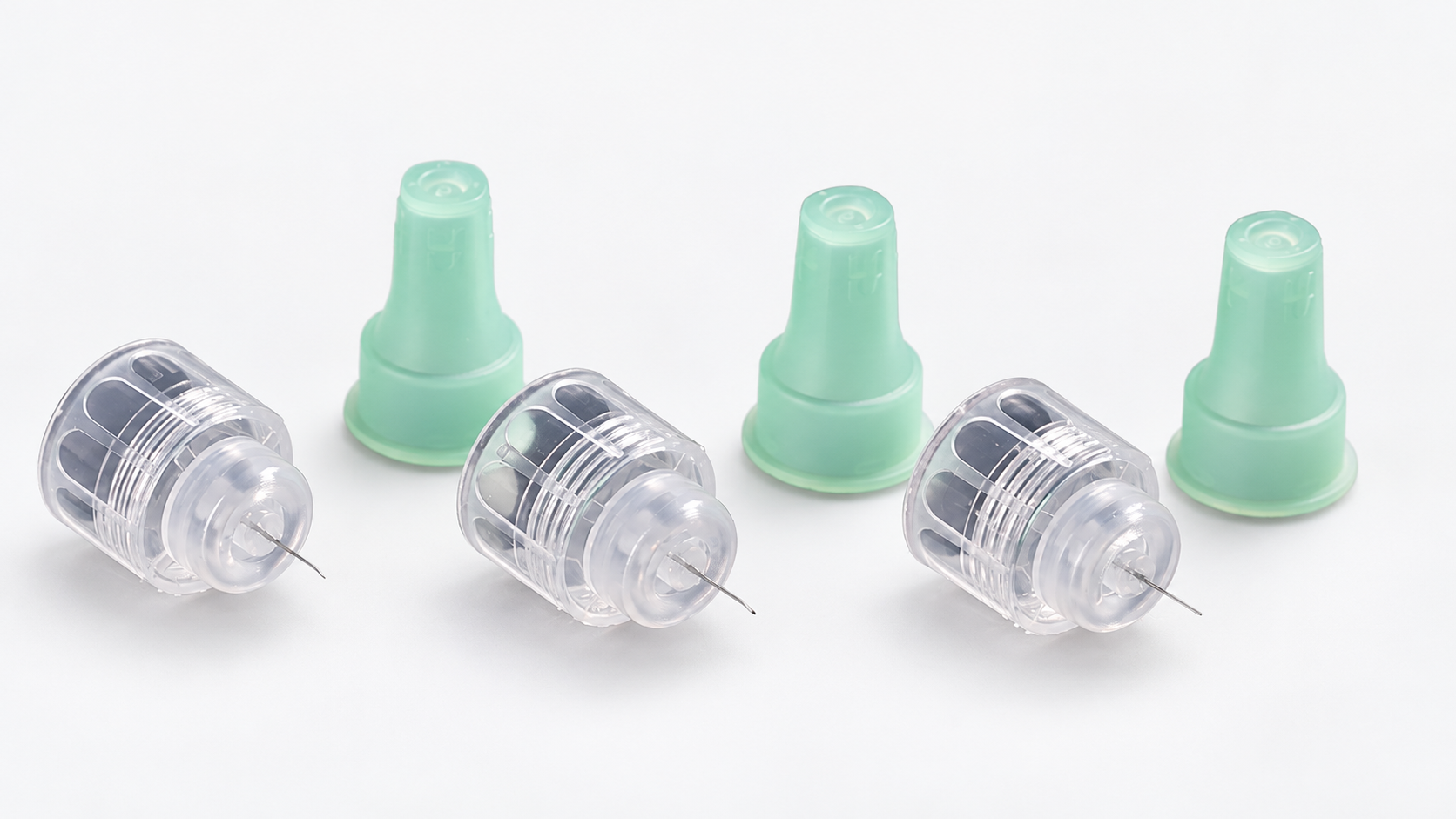
LINKFAR’s featured pen needle combines a wide, flat plastic contact face with a five-bevel metal tip and lubrication. It sits within our broader insulin pen needle portfolio. For sourcing, the useful starting point is a sample of the intended configuration, together with its current specifications, available gauge-and-length combinations and documentation for the destination market.
The featured wide-base configuration, shown with its protective caps. Product photograph retouched for presentation; consult current specifications for dimensions.
Three design questions hidden inside one small product
A buyer comparing pen needles needs to separate three questions. How does the tip enter the skin? How does the needle surface move through tissue? And how does the plastic hub meet the skin as the user holds the pen in place?
These questions overlap, but they are not interchangeable. A sharp tip does not tell us whether the hub is comfortable to hold against the skin. A broad base does not establish the amount of force needed for penetration. A smooth-looking needle photograph cannot reveal the quality or consistency of its lubrication.
| Feature | What it contributes to the design | What to examine during evaluation |
|---|---|---|
| Metal tip geometry | The shape of the cutting edges at initial entry | Tip condition and measured first-puncture penetration force |
| Surface lubrication | The interface between the needle shaft and the test material or tissue | Insertion, shaft friction and withdrawal behaviour |
| Plastic skin-contact face | The way the hub contacts and deforms the skin | Contact pattern, applied force, alignment and achieved depth |
| Needle bore and wall | The internal path through which medication flows | Flow resistance and delivery performance in a defined pen system |
| Caps and hub body | The surfaces people handle before and after an injection | Grip, removal forces, fit and the steps in the approved instructions |
For procurement teams, this is a more useful comparison than judging quality from package size or a single close-up image. Each feature points to a different test, and each test needs a clearly defined question.
Why the shape of the skin-contact base matters
The engineering argument for a broader contact face starts with contact pressure. If the same force were distributed evenly over a larger area, average pressure would be lower. A broad face may therefore offer a way to distribute contact load rather than concentrate it around a small central post.
Real skin is not a flat, rigid test block, however. It deforms. The area actually touching the skin depends on the hub geometry, injection angle, applied force and local tissue. A nominally wider head does not guarantee that its entire surface carries the load.
For LINKFAR’s flat-base design, the practical question is whether this contact face can provide a useful, steady interface while the pen is held against the skin. That is a design rationale worth investigating. It is not yet a measured claim that this product reduces movement, delivers a more accurate depth or causes less pain than another pen needle.
Published work shows why the question matters. A 2019 preclinical study compared different hubs on pen needles with the same labelled needle length. Under the study conditions, hub geometry and applied force affected actual penetration depth. A redesigned contoured hub performed differently from the conventional designs tested. This was an animal study of particular products, not a validation of every broad or flat base. Rini et al., 2019.
A separate clinical crossover study examined a redesigned pen needle that included changes to the hub, inner shield and outer cover. Participants’ assessments supported the value of looking at the whole device. Because several features changed together, the results cannot be attributed to a flat contact face alone or transferred to LINKFAR’s product. Whooley et al., 2019.
Both studies involved manufacturer sponsorship or affiliations. They are useful design evidence, but they are not independent proof of LINKFAR superiority.
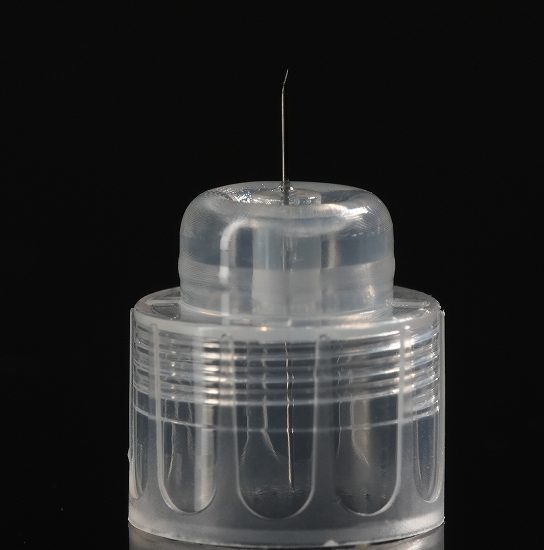
Original, unretouched detail photograph. The plastic contact face and exposed needle are different parts of the design; this is not a microscopic image of the bevels.
What would “more stable” mean in a product test?
“More stable” sounds attractive, but it needs a definition. Does it mean less sideways movement, less variation in pen angle, or more consistent depth under different applied forces? Or simply that users find the contact easier to maintain?
Those are different outcomes. A sensible assessment of a wide-base pen needle would identify the intended outcome first, then compare matched products under the same conditions. For example, an engineering study could examine contact and depth over a defined range of forces. A separate usability study could assess how people handle the device. Neither should be replaced by an informal impression that a bigger head must be better.
This distinction also helps product development. If the intended benefit is steadier contact, the evaluation should focus on contact behaviour. If the intended benefit is user confidence, people need to evaluate the device. The word “stable” becomes useful only when everyone knows what is being measured.
What a five-bevel tip can contribute
The five-bevel feature concerns the metal needle tip, not the plastic head. It changes the geometry of the cutting surfaces at the point of entry. It is a meaningful design choice, but the number of bevels is not a complete quality specification.
In a published comparison of five-bevel and three-bevel pen needles, the five-bevel design required less penetration force in a skin-substitute bench test. The clinical findings were more nuanced: blinded comparisons did not show significant differences in pain, comfort or preference, while other parts of the evaluation favoured the five-bevel design. The authors included BD employees. Hirsch et al., 2012.
The useful lesson is that tip geometry can influence measured penetration, but a laboratory result and a person’s experience are different kinds of evidence. “Five-bevel” is a feature description. “Less painful than another product” is a comparative clinical claim and needs evidence for the products being compared.
For a purchaser, the next questions should be concrete. Is the tip consistently formed and protected during manufacture and packaging? Does the first-puncture force remain consistent across samples and batches?
These questions make a five-bevel specification commercially useful instead of leaving it as a phrase on a catalogue page.
LINKFAR’s featured configuration uses a five-bevel tip. Evaluation should consider that tip alongside the surface finish, lubrication, hub and protective components, rather than treating bevel count as a shortcut for the performance of the complete product.
Lubrication matters after the tip has entered
Initial penetration is only one part of the movement. The needle shaft passes through the contact material, and later withdraws. Surface lubrication is relevant to that movement, which is why an evaluation should not stop at the first force peak.
A study investigating needle design and penetration characteristics found that removing lubrication increased measured penetration force under its test conditions. Some changes in mechanical measurements did not produce corresponding changes in reported pain. This is another reason not to translate a force result directly into a pain claim. Praestmark et al., 2016.
For a lubricated pen needle, useful supplier questions include how the surface treatment is specified and how its consistency is checked. A product description saying “lubricated” does not, by itself, provide that information. Nor does a shiny appearance establish how the needle behaves during withdrawal.
A more informative comparison records the force over the complete movement, with the same test material, speed, insertion depth and needle configuration. That makes it possible to distinguish the initial puncture peak from subsequent friction and withdrawal behaviour. These are proposed evaluation principles, not a claim that a particular LINKFAR test programme has already established every result.
What a repeated-puncture demonstration can and cannot tell you
Demonstrations sometimes show a needle entering a soft object repeatedly until withdrawal lifts the object. They are memorable, but what does that observation actually measure?
If an object rises with the withdrawing needle, the contact is transferring enough upward force to lift it under those particular conditions. Friction, adhesion, material damage or engagement with the needle surface may contribute. The observation does not isolate tip sharpness.
The object’s material, weight and support matter. So do puncture depth and speed, needle diameter, whether each puncture uses a fresh location, and whether the needle or test material changes during the demonstration. Without those details, a count of punctures cannot establish a reliable ranking between products.
For a documented comparison, ask for the method, comparator model, sample numbers and measured results. A first-puncture penetration-force curve answers a different question from repeated withdrawal against a soft object. Both may be useful in development when properly defined; neither automatically demonstrates less pain in people.
Most importantly, repeated punctures in a bench experiment are not an instruction to reuse a pen needle. Pen needles are single-use devices. Official patient guidance from embecta advises using a new needle for every injection. embecta pen needle guidance.
Size choice is more than a gauge number
A broad size portfolio can be valuable for distributors. It gives a sourcing conversation somewhere to go when customers have different specifications, tender requirements or existing product assortments. But “many sizes” should lead to a precise list of available combinations, not an assumption that every gauge is offered in every length.
Gauge, length and internal bore describe different things. Gauge refers to nominal outer diameter, with higher gauge numbers generally indicating a finer needle. Length describes the exposed needle dimension.
The bore is the internal passage. Wall design helps determine the relationship between outer diameter and bore.
That last distinction is easy to miss. Two needles described with the same gauge do not necessarily have identical flow characteristics. Research on a particular extra-thin-wall pen needle design included bench and clinical comparisons of injection performance. It illustrates why wall design belongs in the discussion, but it does not establish a flow advantage for the LINKFAR configuration pictured here. Aronson et al., 2013.
Length should also be considered separately from fineness. Research measuring adult skin and subcutaneous tissue showed that these are not interchangeable dimensions. A person’s overall body size is not, on its own, a complete guide to needle selection. Appropriate selection and technique belong with the relevant clinical guidance and product instructions. Gibney et al., 2010.
A product family is not a single configuration
LINKFAR offers an insulin pen needle portfolio with multiple gauge-and-length combinations. The wider family and the specific flat-base configuration should not be treated as identical lists. The current SKU matrix should establish which sizes use this hub and which are available for the intended market.
For buyers, this avoids a common sourcing problem: approving an attractive sample and later discovering that the ordered size has a different hub, cap or wall specification. Identify the configuration at the beginning. The sample, specification sheet, quotation and supplied product should refer to the same item.
Our broader insulin care supplies category provides context for the range. Product selection still needs to be made at the individual configuration level.
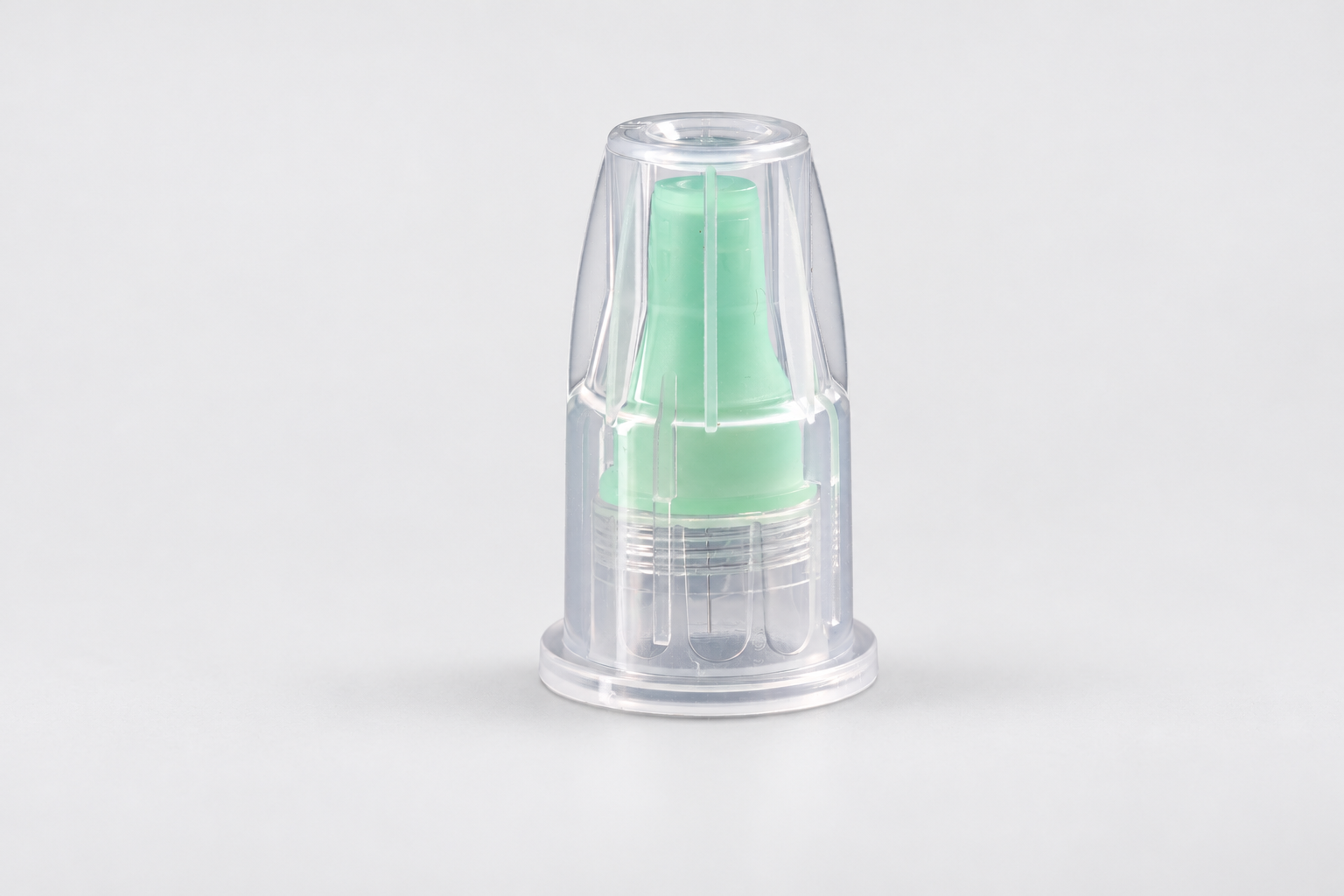
Capped product view, retouched for presentation. Caps and hub surfaces are part of the handling design, not merely packaging details.
How to make a sample evaluation useful
A good evaluation starts before anyone opens a sample. Write down the question the product is supposed to answer. Is the priority the contact surface, first-puncture performance, handling, size availability or suitability for a specified pen system?
Then keep the comparison controlled. If a wide-base sample is compared with a conventional sample of a different gauge, length or wall design, several variables have changed at once. Any observed difference will be difficult to interpret. A matched comparison is more informative, even if the sample set is smaller.
For a sourcing discussion, request the following information:
- The exact model and gauge-and-length combination represented by the sample.
- A drawing or specification identifying the contact face and relevant dimensions.
- Confirmation of the tip and lubrication specifications for that configuration.
- Applicable pen-system compatibility information, rather than a blanket “universal” statement.
- Current instructions, packaging details and documentation appropriate to the destination market.
- Any performance report needed to support a proposed claim, including its comparator and method.
The public scope of ISO 11608-2:2022 covers single-use double-ended pen needles used with specified needle-based injection systems. It is a relevant reference when discussing device requirements. Mentioning the standard, however, is not evidence that a particular product has passed all applicable assessments. ISO 11608-2:2022 scope.
This approach helps keep the commercial discussion practical. A photograph can introduce the design, a sample can reveal handling characteristics, and a documented test can support a defined performance claim. Each has a role, and none needs to stand in for all the others.
Questions buyers ask about flat-base pen needles
Does a flat-base pen needle have a blunt tip?
No. “Flat-base” refers to the plastic skin-contact face around the patient-end needle. It does not describe the metal tip. The featured LINKFAR configuration has a five-bevel metal tip.
Does a wider plastic base prove that an injection is more stable?
No. A wider base provides a design rationale for examining contact and load distribution. A stability claim needs a defined outcome, such as movement, angle or depth variation, and testing of the particular product. Width alone is not proof.
Can a repeated-puncture test show that a pen needle is reusable?
No. Repeated cycles may be part of a bench investigation, but they do not establish safe clinical reuse. Pen needles are single-use devices, and a new needle should be used for each injection according to the applicable instructions.
Are all LINKFAR pen needle sizes available with this flat base?
Do not assume so from the overall product range. Ask for the current gauge-and-length matrix for the specific flat-base configuration, together with market availability and compatibility information.
Look beyond the tip when choosing a pen needle
In a crowded product category, a useful distinction needs to be something a buyer can examine. LINKFAR’s wide, flat-base configuration gives the sourcing conversation a clear focus: how the plastic contact face works alongside a five-bevel tip, lubrication and the selected needle dimensions.
If you are evaluating this design for your product range, contact LINKFAR with your target market, required sizes and intended pen systems. Ask for samples and the current configuration details so that the evaluation starts with the product you actually plan to source.
Related guides
- Private label medical devices in the EU: from product brief to delivery If you distribute medical consumables, you may already know which products your customers need. Building your own brand raises a different set of questions:…
-
 CGM and Insulin Pump Accessories: A Guide to Patches, Skin Care and Secure Wear
A sensor that starts lifting after exercise and a patch that hurts to remove create different problems. Buying a stronger adhesive may help with…